Lung Cancer
Lung Cancer Care at UVM Cancer Center
Lung cancer occurs when abnormal cells in the lung grow uncontrollably and form tumors. In its early stages, lung cancer is often curable. For more advanced disease, we offer many treatment options that can help you live longer.
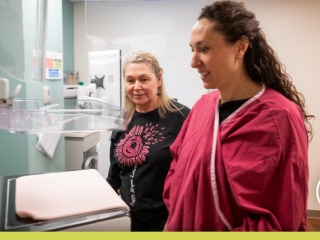
At University of Vermont Health, you receive care from nationally recognized lung cancer specialists. Our team takes a patient-centered approach that includes comprehensive support for you and your family. We develop a personalized lung cancer treatment plan that may include multiple therapies, including possible enrollment in clinical trials only available at select cancer centers nationwide.
Why Choose UVM Health?
With locations across Vermont and northern New York, you can count on us for leading-edge cancer care throughout the region. We offer:
- Expert team: Our skilled pulmonologists work alongside cardiothoracic surgeons, medical oncologists, radiation oncologists, pathologists and radiologists to deliver comprehensive lung cancer care.
- Advanced treatments: Our experience helps us select the right set of therapies based on your specific needs and develop a personalized treatment plan to give you the most effective care possible.
- Innovation: As part of a health system anchored by an academic medical center, many of our specialists are active researchers who lead clinical trials. Their efforts give you access to new treatments that may not be widely available.
- Convenience: Our network of providers gives you access to lung cancer services in clinic locations throughout Vermont and northern New York. We coordinate appointments whenever possible, so you can see multiple experts in one day and make fewer visits to your provider's office.
Lung Cancer Screening
Lung cancer is highly treatable when detected early. If you have a history of smoking cigarettes and are at least 50 years old, you may be eligible for lung screening at our American College of Radiology Certified Lung Cancer Screening Center. Speak with your health care provider to see if you are eligible for this potentially life-saving procedure.
Learn more about lung cancer screening
Types of Lung Cancer
The two main types of lung cancer include:
- Non-small cell lung cancer: This type accounts for about 80% to 85% of lung cancers. There are several subtypes of non-small cell lung cancer, including adenocarcinoma, squamous cell carcinoma and large cell carcinoma. Patients with non-small cell lung cancer typically have a better prognosis than those with small cell lung cancer.
- Small cell lung cancer: Less common but faster-growing cancer. Small cell lung cancer has often spread outside the lungs at the time of diagnosis. It is also more likely to return after treatment.
Better health data means we have the opportunity to reach more people, improve the rate of early detection, and prevent a lot of unnecessary mortality for lung cancer.
Clinical Trials
The UVM Cancer Center supports more than 100 active clinical trials focused on prevention, screening, treatment, supportive care and survivorship.

Lung Cancer Diagnosis
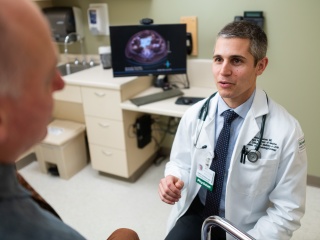
When you come to UVM Cancer Center for cancer care, you have access to advanced tests and expert evaluations. Tests we use to diagnose lung cancer include:
Imaging tests include ultrasound, CT, MRI and PET scans. These tests help us identify tumors in your lungs and find out if they have spread to other areas of your body.
A biopsy is a procedure done to collect a tissue sample from your lungs. A specialist in diagnosing lung cancer (pathologist) then looks at the tissue under a microscope to confirm or rule out a lung cancer diagnosis.
Our team of experts decides the best strategy for collecting a tissue sample, including:
- Bronchoscopy: A pulmonologist passes a thin tube (bronchoscope) equipped with a small camera into your lungs and takes a small tissue sample.
- Needle biopsy: An interventional radiologist uses X-ray or CT imaging to guide a needle into the tumor from outside the chest.
Some cancers have genetic changes that can be targeted by specific treatments. We evaluate the genetic features of lung cancer tumors to determine your eligibility for these treatments.
Lung Cancer Treatment
If you are diagnosed with lung cancer, we work to start your treatment as quickly as possible. Our nurse navigators are by your side throughout your cancer journey to coordinate appointments, answer questions and guide your care.
Surgical removal of lung tumors offers the best chance of a cure, especially for early-stage lung cancer. Your surgeon may remove a portion or all of your lung, depending on the size and location of the tumor.
Our cardiothoracic surgeons perform video-assisted thoracic surgery (VATS) when possible. This procedure uses a small camera and tools inserted through tiny incisions. VATS is less invasive than traditional surgery, so you heal faster.
Some of our surgeons may use robotic-assisted technology to perform VATS.
Medical oncology uses medications to destroy cancer cells. These include:
- Chemotherapy: You may receive chemotherapy before surgery to shrink a tumor, or after surgery to kill any remaining cancer cells.
- Immunotherapy: These medications direct your immune system to destroy cancer cells. Immunotherapy with or without chemotherapy may be an option for people who cannot have surgery or radiation, have advanced cancers or have cancer that has spread outside the lungs.
- Targeted therapy: Targeted therapy drugs bind to certain molecules on the surface of cancer cells and attack them. Your care team will select the appropriate targeted therapy medications for you based on tumor genetic testing and cancer stage.
Immunotherapy and targeted therapy are evolving rapidly. Through participation in clinical trials, we offer patients access to new therapies that are not widely available. All participation in clinical trials is voluntary.
Radiation oncology, or radiation therapy, uses high-energy radiation beams to destroy cancer cells. Radiation therapy is used as an option sometimes in combination with surgery and chemotherapy.
Stereotactic body radiation therapy (SBRT) is a type of radiation therapy that delivers targeted, high doses of radiation to early or small tumors. SBRT relies on 3D images and computer technology to map the tumor. Using this imaging, our specialists design treatment to minimize radiation exposure to healthy tissue, such as the heart and surrounding lung tissue.
For small tumors located close to the lung’s surface, we may recommend ablation therapy. Ablation involves inserting a needle into the tumor and applying a treatment that destroys cancer cells. Ablation procedures include:
- Cryotherapy: Uses extreme cold to freeze the tumor
- Radiofrequency ablation: Delivers high-energy radio waves to heat the tumor
Palliative treatments ease the symptoms of serious illness, but don’t treat the disease. We use radiation as a palliative treatment to reduce cancer pain. Nerve blocks, which include surgical and nonsurgical procedures to stop pain signals, can also help relieve pain.
Clinical trials are a routine part of care team discussions. Participation in a clinical trial is voluntary and can give you access to new care methods years before they are widely available. If you are eligible for a specific trial, your specialist will explain the benefits and risks of participating and the next steps for enrollment.
Locations Near You
Share your location to see nearby providers and availability
111 Colchester Avenue
Main Campus, East Pavilion, Level 3
Burlington, VT 05401-1473
75 Park Street
Elizabethtown, NY 12932
101 Adirondack Drive
Ticonderoga, NY 12883
78 Park Street
Elizabethtown, NY 12932
111 Colchester Avenue
Main Campus, Main Pavillion, Level 2
Burlington, VT 05401
75 Beekman Street
Plattsburgh, NY 12901-1438
23 Fourth Street
Suite 1
Malone, NY 12953-1331
111 Colchester Avenue
Main Campus, Main Pavilion, Level 2
Burlington, VT 05401-1473
130 Fisher Road
Berlin, VT 05602-8132
23 Fourth Street
Suite 1 & 2
Malone, NY 12953-1331