Head & Neck Cancers
Head & Neck Cancer Care at UVM Cancer Center
Head and neck cancer refers to a group of cancers that affect the ear, nose and throat including soft tissues of the neck and face.
At University of Vermont Health, we offer advanced treatments for head and neck cancer in a supportive, caring environment. Physicians across the region refer their patients to us for our expertise in managing these complex cancers. Your care team will work with you to understand your personal preferences and customize your treatment plan to ensure you receive the best care possible.

Why Choose UVM Health?
Our team includes experienced otolaryngologists (head and neck surgeons), surgical, radiation and medical oncologists, pathologists, speech and language pathologists and support professionals.
As one of the leading cancer programs in the region, we offer:
- Advanced technology: We are the only program in Vermont to offer transoral robotic surgery, a leading-edge, minimally invasive procedure that treats some types of head and neck cancers with fewer side effects. Our surgeons use TORS to reach cancers in the tonsil area and base of the tongue. With TORS, some patients can avoid chemotherapy or radiation.
- Innovation: As part of a health system anchored by an academic medical center, our physicians are active researchers who lead and participate in clinical trials giving you access to new cancer therapies, before they are widely available.
- Support and rehabilitation services: We provide a range of support services to help you feel better during and after treatment, including speech therapy, nutritional counseling and psychological services. We also provide integrative therapies such as massage, meditation and acupuncture.
- Convenience: Our network of specialists gives you access to head and neck cancer services in clinic locations throughout Vermont and northern New York. We coordinate appointments with multiple members of your care team on the same day whenever possible.
Types of Head & Neck Cancer
Head and neck cancers include those that start in the:
- Mouth: Including the lips, tongue, gums, inner cheeks, and floor and roof of the mouth
- Nasal cavity and sinuses: Including the inside of the nose and the interconnected hollow spaces in the skull, located behind your forehead, eyes, nose and cheeks
- Salivary glands: Produce saliva and are located under and behind your jaw, and throughout your mouth and throat
- Throat: Including the upper area behind your nose (nasopharynx), middle area in the back of your mouth (oropharynx) and lower area that leads into the neck (hypopharynx). One of the most common types of cancers we treat is human papilloma virus (HPV)-associated cancer of the oropharynx. HPV is a common sexually transmitted disease that can cause genital warts and cancers.
- Voice box (larynx): The hollow tube between the back of your throat and windpipe (trachea) that contains your vocal cords
Symptoms of Head & Neck Cancer
Symptoms of head and neck cancer vary depending on the cancer type, but may include:
- Bleeding from the mouth or throat
- Lump or swelling
- Numbness or paralysis in the face
- Pain in the ear, mouth, face, neck or throat
- Growths or red or white patches inside the mouth
- Trouble breathing, speaking or swallowing
- Voice changes
Diagnosing Head & Neck Cancer
When you come to UVM Health for cancer care, you have access to advanced tests and expert evaluations. Tests we use to diagnose head and neck cancer include:
- History and physical exam: Your doctor will ask you about your symptoms and medical history. They will examine your head and neck for any lumps, swelling or other abnormalities.
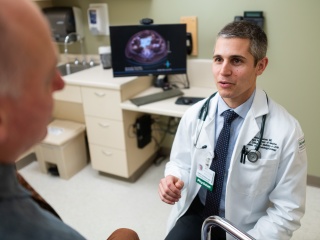
- Medical imaging: Tests such as CT, MRI and PET scans help us identify head and neck cancer and determine whether it has spread to surrounding tissues. Our radiologists have special training in interpreting images of the head and neck. Our surgeons also perform in office ultrasound allowing them to provide you with real-time information.
- Biopsies: A biopsy is a procedure done to collect a tissue sample from an area of concern. A specialist in diagnosing cancer (pathologist) looks at the tissue under a microscope to establish head and neck cancer diagnosis. Whenever possible, we perform biopsies, sometimes with ultrasound guidance, in-office to expedite your care.
Clinical Trials
The UVM Cancer Center supports more than 100 active clinical trials focused on prevention, screening, treatment, supportive care and survivorship.

Head & Neck Cancer Treatment
At UVM Health, you receive a personalized care plan that outlines your treatment options based on the best available evidence for treating your cancer. Throughout your cancer journey, our nurse navigators are by your side to coordinate appointments, answer questions and guide your care.
Surgical removal of the tumor and a margin of surrounding tissue is often the preferred treatment for head and neck cancer. Our surgeons are skilled in these complex and delicate operations. When appropriate, they use leading-edge, minimally invasive procedures such as transoral robotic surgery (TORS), which typically results in less pain and faster recovery.
Surgery may affect surrounding nerves, muscle or other tissue, which can result in impaired function or a change in your appearance. Our team specializes in reconstructive surgery to minimize these effects. We typically perform reconstruction procedures during tumor removal surgery. Post-surgery rehabilitation with speech language pathologists and physical and occupational therapists helps you recover functions faster.
Medical oncologists deliver the latest drug therapies to destroy cancer cells or slow their growth. Our skilled physicians recommend treatment based on the type of cancer and the most recent research findings. Medical oncology options include:
- Chemotherapy: Your doctor may recommend chemotherapy with radiation therapy after surgery to destroy any remaining cancer cells.
- Targeted therapy: Targeted therapy drugs bind to certain molecules on the surface of cancer cells and attack them. Your care team will select the appropriate targeted therapy medications for you based on tumor genetic testing.
- Immunotherapy: These medications direct your immune system to destroy cancer cells. Immunotherapy is an option for difficult-to-treat head and neck tumors, or those that have spread to other areas of the body. For other head and neck tumors, enrollment in a clinical trial can give you access to immunotherapy drugs.
Radiation therapy is a common treatment for head and neck cancers. Your doctor may recommend radiation therapy as your main treatment or after surgery, with or without chemotherapy.
We discuss clinical trials options as part of your care plan if it is appropriate. Participation in a clinical trial is always voluntary and can give you access to new care methods years before they are widely available. If you are eligible for a specific trial, your specialist will explain the benefits and risks of participating to help you make a decision if it is right for you.
Patient Resources
- American Head & Neck Society: Helpful education, fact sheets and patient stories about head and neck cancers.
Locations Near You
Share your location to see nearby providers and availability
111 Colchester Avenue
Main Campus, East Pavilion, Level 3
Burlington, VT 05401-1473
75 Park Street
Elizabethtown, NY 12932
101 Adirondack Drive
Ticonderoga, NY 12883
111 Colchester Avenue
Main Campus, Main Pavillion, Level 2
Burlington, VT 05401
111 Colchester Avenue
Main Campus, West Pavilion, Level 4
Burlington, VT 05401-1473
75 Beekman Street
Plattsburgh, NY 12901-1438
23 Fourth Street
Suite 1
Malone, NY 12953-1331
111 Colchester Avenue
Main Campus, Main Pavilion, Level 2
Burlington, VT 05401-1473
130 Fisher Road
Berlin, VT 05602-8132
23 Fourth Street
Suite 1 & 2
Malone, NY 12953-1331