Melanoma and Other Skin Cancers
Melanoma and Skin Cancer Care at UVM Cancer Center
University of Vermont Health offers leading-edge skin cancer care across Vermont and northern New York in a supportive and caring environment. As a patient, you have access to some of the world's premier specialists in the screening, diagnosis and treatment of skin cancer.
Patients and referring providers regularly turn to us for our expertise with difficult-to-treat skin cancers — our team successfully cares for some of the region’s most complex cases. We also offer advanced options for cancers that spread rapidly or recur (come back after treatment).
Why Choose UVM Health?
As a leading cancer program in the region, we offer:
- An expert team: Our expert skin care specialists work alongside experienced surgeons, medical oncologists, radiation oncologists and pathologists to deliver advanced, comprehensive skin cancer care with compassion. As part of a health system anchored by an academic medical center, our physician-leaders are also researchers, many of whom train the next generation of experts.
- Innovation: Many of our specialists are active researchers and lead clinical trials, giving you access to new treatments that may not be widely available. Current research includes methods for treating cancer with effective but less intense therapies and optimizing the timing of different therapy options. Researchers are also looking into novel drug combinations to activate the patient’s own immune system to attack their cancer.
- Advanced treatments: Our specialists are experts in the full range of skin cancer treatments, including advanced techniques that improve outcomes. When skin cancer occurs in highly visible areas, such as the face, scalp and chest, our team removes it with precise techniques that minimize changes to your appearance.
- Convenience: Our network of specialists gives you access to some skin cancer services in clinic locations throughout the region. Out of respect for your time, we schedule your appointments with multiple members of your care team on the same day whenever possible.
Types of Skin Cancer
There are many types of skin cancer. Our team of specialists is experienced in treating both rare and more common skin cancers, including:
- Basal cell carcinoma: The most common form of skin cancer, this usually slow-growing cancer develops in the basal cells, which produce new skin cells as old ones die. It typically occurs on areas of the skin exposed to the sun (such as the face and neck). If left untreated, it can cause local damage to tissues but rarely spreads to other areas of the body.
- Squamous cell carcinoma: The second most common type of skin cancer, squamous cell carcinoma develops in the upper skin layers. It is most often caused by UV exposure and can occur anywhere on the body. While not usually life-threatening, it can grow rapidly and spread to other areas of the body.
- Melanoma: This aggressive skin cancer develops in melanocytes, the cells that give skin its color. It can occur anywhere on the body and is likely to spread (metastasize) if not caught early.
- Merkel cell carcinoma: This fast-growing cancer usually appears on the face and neck. It is much more likely to spread to other parts of the body and recur than other skin cancers.
Diagnosing Melanoma and Skin Cancer
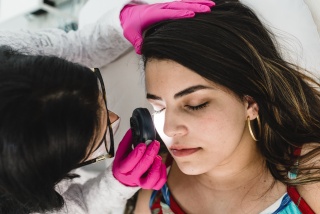
If your clinician suspects you may have skin cancer, they will perform a comprehensive evaluation. Your diagnosis may include advanced tests, some of which are not widely available elsewhere in the area.
Tests used to diagnose skin cancer include:
- Biopsy: During a biopsy, your clinician takes a tissue sample from the skin. A dermatopathologist examines the sample under a microscope to identify cancer cells. We may also biopsy a nearby lymph node to determine whether cancer has spread.
- Imaging studies: For advanced skin cancers, your provider may order one or more imaging tests, such as an ultrasound, CT, MRI or positron emission tomography (PET). PET/CT scans are sophisticated tests that use a small amount of a radioactive substance injected into a vein to show abnormal cell activity.
Melanoma and Skin Cancer Treatment
Most skin cancer can be treated with in-office procedures such as Mohs micrographic surgery, which removes cancer layer by layer. Complex melanoma and other advanced skin cancers may require evaluation for more intensive therapies.
At UVM Health, you receive a personalized care plan. Throughout your cancer journey, our nurse navigators are by your side with support, coordinating appointments, answering questions and guiding your care.
Mohs surgery, also called Mohs micrographic surgery, is a specialized form of surgery used to remove skin cancers from delicate areas like the face and neck. Our fellowship trained and board-certified surgeons perform this procedure in-office by surgically removing precise areas of the skin to remove cancer cells. This technique preserves as much healthy tissue as possible.
During Mohs surgery:
- The surgeon removes a layer of skin from the area and examines it under a microscope while you wait.
- They create a detailed map of the tissue to see exactly where any cancer cells remain.
- If cancer is still present, they remove another precise layer only from the affected area. This process repeats until all cancer cells are gone.
Most patients need just one stage, but some may need more. Because every layer is checked so carefully, Mohs surgery offers the highest cure rate — up to 99% — while keeping the wound as small as possible.
Once the area is cancer‑free, your Mohs surgeon will usually repair the wound the same day. In rare cases, a specialist such as an oculoplastic surgeon may help with repairs in very delicate areas (like certain parts of the eyelid). When you leave the office, your surgery is complete and the skin cancer has been fully removed.
Our medical oncologists work as a part of a team that specializes in treating advanced melanoma and skin cancer using medications that go through the entire body to fight cancer (systemic therapy).
You have access to numerous medical therapies, including newly approved options for skin cancers that spread rapidly or come back after treatment. Medical oncology therapies we offer include:
- Immunotherapy drugs that enhance your own immune system to fight cancer, such as the injectable cancer vaccine, T-VEC
- Targeted therapy drugs that destroy cancer cells with a specific genetic mutation
Radiation therapy can be an effective treatment for skin cancer, either alone or in combination with surgery and/or medical oncology drugs. Your doctor may recommend radiation if you cannot have surgery, to destroy cancer cells left behind after surgery, or if cancer recurs.
As part of our efforts to treat earlier-stage cancers with gentler methods, we may use radiation instead of surgery. Our specialists deliver radiation therapy using leading-edge technologies with the highest level of precision.
Our multidisciplinary team of specialists participate in industry, cooperative group and investigator-led studies that offer patients access to the latest care methods. While some studies are designed to improve cancer outcomes, we also have studies that help in the early detection and monitoring of cancer.
Participation in clinical trials is always voluntary. If you are eligible for a specific trial, your specialist will explain the benefits and risks of participating and the next steps for enrollment.
Clinical Trials
The UVM Cancer Center supports more than 100 active clinical trials focused on prevention, screening, treatment, supportive care and survivorship.

Patient Resources
- National Comprehensive Cancer Network: Patient guideline, webinars, information and support for patients and caregivers with skin cancer.
- American Cancer Society: Overview information about skin cancer, including symptoms, diagnosis and treatment.
- American College of Mohs Surgery: Learn more about Mohs surgery, post-operative care and FAQs from this national organization of fellowship-trained skin cancer and reconstructive surgeons specializing in the Mohs micrographic surgical technique.
Locations Near You
Share your location to see nearby providers and availability
111 Colchester Avenue
Main Campus, East Pavilion, Level 3
Burlington, VT 05401-1473
75 Park Street
Elizabethtown, NY 12932
101 Adirondack Drive
Ticonderoga, NY 12883
214 Cornelia Street
Suite 103
Plattsburgh, NY 12901-2332
111 Colchester Avenue
Main Campus, Main Pavillion, Level 2
Burlington, VT 05401
350 Tilley Drive
Suite 201
South Burlington, VT 05403-4539
130 Fisher Road
MOB C
Berlin, VT 05602-9516
111 Colchester Avenue
Main Campus, West Pavilion, Level 4
Burlington, VT 05401-1473
75 Beekman Street
Plattsburgh, NY 12901-1438
23 Fourth Street
Suite 1
Malone, NY 12953-1331