Improving Dermatology Access Across the Region
A new triage model speeds care for high-acuity patients and streamlines primary/specialty collaboration.
Demand for dermatology care has grown steadily across Vermont and Northern New York, driven by an aging population, higher skin cancer rates and increased awareness of skin health. Like many health systems, University of Vermont Health saw demand rise faster than its previous scheduling approach could accommodate.
“It became clear that we needed a more targeted approach,” says Joseph Pierson, MD, chair of the Department of Dermatology at UVM Health. “Not because care was lacking, but because the system needed to evolve.”
A Smarter, Referral-Based Triage Model
Dermatology and primary care teams partnered to redesign access, shifting to a referral-based model supported by clinical guidelines and e-consults. Research shows skin disease is the most common reason for primary care visits, and many routine conditions — including rashes, eczema, acne and fungal infections — can be managed in primary care.
“It’s a win for patients, a win for primary care and a win for specialty access,” Dr. Pierson says. “The key was working together.”
Dermatology access constraints are not unique to Vermont or northern New York. Nationwide, a long-standing shortage of dermatologists, combined with delays in routine care during the COVID-19 pandemic, has created similar pressures across academic and community health systems. UVM Health dermatologists approached the challenge by tracking outcomes, refining workflows based on data and sharing results. The team’s access-redesign work is now under review for publication in the Journal of the American Academy of Dermatology.
Expanding High-Impact Capacity: Mohs Surgery
Improving specialty access also required expanding services where the need is greatest — particularly for Mohs surgery. Many North Country patients face three-hour or more travel times for this care.
System-approved additions:
- A full-time Mohs surgeon at University of Vermont Health - UVM Medical Center.
- Planned expansion of Mohs services to University of Vermont Health - Champlain Valley Physicians Hospital one day per week as space and infrastructure allow. Space-planning work at CVPH is underway.
“This is about bringing the right care closer to home when possible,” says Melanie Bui, MD, PhD., a dermatologist at UVM Health, “while also making sure services are matched appropriately to each community.”
High-Risk Skin Cancer Clinic and Improved Outcomes
Dermatology also launched a high-volume clinic focused on evaluating patients for skin cancer, preserving capacity elsewhere while ensuring quicker assessment for those at highest risk.
Early impact:
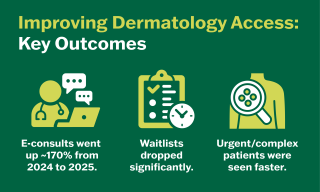
- For patients facing the greatest barriers to care, skin cancer diagnoses within seven days increased tenfold.
- Access improved for patients with complex inflammatory and vascular skin diseases that require specialty expertise. “We’re now seeing patients who truly need specialty care in a more timely way,” Dr. Bui says. “That makes a real difference in outcomes.”
Clinicians say the redesigned model has improved professional sustainability by ensuring higher-acuity patients reach specialty care instead of urgent care or emergency departments.
“Now the right patients are in the right seats,” Dr. Pierson says. “The work is more relevant, more impactful and better aligned with why people come to see us.”