Cardiology Imaging & Stress Testing
Cardiology Imaging & Stress Testing at UVM Health
Effective heart treatment plans start with an accurate diagnosis. At University of Vermont Health, our cardiologists and radiologists use advanced imaging and testing tools to diagnose heart conditions precisely and efficiently.
With a network of heart and vascular practice locations across Vermont and northern New York, you’re never far from an expert diagnostic team, no matter where you live.

Why Choose UVM Health?
As one of the leading heart and vascular programs in the region, we offer:
- Advanced diagnostic tools: We use the latest imaging equipment for more accurate testing, including a sophisticated camera for nuclear cardiology, cardiac magnetic resonance imaging (MRI) and cardiac CT scans. We are home to the only center in Vermont offering cardiac MRI and positron emission tomography (PET) nuclear cardiac studies.
- Coordinated, convenient care: As a patient of UVM Health, you’re always connected to the expertise of a larger team of cardiologists, electrophysiologists, cardiothoracic surgeons, cardiac radiologists, vascular surgeons and other specialists. Our cardiology and radiology teams work closely to analyze your tests results to ensure you receive an accurate, careful diagnosis that guides your treatment plan.
- Evidence-based tools and treatments: Many of our physicians are active researchers and lead and participate in national clinical trials providing you access to promising emerging therapies that aren’t yet widely available.
Types of Cardiology Imaging
We use a range of advanced cardiology imaging tests to look for blocked blood vessels, damaged heart tissue or other cardiovascular problems. When your physician orders a cardiac test, a specially trained nurse reviews the request to ensure it’s the best diagnostic test for your symptoms.
If we think there’s an option that might work better, we work directly with your physician to discuss all the possible options. This step in our process reduces the chances that you receive repeat or unnecessary testing.
Types of imaging include:
Calcium in your coronary arteries, the vessels that supply the heart, can be detected with this type of CT scan. This can help determine your risk of heart attacks and stroke and whether you need treatment or further cardiac testing. No preparation, medication, fasting or intravenous line is required for calcium scoring CT.
In a cardiac catheterization, a cardiologist inserts a flexible, hollow tube (catheter) through a blood vessel in your groin or wrist. They use imaging guidance to direct the catheter to your heart. They may inject a contrast dye through the catheter that highlights your heart and blood vessels on an X-ray.
These tests use specialized computers and X-rays to create detailed, cross-sectional images of your heart. We use the latest CT technology that allows us to obtain precise images quickly. This fast testing means you benefit from timely diagnosis and less radiation exposure.
There are many reasons why cardiac CT is performed. Coronary CT Angiography can be used to find blockages and other abnormalities of the coronary arteries, or the vessels that supply the heart. This can help determine whether you need treatment or further cardiac testing. Cardiac CT can also be used to plan for certain procedures, such as atrial fibrillation ablation or heart device placement. It can also be used to look for blood clots in the heart’s chambers.
A cardiac MRI uses powerful magnets and radio waves to create high-resolution images of your heart. An MRI doesn’t use radiation and allows us to look for problems with your heart’s structure and function.
Echocardiograms use ultrasound waves to watch how your heart is pumping blood. It gives us information about your heart tissue, valves and blood vessels.
Cardiac positron emission tomography (PET) and single photon emission computed tomography (SPECT) scans use a small, safe injection of a radioactive substance to check how blood flows throughout your body and heart. This can show us if you have a damaged heart muscle, reduced blood flow that may be caused by narrowed coronary arteries (the blood vessels supplying blood to your heart) or a history of heart attacks. PET scans use lower radiation and offer advanced imaging in a shorter time.
Conditions We Diagnose
We use cardiac imaging to diagnose a range of conditions, including:
- Cardiomyopathy: A condition in which the heart has difficulty pumping blood through the body
- Congenital heart disease: A problem with the heart’s structure that are present at birth
- Coronary artery disease: Narrowing in the blood vessels that carry blood to the heart, most often caused by a buildup of a fatty substance called plaque
- Heart failure: A chronic condition in which the heart doesn’t pump enough blood to meet the body’s needs
- Heart valve disease: Leaking or narrowing in the heart valves, which control how blood flows through the heart. There are many types of heart valve disease, such as mitral valve regurgitation, each affecting the heart’s valves in different ways.
What to Expect During a Stress Test
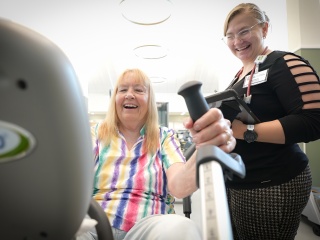
A stress test measures your heart’s electrical activity before, during and after exercise. The results of a stress test can help us determine whether you have narrowed or blocked coronary arteries or other problems with your heart’s structure or rhythm.
During a stress test:
- A technologist attaches sticky patches (electrodes) to your chest and a blood pressure cuff around your arm. The patches connect to a machine that records your heart’s electrical activity.
- You begin slowly walking or cycling on a treadmill or stationary bike. The exercise intensity gradually increases.
- You continue exercising until you can’t sustain it any longer. Your provider tells you when you can stop.
- You remain still for a short period, then lie down with the sensors still attached to your body. This helps your provider watch your heart rate and vital signs to ensure they return to normal.
If you’re unable to exercise, your provider may give you a medication that mimics the effects of exercise. Depending on stress test results, you may need further tests to diagnose a heart condition.
View Your Radiology Images
MyChart is your personalized patient portal and keeps you connected to your imaging and radiology records — no matter where you are.

Locations near you
Share your location to see nearby providers and availability
118 Tilley Drive
Suite 102
South Burlington, VT 05403-4450
75 Park Street
Elizabethtown, NY 12932
101 Adirondack Drive
Suite 1
Ticonderoga, NY 12883
133 Park Street
Malone, NY 12953
62 Tilley Drive
Suite 101
South Burlington, VT 05403-4407
130 Fisher Road
MOB-A Suite 2-2
Berlin, VT 05602-9000
214 Cornelia Street
Suite 203
Plattsburgh, NY 12901-2332
115 Porter Drive
Middlebury, VT 05753-8527
133 Park Street
Malone, NY 12953-1241
130 Fisher Road
Berlin, VT 05602-9516