Ankle & Foot Injury
Ankle & Foot Injury Care at UVM Health
Your feet and ankles carry you through all your daily activities. They’re made to support the weight of your body and help you move with ease. Sometimes, a trip, fall or traumatic accident can injure the delicate framework of bones and soft tissues that make up your foot and ankle.
At University of Vermont Health, we provide leading-edge care for ankle and foot injuries to people throughout Vermont and northern New York. An experienced team of ankle and foot surgeons, podiatrists and advanced practice professionals work together to bring you effective treatment for the full range of injuries to the ankles and feet.
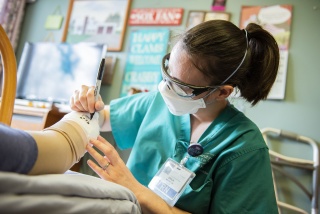
Why Choose UVM Health?
As one of the leading orthopedic programs in the region, we offer:
- Expert physicians: Our team includes surgeons who are fellowship-trained in both orthopedic trauma and foot and ankle surgery. Their expertise allows us to offer the most advanced treatments, including complex foot and ankle reconstructions.
- Patient-centered approach: We take time to listen to your needs and preferences. Your personalized care plan prioritizes nonsurgical treatment — we only recommend surgery when it’s the most effective option.
- Convenient services: We offer convenient access to on-site services, such as X-rays, ultrasound and MRIs, that allow us to make efficient diagnoses and get you started on treatment right away. Podiatrists and advanced practice professionals throughout the region provide expert care for foot and ankle injuries.
- Research emphasis: As part of a health system anchored by an academic medical center, our physicians are active researchers, many of whom train the next generation of experts. We are at the forefront of research into foot and ankle care.
Types of Foot & Ankle Injuries
Rolling your ankle, a high-impact blow to your foot or simply stepping down the wrong way can lead to an injury. Some of the most common foot and ankle injuries include:
- Achilles tendon tears: A partial or full tear of the Achilles tendon, which connects your heel to your calf muscles
- Fractures: A break or crack in one of your foot or ankle bones
- Sprains: A strain or tear in one of your ligaments, the bands of tissue that connect bones to one another
Fall Prevention Resources
If you are concerned that you or a loved one may be at risk of a fall, explore our Fall Prevention Guide.

Diagnosing Foot & Ankle Injuries
When diagnosing a foot or ankle injury, your specialist will examine your foot, ankle and heel. They’ll ask about your symptoms, including when they started, how they’ve progressed and what relieves them.
Your provider may also look for signs of foot or ankle deformities that increase your risk of injuries. We use several tests to get a closer look at your foot and ankle, including:
Treatment for Foot & Ankle Injuries
Many foot and ankle injuries heal with nonsurgical treatment. Our team starts with a noninvasive approach, only turning to surgery when other treatments aren’t effective. Your care plan may include:
Depending on the injury, you may need to stop certain activities temporarily or long-term. For example, you may need to stop running to allow a stress fracture or Achilles tendon tear to heal.
You may wear a walking boot, brace or cast while the injury heals. Sometimes you may also need to avoid bearing weight on your foot or ankle during healing by using crutches or other assistive devices.
Our specialists may recommend different shoes or inserts that lower your risk of further injury. You may also use commercial or custom orthotics that improve your foot position, decrease pressure and correct deformities.
A physical therapist teaches you exercises that improve your strength, flexibility and range of motion. They may also use hands-on techniques that stretch your muscles and joints and promote healing.
In some cases, you may need surgery to repair an Achilles tendon injury or a ligament tear. You may also need surgery to correct a foot or ankle deformity that causes recurrent injuries. Depending on the severity of a fracture, you may need open reduction and internal fixation (ORIF), a surgery to realign and stabilize a broken bone with pins, screws, plates or rods.
Locations Near You
Share your location to see nearby providers and availability
75 Park Street
Elizabethtown, VT 12932
101 Adirondack Drive
Suite 1
Ticonderoga, NY 12883
187 Park Street
Suite 2
Malone, NY 12953-1233
1311 Barre Montpelier Road
Suite 400
Berlin, VT 05602
192 Tilley Drive
South Burlington, VT 05403-4440
1311 Barre Montpelier Road
Suite 400
Berlin, VT 05602
23 Pond Lane
Middlebury, VT 05753-2057
76 McNeil Road
Suite 2
Waterbury Center, VT 05677-7162
206 Cornelia Street
Suite 201
Plattsburgh, NY 12901-2779