Stroke Care at UVM Health
A stroke occurs when blood flow in the brain is interrupted, either because of a blockage or because of bleeding. With stroke, minutes matter. The sooner you receive treatment, the better your chance of a good recovery.
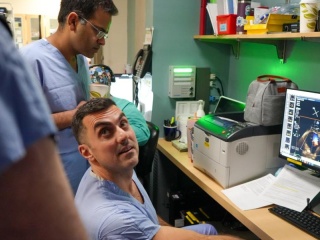
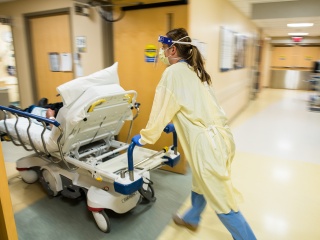
At University of Vermont Health, our team of stroke specialists provides quick, coordinated emergency treatment. Our team has extensive experience treating stroke, and cares for more than 1,000 patients from across the region each year.
We are home to a Comprehensive Stroke Center at UVM Medical Center and a Primary Stroke Center at Central Vermont Medical Center — the only stroke centers in Vermont with this designation.

Why Choose UVM Health?
As one of the leading vascular programs in the region, we offer:
- Coordinated care: Every emergency center across UVM Health has the expertise to treat stroke with clot-busting medication. If you need further treatment, we rapidly transfer you to the right location so you receive interventional procedures or surgery as quickly as possible.
- Access to stroke specialists: UVM Medical Center is the only stroke center in Vermont with specialty-trained stroke neurologists. Our experts provide 24/7 stroke coverage in the emergency department and provide consultations, including digital health, across our entire health system.
- Team-based treatment: Your care team includes stroke specialists, nurses, case managers, social workers, physical therapists, occupational therapists, and speech and language pathologists. We also offer a range of outpatient and inpatient rehabilitation services to support recovery after a stroke.
- Access to clinical trials: Many of our physicians lead and participate in clinical trials to advance stroke care and grant you access to promising new therapies, often before they’re widely available. We are part of StrokeNet, a national consortium of academic medical centers that participate in stroke trials.
- Treatment for pediatric patients: Our Golisano Children’s Hospital's at UVM Health pediatric neurologists partner with our stroke team, pediatric neurosurgeon, pediatric intensivists and pediatric hospitalists to treat children who experience a stroke quickly and effectively.
Types of Stroke
The UVM Health stroke team provides advanced care and state-of-the-art technology to treat all stroke types. The two main types of stroke are:
- Hemorrhagic stroke: Occurs when a blood vessel in the brain bursts or leaks, causing bleeding in the brain. High blood pressure is the leading cause of this type of stroke. Aneurysms (bulges in the wall of a blood vessel) are also a cause of hemorrhagic stroke.
- Ischemic stroke: Occurs when there’s a blockage in blood flow to the brain. This may be caused by a blood clot or the buildup of a fatty substance called plaque in the blood vessels that supply blood to the brain.
Stroke Treatment
All UVM Health emergency departments use clot-busting medications. If you need further treatment, we coordinate timely transfer to the UVM Medical Center for interventional or surgical procedures.
Stroke treatment may include:
Thrombolytic drugs help break up blood clots quickly to restore blood flow and minimize brain damage. It’s most effective within the first three hours after a stroke starts and must be given within four and half hours after a stroke starts. Timely treatment is critical.
Neurointerventional radiologists perform procedures using a small, flexible tube (catheter) inserted through a blood vessel in the arm or leg and guided to the blood vessels in the brain. They may use special techniques to seal a leaking or ruptured blood vessel (embolization). They may thread a special device through the catheter that pulls out or suctions out a blood clot (thrombectomy). If an aneurysm is the source of bleeding, they may place a coil in the aneurysm that seals it off and stops bleeding (aneurysm coiling). They may also use special techniques to seal a leaking or ruptured blood vessel (embolization).
In severe cases, you may need neurosurgery to treat a stroke. Our neurosurgeons may use open techniques to place an aneurysm clip, stop bleeding or provide emergency interventions for complications related to stroke. Neurosurgeons or vascular surgeons may also operate to remove plaque from the carotid arteries (carotid endarterectomy).
Physical therapists are important members of your treatment team during stroke recovery. These experts assess your overall strength, mobility and balance. They offer specialized treatments to help improve your movement abilities and restore function.
Occupational therapists contribute to stroke recovery by evaluating your ability to perform self-care, home management activities, cooking, recreational and other tasks that were previously automatic to you. They may assist you in recovering these skills by providing therapeutic intervention and education in adaptive techniques and strategies.
Speech therapy is also an important part of stroke recovery. Our speech therapists evaluate and treat your speech, language, attention, memory and problem-solving skills. In some cases, we may also offer treatments to help improve swallowing.
It was a scary and emotional time for me, but thankfully a lot of people acted fast and got me the care I needed.
Care Outcomes
An endovascular procedure or a mechanical thrombectomy is a strongly recommended option to remove a clot in eligible patients with a large vessel occlusion, or LVO. In this procedure, doctors use a wire-cage device called a stent retriever. They thread a catheter through an artery in the groin up to the blocked artery in the brain. The stent opens and grabs the clot. Special suction tubes may also remove the clot.
[Source: Ischemic Stroke Treatment | American Stroke Association]
Get With The Guidelines®
Get With The Guidelines®–Stroke is an in-hospital program for improving stroke care by promoting consistent adherence to the latest scientific treatment guidelines. Numerous published studies demonstrate the program’s success in achieving measurable patient outcome improvements.
[Source: Get With the Guidelines - Stroke Database]
In 2025, 86.8% of stroke thrombectomies performed at UVM Medical Center resulted in successful reperfusion (TICI 2B, 2C or 3).
- Of those cases, 80% of UVM Medical Center thrombectomies were completed within 120 minutes (national goal) of hospital arrival.
- Of those cases, the UVM Medical Center Neurointerventional Radiologists had a median time from skin puncture to substantial reperfusion of 16 minutes, versus all Comprehensive Stroke Centers which report a median time of 25 minutes.
In 2025, 33.8% of stroke patients who underwent thrombectomy at UVM Medical Center were discharged home or to an acute care facility. All New England hospitals report 28.3% of patients fell into the same discharge categories.
Patient Resources
At UVM Health, we have created a helpful resource to explain stroke and what to expect in your care and recovery. Please review our Stroke Patient and Family Education Guide. This booklet will help you understand:
- What a stroke is
- What might have caused it
- What to expect during your hospital stay
- How you and your family can support your recovery
- How to work with your care team to help prevent another stroke
We offer many education and wellness programs to help members of our community reduce their risk of stroke and other health concerns, including:
- Health information and resources at the Frymoyer Community Health Resource Center
- Quit smoking classes and counseling
- Blood pressure and cholesterol screenings
- Support groups
There is an abundance of stroke information and resources that can be accessed online. We recommend the following websites for additional information:
Awards & Certifications
The Joint Commission
UVM Medical Center has achieved Comprehensive Stroke Center (CSC) certification — the highest level of stroke care recognition nationally by The Joint Commission recognizing the exceptional multidisciplinary care we deliver to stroke patients every day.
Central Vermont Medical Center is designated as a certified Primary Stroke Center by The Joint Commission, the nation’s leading organization for setting health care quality standards.
American Heart Association
In 2025, three of our hospitals, UVM Medical Center, Central Vermont Medical Center and Champlain Valley Physicians Hospital, were recognized by the American Heart Association’s Get With The Guidelines® program for outstanding performance in stroke care.
Locations Near You
Share your location to see nearby providers and availability
62 Tilley Drive
Suite 101
South Burlington, VT 05403
118 Tilley Drive
Suite 102
South Burlington, VT 05403-4450
115 Porter Drive
Middlebury, VT 05753
78 Park Street
Elizabethtown, NY 12932
130 Fisher Road
Berlin, VT 05602
210 Cornelia Street
Ste 104
Plattsburgh, NY 12901
62 Tilley Drive
Suite 101
South Burlington, VT 05403-4407
3113 Roosevelt Highway
Colchester, VT 05446