Stroke Strikes Fast — So Should You
Quick action saved Cindy Scott’s life. Here’s how you can spot the signs and act quickly.
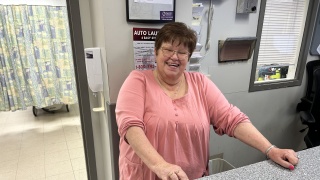
Cindy Scott was relaxing on her couch one afternoon when something felt off. Her tongue felt strange. Her hand curled up in a way she couldn’t control.
“I was doing the stroke test we use here at the hospital,” says Scott, who works as a receptionist in the emergency department at University of Vermont Health – Alice Hyde Medical Center. “I thought, ‘Oh no, this isn’t good.’”
Her daughter, Becky, who works in the hospital pharmacy, had just come home. She saw her mother and immediately called 911. Within minutes, Scott was on her way to the ED — this time as a patient.
Every Minute Matters
Nearly two million brain cells can die every minute a stroke goes untreated, according to the American Heart Association. Scott’s care team moved quickly: The charge nurse quickly got her to a CT scan; other clinicians consulted with stroke specialists at UVM Health - University of Vermont Medical Center. Kyle Barbour, MD, a physician in the ED, explained the treatment options. Among them: a powerful medication that could break up the clot causing her stroke.
“I was scared,” Scott recalls. “The medicine sounded serious. But everyone kept telling me, ‘It’ll help you. You need to take it.’ So, I did. Thank God I did.”
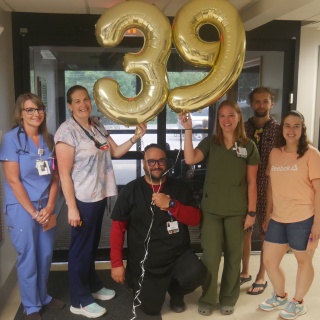
She received IV thrombolytics — medication that breaks up clots and restores blood flow to the brain, just 39 minutes after arrival, well under the national goal of 60 minutes. Scott was later transferred to UVM Medical Center and returned home with no lasting effects.
Jenna Wydra, interim stroke program manager for UVM Health, is impressed with the team’s performance. “What Cindy’s case shows is how far our health system has come in advancing regional stroke care. It’s a testament to everyone’s hard work and dedication.”
“I’m very lucky,” Scott says. “They were perfect. Who knows what my life would be right now if they hadn’t treated me so quickly.”
Today, Scott is back at work, grateful for every day.
Know the Stroke Signs: BE FAST
Stroke symptoms can appear suddenly. Use BE FAST to remember what to look for:
- Balance: Sudden loss of balance
- Eyes: Vision changes
- Face: Facial drooping
- Arms: Arm weakness
- Speech: Slurred speech
- Time: Call 911 immediately
Don’t wait. Every second counts. If you notice these signs, BE FAST and get help right away.
Listen to Our Podcast
For stroke survivors, time is brain. Join us this week as we explore the regional system built on technology and neurocritical expertise that is reshaping how leading-edge stroke care is delivered in rural communities.
About Living Healthy Together
Each week we share stories, advice and insights from those closest to care in Vermont and northern New York while exploring the local and national issues shaping health care. Catch Living Healthy Together live airing on Radio Vermont's WDEV Fridays at 1 pm.