
Head & Neck Surgery
Head & Neck Surgery at UVM Health
Highly trained otolaryngologists-head and neck surgeons at University of Vermont Health provide surgical treatment for conditions affecting the oral cavity, throat and neck, including the thyroid, parathyroid and salivary glands.
Our head and neck surgeons use the latest and most advanced surgical techniques and tools to navigate these complex and detailed areas of your body. Working closely with you, their team and other specialists, they deliver personalized care in a compassionate and supportive environment.
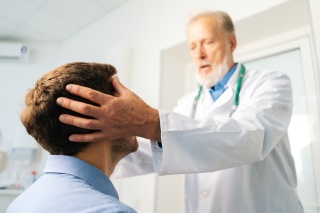
Why Choose UVM Health?
With ENT services available in clinic locations across the region, you can access to head and neck surgery services no matter where you live in Vermont and northern New York. As a leading ear, nose and throat (ENT) program in the region, we offer:
- Experience: Our otolaryngologists–head and neck surgeons are fellowship-trained and board-certified. They receive patient referrals from physicians across the region and perform a high volume of surgeries, especially thyroid and parathyroid surgeries. Research shows that patients have better results at centers, such as ours, that perform more than 100 thyroid/parathyroid surgeries per year.
- Multispecialty care: As part of a health system anchored by an academic medical center, our head and neck surgeons partner with a wide range of specialists, including endocrinologists, radiologists, pathologists, vascular surgeons and neurosurgeons. We also participate in multidisciplinary teams that care for people with head and neck cancer, thyroid cancer and skin cancer.
- Advanced procedures: We provide leading-edge, minimally invasive procedures that are not available elsewhere in the region, including transoral robotic surgery (TORS) for some types of throat tumors. We are the only program in Vermont to offer radiofrequency ablation to shrink thyroid nodules and sialendoscopy to treat salivary gland conditions.
- In-office testing: We offer in-office ultrasound imaging and ultrasound-guided biopsies for patients with head and neck masses. This approach is more convenient for you and results in a faster diagnosis. The efficient use of ultrasound technology also reduces your exposure to radiation you might receive from other imaging tests (X-rays, CT scans).
Conditions We Treat
We treat noncancerous (benign) and cancerous (malignant) masses, congenital (present at birth) disorders and inflammatory conditions of the:
- Oral cavity (mouth and tongue)
- Salivary glands
- Soft tissues of the face and neck
- Throat and voice box
- Thyroid and parathyroid glands
Some specific diseases we treat include:
- Advanced skin cancer: Cancers that spread rapidly or recur (come back after treatment), such as melanoma and Merkel cell carcinoma.
- Cystic neck masses: Fluid-filled masses that can become infected or contain cancerous cells
- Goiter: An enlarged thyroid gland that can cause neck or throat symptoms
- Hyperparathyroidism: An overactive parathyroid gland that can cause high calcium levels and lead to other medical problems
- Hyperthyroidism: An overactive thyroid gland, often caused by Graves’ disease (an autoimmune disorder)
- Salivary gland masses: Benign and malignant tumors in the salivary glands
- Salivary stones or strictures: Conditions that block the salivary glands and cause painful swelling
- Sleep apnea: A sleep disorder that causes interrupted breathing while you sleep
- Thyroid nodules: Benign and malignant masses in the thyroid gland
What to Expect
Head and neck surgery often involves the removal of a mass or tumor (resection). If the tumor is cancerous, the surgeon also removes a margin of surrounding tissue. Sometimes, we take out the entire structure, such as the thyroid (thyroidectomy), voice box (laryngectomy) or the salivary gland (parotidectomy).
Our surgeons are highly skilled in minimally invasive techniques that use small incisions and lighted tubes (endoscopes) or robotic approaches whenever possible. They also perform traditional (open) surgery with larger incisions when necessary.
Highlights of our head and neck surgical services include:
TORS uses robotic technology to treat hard-to-reach cancerous and noncancerous tumors in the back of the throat. Because it is minimally invasive, TORS results in less pain and faster recovery. Some patients with cancer who receive TORS can avoid chemotherapy and radiation.
We use this endoscopic technique to diagnose and treat problems of the salivary glands. Our surgeons insert a tiny endoscope narrower than a toothpick into a salivary gland through a tiny duct in your mouth. Using the endoscope, your surgeon can view the inside of the gland, extract small salivary gland stones and open blockages.
This minimally invasive procedure uses radiofrequency energy to shrink thyroid nodules. You receive local anesthesia to numb the area. The surgeon then inserts a probe into the nodule using ultrasound guidance. The thermal energy destroys the targeted tissue, shrinking the nodule. You can go home the same day and resume normal activities within a few days.
Head and neck conditions and their treatment can affect how you look and function. Our head and neck surgeons understand the importance of preserving your appearance and ability to speak and swallow. When possible, they remove a mass or tumor and reconstruct the area during the same procedure.
When needed, we use sophisticated reconstruction techniques after the removal of a mass or tumor. Free flap surgery involves the transfer of muscle, skin, fat or bone tissue from elsewhere on the body to close the space. Microsurgical techniques connect blood vessels and provide blood flow to the transferred tissue.
Nerves that control your vocal cords and facial movements lie close to your thyroid and parotid salivary glands. During surgery, we use intraoperative nerve monitoring to identify and protect these nerves.
People who receive head and neck surgery often benefit from rehabilitative therapy. We partner with UVM Health speech-language pathologists and physical therapists to help you heal and improve function. Our surgeons follow you long term to monitor your progress and help you achieve the best possible outcomes. We're here to make sure you get the care you need, when you need it.
Locations near you
Share your location to see nearby providers and availability
111 Colchester Avenue
Main Campus, West Pavilion, Level 4
Burlington, VT 05401
111 Colchester Avenue
Main Campus, West Pavilion, Level 4
Burlington, VT 05401-1473
116 Porter Drive
Middlebury, VT 05753-1419
