Thyroid Cancer
Thyroid Cancer Care at UVM Cancer Center
Your thyroid gland is shaped like a butterfly, with two lobes that sit on either side of your windpipe, at the base of your neck. The thyroid produces hormones that control many essential bodily functions, such as your heart rate, body temperature and metabolism. Thyroid cancer, a type of endocrine cancer, occurs when abnormal cells in the thyroid gland grow uncontrollably and form a tumor.
At University of Vermont Health, our team of highly trained physicians, nurses and support staff deliver advanced thyroid cancer care in a compassionate, supportive environment.

Why Choose UVM Health?
We develop a personalized treatment plan that may include multiple therapies. As a patient of UVM Health, you may also be eligible for enrollment in a clinical trial only available at select cancer centers nationwide.
As a leading thyroid cancer program in the region, we offer:
- Multispecialty team: Your care team includes otolaryngologists (head and neck surgeons), surgical oncologists, medical oncologists, radiation oncologists, pathologists, radiologists and endocrinologists. As part of a health system anchored by an academic medical center, our physician-leaders are active researchers who train the next generation of experts.
- Experience: Our otolaryngologists and surgical oncologists perform more than 100 thyroid surgeries per year. Studies show that high surgical volumes lead to better patient outcomes in thyroid cancer treatment.
- Ease of access: Through our network of specialists, we offer thyroid cancer services at clinic locations throughout Vermont and northern New York. We coordinate appointments whenever possible, so you can see multiple experts on one day.
Types of Thyroid Cancer
The main types of thyroid cancer include:
- Papillary: About 80% of thyroid cancers are papillary cancers. They are slow-growing and highly treatable.
- Follicular: This type accounts for about 10% of thyroid cancers. They are somewhat more likely than papillary thyroid cancers to spread to other areas of the body.
- Medullary: Medullary thyroid cancers make up about 3% of thyroid cancers. A quarter of people with this type have a family history of the disease.
- Anaplastic: About 2% of thyroid cancers are anaplastic. This rare cancer often spreads quickly to other parts of the body and is difficult to treat.
Symptoms of Thyroid Cancer
Thyroid nodules are very common, but most are noncancerous (benign). Less than 15% of thyroid nodules are cancerous (malignant). The most common symptom of thyroid cancer is a painless lump (nodule) in your neck, though pain, hoarseness and trouble swallowing can occur if the tumor invades nearby nerves.
Diagnosing Thyroid Cancer
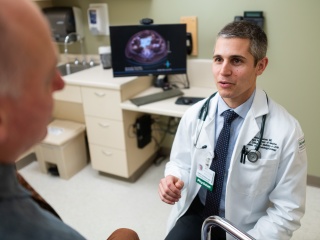
At UVM Health, you have access to advanced tests and expert evaluations. Our thyroid surgeons and endocrinologists offer in-office ultrasound imaging and biopsies for patients with thyroid nodules. This approach minimizes your visits to the hospital and makes diagnosis faster, so you can start cancer treatment.
Tests we use to diagnose thyroid cancer include:
- Imaging: Ultrasound imaging is the main test used to identify thyroid cancer. Our otolaryngologists perform in-office ultrasounds for quick and convenient assessment.
- Biopsy: A biopsy is a procedure done to collect a tissue sample from your thyroid gland. Your doctor inserts a fine needle into the thyroid nodule using ultrasound imaging guidance to collect the sample. A specialist in diagnosing thyroid cancer (pathologist) looks at the tissue under a microscope to find out if cancer cells are present.
- Family genetic testing: Your doctor may recommend genetic testing if you have certain types of thyroid cancer or a family history of the disease. Our compassionate genetic counselors can find out if cancer-causing genes run in your family and help you understand your risk.
Clinical Trials
The UVM Cancer Center supports more than 100 active clinical trials focused on prevention, screening, treatment, supportive care and survivorship.

Thyroid Cancer Treatment
At UVM Health you receive a personalized care plan that outlines your treatment options based on the best available evidence for treating your cancer. Our nurse navigators are available throughout your cancer journey to coordinate appointments, answer questions and guide your care.
Surgery to remove all or part of the thyroid gland is usually the preferred treatment for thyroid cancer. In more advanced cases, your surgeon may also remove nearby lymph nodes or surrounding tissues.
Protecting the laryngeal nerve that controls the vocal cords and lies close to the thyroid gland is critical. Our surgeons use leading edge techniques, such intraoperative nerve monitoring to help identify and protect the laryngeal nerve.
They also perform nerve grafting and other reconstructive procedures in the rare event that surgery requires removal of the laryngeal nerve or surrounding tissue. These procedures can reduce the side effects of surgery and help you maintain your quality of life.
Iodine is an element you get from the food you eat. Your thyroid gland absorbs iodine and uses it to make thyroid hormones.
Radioactive iodine is taken orally. It collects in your thyroid, where it gives off radiation that destroys cancer cells. If thyroid cancer has spread to other areas of your body, those cells will absorb the radioactive iodine too.
Endocrinologists and radiologists work together to plan and deliver radioactive iodine treatment. You may receive radioactive iodine therapy after surgery or if you are unable to have surgery.
Radiation therapy uses high-energy radiation beams to destroy cancer cells. It is typically an option for people with advanced thyroid cancer.
Medical oncology uses medications to treat cancer. For advanced, recurrent or metastatic thyroid cancer, we offer the latest medical oncology treatment options, including:
- Chemotherapy: Chemotherapy stops or slows the growth of cancer cells. It may be used alone or in combination with radiation therapy.
- Targeted therapy: Targeted therapy drugs bind to certain molecules on the surface of cancer cells and attack them.
- Immunotherapy: Immunotherapy trains your immune system to destroy cancer cells.
Our doctors use tumor genetic testing to determine whether to include targeted therapy or immunotherapy medications in your treatment plan.
Thyroid cancer treatment can reduce or eliminate your ability to produce thyroid hormones. Our endocrinologists monitor your hormone levels during and after treatment. If necessary, they prescribe thyroid hormone medication to replace your natural thyroid hormones.
We discuss clinical trial options as part of your care plan if it is appropriate. Participation in a clinical trial is always voluntary and can give you access to new care methods years before they are widely available. If you are eligible for a specific trial, your provider will explain the benefits and risks of participating to help make you a decision if it is right for you.
Patient Resources
- American Thyroid Association: Printable brochures and materials about thyroid health, surgery and cancer.
Locations Near You
Share your location to see nearby providers and availability
111 Colchester Avenue
Main Campus, East Pavilion, Level 3
Burlington, VT 05401-1473
75 Park Street
Elizabethtown, NY 12932
101 Adirondack Drive
Ticonderoga, NY 12883
111 Colchester Avenue
Main Campus, Main Pavillion, Level 2
Burlington, VT 05401
111 Colchester Avenue
Main Campus, West Pavilion, Level 4
Burlington, VT 05401-1473
75 Beekman Street
Plattsburgh, NY 12901-1438
23 Fourth Street
Suite 1
Malone, NY 12953-1331
111 Colchester Avenue
Main Campus, Main Pavilion, Level 2
Burlington, VT 05401-1473
130 Fisher Road
Berlin, VT 05602-8132
111 Colchester Avenue
Burlington, VT 05401-1473