Gallbladder Cancer
Gallbladder Cancer Care at UVM Cancer Center
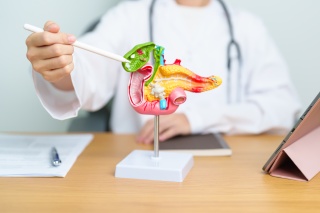
Gallbladder cancer is a rare condition in which malignant (cancer) cells form in the tissues of the gallbladder. The gallbladder is a pear-shaped organ that lies just under the liver in the upper abdomen. It stores and releases bile (a fluid made by the liver that helps the body digest fat).
At University of Vermont Health, you’ll receive care from skilled and experienced cancer specialists offering advanced treatments for gallbladder cancer in a supportive, caring environment.
Why Choose UVM Health?
As a leading cancer program in the region, we offer:
- Expert team: Our expert team includes gastroenterologists, surgical oncologists, medical oncologists, radiation oncologists, pathologists and radiologists with expertise in gallbladder cancer. These specialists work together to plan your treatment and deliver advanced, comprehensive care.
- Innovation: As part of a health network anchored by an academic medical center, our physician-leaders are also active researchers, many of whom train the next generation of experts. Many of our physicians participate in clinical trials that can provide you with access to new therapies that are not widely available.
- Convenience: Our network of specialists gives you access to cancer services in clinic locations throughout Vermont and northern New York. We coordinate appointments whenever possible, so you can see multiple experts in one day and make fewer visits to your provider’s office.
Symptoms of Gallbladder Cancer
Gallbladder cancer symptoms often don’t appear until the cancer is advanced. When they appear, symptoms may be similar to those of many other illnesses, making the disease difficult to diagnose.
Symptoms of gallbladder cancer may include:
- Jaundice (yellowing of the skin and the whites of the eyes)
- Upper abdominal pain, particularly on the right side
- Abdominal bloating
- Itchiness
- Fever
- Loss of appetite
- Unexplained weight loss
- Nausea and vomiting
Diagnosing Gallbladder Cancer
Gallbladder cancer is difficult to detect and diagnose. However, if caught early, it is treatable. If your doctor suspects that you may have gallbladder cancer, they will order a range of tests to confirm the diagnosis. Common tests used to diagnose gallbladder cancer include:
- Physical exam: To check for signs of disease and assess your overall health
- Blood tests: To measure your liver function
- ERCP (endoscopic retrograde cholangiopancreatography): A procedure that uses a special dye to highlight the tubes (ducts) that carry bile to and from the gallbladder. A flexible, lighted tube (endoscope) is inserted down the throat and into the upper part of the small intestine (duodenum) to examine the ducts. X-rays are typically taken during the procedure, and your clinician may also take a tissue or cell sample (biopsy).
- Imaging tests: CT scans, MRI scans and abdominal ultrasound are used to identify the location of the tumor and determine whether it has spread
Gallbladder Cancer Treatment
At UVM Health, you receive a personalized care plan that may include multiple therapies. Throughout your cancer journey, our nurse navigators are by your side to coordinate appointments, answer questions and guide your care.
Gallbladder cancer can often be removed surgically in the early stages, before the cancer has spread. Your surgeon will typically perform a cholecystectomy (surgery to remove the gallbladder). Surrounding tissues, lymph nodes and/or part of the liver may also be removed, depending on how far the cancer has spread.
If the cancer has spread and cannot be removed, the following surgical options may help relieve symptoms of gallbladder cancer:
- Biliary bypass: A procedure done when a tumor is blocking a bile duct. Your surgeon creates a new pathway around the blocked area by connecting the gallbladder or bile duct to the small intestine.
- Endoscopic stent placement: A procedure to drain bile that has built up in the gallbladder as a result of blockages in the bile ducts. Your surgeon uses an endoscope (a flexible tube with a light at one end) to place a hollow metal tube called a stent in the affected bile duct to hold it open. A catheter is then used to drain excess bile into a bag outside of the body or into the small intestine.
- Percutaneous transhepatic biliary drainage: A procedure done to drain bile when an endoscopic stent placement is not possible. The blockage is identified through an X-ray of the liver and bile ducts and ultrasound is used to guide the placement of the stent.
Radiation therapy may be necessary after surgery to destroy any remaining cancer cells, or if cancer comes back after treatment. Our specialists deliver radiation therapy using leading-edge technologies such as intensity modulated radiation therapy (IMRT), which offers a high level of precision and protects healthy tissue.
Chemotherapy is a common cancer treatment that uses drugs to stop the growth of cancer cells, either by destroying them or stopping them from dividing. As with radiation, the type of chemotherapy you receive will depend on the stage and location of the cancer.
Clinical trials are always part of care team discussions. Participation in a clinical trial is entirely voluntary and can give you access to new care methods years before they are widely available. If you are eligible for a specific trial, your clinician will explain the benefits and risks of participating.
Clinical Trials
The UVM Cancer Center supports more than 100 active clinical trials focused on prevention, screening, treatment, supportive care and survivorship.

Locations Near You
Share your location to see nearby providers and availability
111 Colchester Avenue
Main Campus, East Pavilion, Level 3
Burlington, VT 05401-1473
75 Park Street
Elizabethtown, NY 12932
101 Adirondack Drive
Ticonderoga, NY 12883
111 Colchester Avenue
Main Campus, Main Pavillion, Level 2
Burlington, VT 05401
75 Beekman Street
Plattsburgh, NY 12901-1438
23 Fourth Street
Suite 1
Malone, NY 12953-1331
111 Colchester Avenue
Main Campus, Main Pavilion, Level 2
Burlington, VT 05401-1473
130 Fisher Road
Berlin, VT 05602-8132
23 Fourth Street
Suite 1 & 2
Malone, NY 12953-1331
130 Fisher Road, MOB-B
Suite 1-2
Berlin, VT 05602-9516