Pediatric Endocrinology
Pediatric Endocrinology at Golisano Children's Hospital
The endocrine system is a complex network of hormone-producing glands which regulates many of your child’s essential bodily functions, including metabolism, growth, sexual development and responses to stress and injuries.
The pediatric endocrinology team at Golisano Children’s Hospital at University of Vermont Health offers a child- and family-centered approach to meet your child’s health needs. We work to build a relationship of trust and support with your whole family as we provide expert, personalized care.
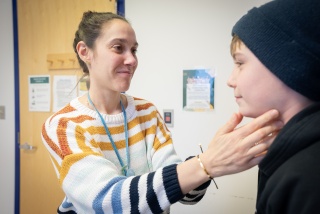
Why Choose Golisano Children's Hospital?
As the only dedicated Pediatric Endocrinology Clinic in the state of Vermont, we offer families from Vermont and northern New York:
- Pediatric endocrinology expertise: Your child receives care from board-certified, fellowship-trained endocrinologists who specialize in pediatric endocrine disorders. These experts partner with your child’s primary care provider for seamless care.
- Family-centered approach: Whether your child needs short- or long-term treatments, we offer comprehensive support for your whole family. When teens are ready to transition to adult medical care, we help streamline the process.
- Convenient access to care: Our dedicated clinics bring together all the experts your child needs during one appointment. Your family also has 24/7 emergency access to a pediatric endocrinology specialist and the option of using digital health visits and MyChart.
Pediatric Endocrinology Services
Some endocrine disorders, like diabetes, require lifelong care. Managing these disorders can be challenging for children and their families. Our Pediatric Endocrine Disorders Clinic provides comprehensive support services in partnership with specialists from across UVM Health.
In addition to an evaluation by a pediatric endocrinologist, your child may see a pediatric endocrine nurse, registered dietitian, social worker, Child Life specialist or psychologist. These specialists work as a team to create the best treatment plan for your child. When appropriate, we collaborate with other specialists from across UVM Health, such as surgeons, oncologists and radiologists.
Conditions We Treat
We offer a full range of treatments for all types of pediatric endocrine disorders, including:
The pancreas makes little or no insulin, a hormone that regulates blood sugar (glucose). Type 1 diabetes was previously called juvenile-onset diabetes or insulin-dependent diabetes.
The pancreas still makes some insulin, but your child’s body is unable to respond to insulin as it should to regulate blood sugar. Eventually, the pancreas cannot make enough insulin to keep up. As a result, sugar levels in the blood can become dangerously high resulting in frequent urination, intense thirst, fatigue and blurred vision. In extreme cases, type 2 diabetes can also cause nausea or vomiting, and severe belly pain. Type 2 diabetes was previously known as adult-onset diabetes.
Growth disorders include conditions, such as short stature, constitutional delay, slow height gain, failure to thrive, growth hormone deficiency or excessively rapid linear growth.
Puberty disorders include conditions, such as early pubertal development (precocious puberty), late pubertal development (delayed puberty), Kallmann syndrome, Klinefelter syndrome or Turner syndrome.
Thyroid disorders include conditions, such as an underactive thyroid gland (hypothyroidism and Hashimoto’s disease) an overactive thyroid (hyperthyroidism and Grave’s disease), thyroid nodules or thyroid cancer.
Parathyroid disorders include conditions, such as too much parathyroid hormone (hyperparathyroidism), not enough hormone (hypoparathyroidism) or the body doesn’t respond to the hormones as it should (pseudohypoparathyroidism or parathyroid hormone resistance).
Calcium metabolic disorders include conditions, such as too much calcium (hypercalcemia), too little calcium (hypocalcemia), vitamin D disorders (rickets) or phosphate wasting (hypophosphatemic rickets).
Metabolic bone disorders include conditions, such as low bone mineral density (osteopenia) or rickets.
Adrenal gland disorders include conditions, such as underactive adrenal gland (hypocortisolism and Addison’s disease), an overactive gland (Cushing’s syndrome), or genetic disorders affects the adrenal glands (such as congenital adrenal hyperplasia).
Arginine vasopressin deficiency (AVP-D), previously called central diabetes insipidus, results from a deficiency of arginine vasopressin (AVP), also known as antidiuretic hormone (ADH). This results in a significant increase in urine production and increase in thirst, that can lead to dehydration and abnormal levels of sodium in the blood.
Disorders of sexual development include conditions that result in atypical genitalia (also called ambiguous genitalia).
Hypoglycemia occurs when the level of sugar (glucose) in a person's blood gets too low. Some symptoms of low blood sugar are mild, such as sweating or feeling hungry. Others are severe, such as passing out.
These disorders include Turner syndrome, Klinefelter syndrome, Kallmann syndrome, Prader-Willi syndrome, Russell-Silver syndrome, multiple endocrine neoplasia (MEN) and autoimmune polyglandular syndromes.
The doctor's approach to establishing a long-term relationship for a chronic condition is excellent. We feel really good knowing we can work together, especially in helping our child with a condition that impacts their development, and in sensitive ways.
Diagnostics
It can be distressing to learn your child has an endocrine disorder, especially one that might require lifelong care. We perform advanced diagnostic tests to quickly pinpoint the cause of your child’s symptoms and start personalized treatment to protect their health.
Your child’s provider may order a range of diagnostic tests depending on your child’s symptoms.
Diagnostic tests for endocrine disorders include:
- Blood tests: Measure levels of hormones, electrolytes, blood sugar, vitamins and minerals.
- Dynamic endocrine testing: Specialized testing that takes place at our dedicated pediatric infusion suite. These tests may include growth hormone stimulation tests, ACTH stimulation tests, gonadotropin (GnRH) stimulation tests, fasting challenges and water deprivation tests.
- Genetic tests: Testing for gene changes that cause certain inherited endocrine disorders.
- Imaging tests: May include X-rays, ultrasounds, MRIs and CT scans.
Awards & Certifications
American Diabetes Association
Our clinic is recognized by the American Diabetes Association for its excellence as a Pediatric Diabetes Self-Management Education Program. This designation reflects our team’s expertise in helping children and families learn how to confidently manage diabetes.
Locations near you
Share your location to see nearby providers and availability
111 Colchester Avenue
Burlington, VT 05401-1473