University of Vermont Center for Aortic Diseases
Aortic Disease Treatment at UVM Health
The aorta is the largest artery in the body, carrying blood from your heart to the rest of your body. Diseases of the aorta — such as aortic aneurysm (an abnormal enlargement of the blood vessel) or aortic dissection (a tear in the wall of the blood vessel) — can be life-threatening and require specialized treatment.
The University of Vermont Center for Aortic Diseases is the only clinic of its kind in the region, bringing together a multidisciplinary team of vascular and cardiothoracic surgeons to diagnose and treat complex aortic disease.

Why Choose UVM Health?
Our team will work closely with you to develop a comprehensive and personalized treatment plan that minimizes your risk of serious complications and helps you live a full, healthy life.
As one of the leading heart and vascular programs in the region, we offer:
- Excellent outcomes: We track patient outcomes in national quality improvement registries, such as the Vascular Quality Initiative (VQI) and the Northern New England Cardiovascular Disease Study Group. Our outcomes consistently meet — or exceed — national benchmarks.
- Advanced treatments: We offer leading-edge, minimally invasive procedures to treat serious aortic conditions, including endovascular aneurysm repair (EVAR), thoracic aortic endovascular repair (TEVAR) and physician-modified endografts (PMEG).
- State-of-the-art imaging: Our vascular laboratory and hybrid operating room are equipped with the modern aortic imaging equipment required for accurate diagnoses and advanced endovascular aortic procedures. Our collaboration with UVM Medical Center Radiology provides patients access to imaging tests for diagnosis, treatment planning and follow-up.
A Message to Our Patients
We welcome you to the Center for Aortic Diseases on behalf of the surgeons, nurses and support staff. We understand and appreciate the trust you place in us to deliver the care necessary to manage your aortic condition.
We recognize the challenges in navigating the complex health care system and will make every effort to help you through it.
We at the Aortic Center are committed to teamwork, patient focused care and continuous quality improvement. Thank you for allowing us to provide the care you deserve.
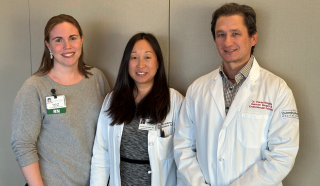
Caitlyn King, RN, Clinical Program Coordinator, Dr. Fuyuki Hirashima, Cardiothoracic Surgeon, and Dr. Daniel Bertges, Vascular Surgeon
Conditions We Treat
Our expert team works together to develop customized treatment plans for all types of complex aortic disease, including:
An aneurysm is a bulge that forms in a weakened or damaged area of the aortic wall. They can develop anywhere along the aorta but frequently occur in the abdomen (abdominal aortic aneurysm) and in the chest (thoracic aortic aneurysm). They can also occur in the iliac arteries, which carry blood to your legs.
Large aneurysms are at risk of rupturing (bursting) or tearing (dissection), which can cause life-threatening internal bleeding or other serious complications.
A tear may develop in a weakened area of the aorta. Blood flows through the tear and between the layers of the aortic wall, causing them to separate (dissect). This can block normal blood flow to the rest of your body or cause the outer aortic wall to rupture. An aortic dissection is a medical emergency.
Other serious conditions affecting the aorta include intramural hematoma, which occurs when blood leaks between the layers of the aortic wall, and penetrating atherosclerotic ulcer (lesions that form on the aortic wall).
Some people may be at higher risk of developing certain aortic diseases as a result of a genetic variant inherited from your parents. These conditions, including Marfan syndrome and Loeys-Dietz syndrome, typically affect the thoracic aorta.
What to Expect
Most patients are referred to the Center for Aortic Diseases by their primary care provider or cardiologist after being diagnosed with of a complex or difficult-to-treat aortic condition. Self-referrals are also welcome.
As a new patient of our clinic, you will be connected with our dedicated nurse navigator, who will help coordinate your care from initial referral through postoperative follow-up.
In your initial appointment, you will meet your cardiothoracic surgeon (specializing in the heart, lungs and chest) and vascular surgeon (specializing in the vascular system, which includes your blood vessels, veins and arteries). Together, they will assess and diagnose your condition. They may order aortic imaging tests to confirm your diagnosis and get more information about your condition, so they can determine the best course of treatment.
Many complex aortic conditions need to be surgically repaired. In some cases, your team may recommend a nonsurgical approach.
Our surgeons offer several advanced procedures to treat complex aortic disease. Your surgical team will determine which surgery is appropriate for you.
Endovascular Surgery
Endovascular aneurysm repair (EVAR) and thoracic aortic endovascular repair (TEVAR) are minimally invasive procedures performed through small incisions in your groin. Your surgeon will insert a tube called a stent graft (endograft) through a small tube (catheter) into the artery in your groin. The doctor will guide the catheter to your aorta using fluoroscopy (a type of X-ray) and insert the stent graft. The endovascular stent graft strengthens the weakened aorta to prevent the aneurysm from rupturing.
We also offer fenestrated EVAR and branched EVAR, leading-edge procedures that use physician-modified endovascular grafts (PMEG) and customized stent grafts built for your unique anatomy.
Open Surgery
In an open surgical repair, your surgeon will make an incision in your abdomen or chest to repair the abnormal section of the aorta with a tube-like device called a graft.
Post-Surgery
After surgery, your condition will be managed by your surgical team. Once you have recovered, we will work closely with your cardiologist or primary care provider on transfer of care.
If you have had endovascular surgery, you will need lifelong follow-up care to monitor the stent graft. This typically includes regular CT scans in the months and years following your operation.
Your surgical team may decide that your aneurysm does not need immediate repair, or that you would not benefit from surgical treatment. We offer long-term disease management for patients with an aneurysm that is not large enough to be operated on, an aortic dissection that can be managed with medication, or a health condition that makes them ineligible for surgery.
Monitoring consists of regular imaging tests and follow-up visits with your providers. For your convenience, many imaging tests can be done at UVM Health locations throughout Vermont and northern New York. We also offer digital health visits, both by video and by telephone, when medically appropriate.
Patient Resources
We have created resources with helpful illustrations to explain health conditions and prepare you for testing, treatment and more.
- Patient Booklet - Aortic Aneurysm
- Patient Booklet - Acute Aortic Syndrome
- Short Guide - Aortic Aneurysms
- Short Guide - Open Thoracic Aortic Surgery
- Short Guide - Types of Open Thoracic Aortic Surgery
- Short Guide - Endovascular Aortic Surgery
- Short Guide - Open Abdominal Aortic Surgery
- Short Guide - Aortic Disease & Mental Health
- Short Guide - Aortic Dissection
- Short Guide - What to Ask Your Surgeon About Your Abdominal Aortic Aneurysm
Locations near you
Share your location to see nearby providers and availability
111 Colchester Avenue
Main Campus, East Pavilion, Level 5
Burlington, VT 05401-1473
111 Colchester Avenue
Main Campus, Main Pavilion, Level 5
Burlington, VT 05401-1473