A New Option for Stubborn High Blood Pressure
Vermonters and New Yorkers gain access to innovative hypertension treatment after clinical trial success.
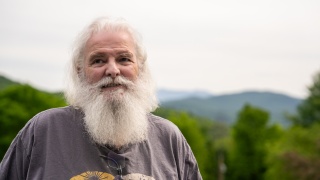
John Kohlmeyer spends long stretches on the deck of his Richmond home, watching the birds come and go and the clouds drift over the valley, Mt. Mansfield in the distance. It is the kind of quiet that ought to ease a person's blood pressure. For Kohlmeyer, though, hypertension had become a persistent problem.
Lightheadedness and swelling in his lower legs became routine. Medications helped, but the nausea and digestive side effects made them hard to tolerate.
"I'm not a big fan of medication being the answer to everything," says Kohlmeyer, who moved to Vermont about 40 years ago with his wife, Kea. "Some of the drugs had side effects I didn't care for, and they don't really fix anything — so when this came up as an opportunity to be a true fix, I was very interested."
That opportunity to better control his hypertension came through a clinical research study at University of Vermont Health - UVM Medical Center. Researchers were evaluating renal denervation, a minimally invasive procedure to treat high blood pressure. At the time, it was only available through a clinical research trial. Now, with FDA approval, UVM Medical Center is able to offer the procedure without the need to enroll in trials and is working to expand access across Vermont and northern New York.
A new approach to an old problem
Nearly half of U.S. adults have hypertension. Despite a wide range of medications available, many struggle to keep it under control. Some cannot tolerate the side effects. Others take multiple drugs and still fail to reach a safe range. Renal denervation offers a new path to help better manage elevated blood pressure — one that is complimentary to better lifestyle choices and medications. During the procedure, interventional cardiologists like Rony Lahoud, MD, thread a thin catheter through the blood vessels to the renal arteries. There, they deliver low-level radio frequency energy to calm overactive nerve signals near the kidneys that contribute to elevated blood pressure.
"High blood pressure is one of the most common conditions we treat, but it is not always simple to control," says Dr. Lahoud. "Some patients are doing everything right and their blood pressure is still too high. Others have side effects that make it hard to stay on the medications they need. For the right patient, renal denervation can be a compelling option." To qualify for the study, patients needed a persistent systolic blood pressure of 140 or higher. Most were already taking multiple medications — making the procedure a next step rather than a first-line treatment.
High blood pressure is one of the most common conditions we treat, but it is not always simple to control.
Clinical Research Coordinator Amy Henderson helped identify and guide those patients, overseeing screening and the careful blood pressure monitoring the study demanded. Fourteen people ultimately received the procedure. Researchers will continue to track their blood pressure for three years.
Henderson recalls that Kohlmeyer stood out from the start.
"He was motivated and interested in his health," she says. "He wanted to understand what might be causing his blood pressure and what he could do differently."
A recovery easier than expected
For Kohlmeyer, the procedure was quick and largely painless. He stayed overnight for monitoring and returned home without side effects.
"It got me out of the danger zone," he says.
He continues to monitor his blood pressure. Some days it runs higher than he would like. But overall, it remains in a safer range. The lightheadedness and leg swelling that once troubled him are gone.
Expanding advanced care close to home
With FDA approval secured, UVM Medical Center has now made renal denervation available to all eligible patients, not only those who would fit the narrow inclusion criteria of clinical research. The goal is to offer patients in the region a treatment that once required travel out of state.
"Clinical research gives our patients access to promising therapies before they're widely available,” Dr. Lahoud says. “It also allows us to build the expertise to offer those treatments safely once they become standard care. Patients shouldn't have to leave the area to benefit from the latest advances in cardiovascular medicine."