Breast Cancer
Breast Cancer Care at UVM Cancer Center
Breast cancer occurs when abnormal cells in the breast divide uncontrollably. These cells can spread to surrounding tissues and other areas of the body.
A breast cancer diagnosis may leave you with many questions about your health. The breast cancer team at University of Vermont Cancer Center can help you find answers. Our comprehensive support services are available throughout your journey to help you have a comfortable, less stressful experience.

Why Choose UVM Health?
With locations across Vermont and northern New York, you can count on us for leading-edge cancer care throughout the region.
We offer:
- Expertise: Our team includes surgeons, medical oncologists, radiation oncologists, pathologists, and radiologists with decades of experience, many of which completed fellowship training in breast care.
- Advanced diagnostics: We are home to the only cancer program in the region offering in-house genomic testing and among a select few health systems with a dedicated breast MRI scanner to detect cancer with greater precision.
- Innovative treatments: As a health system anchored by an academic medical center, our research has significantly improved care experiences and outcomes. We completed one of the largest surgical trials in breast cancer, which found that surgeons can safely remove fewer lymph nodes as part of breast cancer surgery. This groundbreaking study has become the standard of care worldwide.
- High-risk cancer care: We perform genetic testing to assess your individual risk and routine imaging and lab tests to check for signs of cancer. If you receive a cancer diagnosis, you have access to advanced therapies, some of which are only available through clinical trials.
- Convenience: Our network of specialists gives you access to breast cancer services in our cancer treatment centers throughout Vermont and northern New York.
Types of Breast Cancer
There are many types of breast cancer. Whether your condition is early-stage or advanced, we offer personalized treatments and hope for healing.
- Ductal Carcinoma in Situ: This is type of breast cancer forms in the milk ducts and has not spread to surrounding breast tissue. It is an early-stage or noninvasive type of breast cancer.
- Invasive Breast Cancer: Also called infiltrating breast cancer, this type spreads from its original location to other areas of the breast. Invasive ductal carcinoma and invasive lobular carcinoma are the two most common types of invasive breast cancer.
- Inflammatory Breast Cancer: This is a rare but aggressive type of invasive breast cancer. The cancer cells block the normal drainage of lymph from the breast which causes red, swollen breasts.
Symptoms of Breast Cancer
Breast cancer is often detected on a mammogram before symptoms appear.
The most common symptom of breast cancer is a painless lump in the breast or underarm area. Other symptoms may include:
- Changes in the size, shape or appearance of the breast
- Changes to the nipple, such as turning in, developing a scaly appearance or leaking fluid
I was surrounded by support: a talented surgeon, oncologist, board-certified oncology naturopath, primary care provider, cancer counselor, plus wonderful family and friends. I am forever grateful.
Diagnosing Breast Cancer
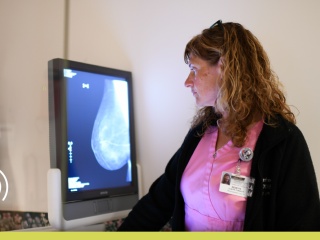
Diagnosis often starts with a 3D mammogram, an imaging study that can diagnose cancer in earlier stages. This may occur during an annual mammogram, one of the many cancer screenings we provide.
Depending on what your initial screening shows, you may need additional tests. We offer a range of advanced options, including:
- Breast ultrasound: An additional test for women with dense breast tissue.
- Breast MRI: Provides even more detail than mammograms and ultrasound. Our dedicated breast MRI scanner is among a select few in the region.
- Biopsy: A tissue sample usually taken by a radiologist using a hollow needle guided by medical imaging. A breast pathologist (specialist in diagnosing breast disease) evaluates the sample to confirm the cancer type.
Breast Cancer Treatment
At UVM Cancer Center, you receive a personalized care plan that may include multiple treatment strategies, depending on the type of breast cancer you have. Throughout your cancer journey, our nurse navigators are by your side to coordinate appointments, answer questions and guide your care.
Breast surgeons use proven methods to successfully remove cancer while preserving as much healthy tissue as possible. We may implant a small ultrasound-visible marker clip during your biopsy to make it easier to identify the tumor during surgery. Our surgeons are also experts in breast reconstruction surgery and nipple-sparing techniques.
Many types of oral or intravenous (IV) medications are used to destroy cancer cells or slow their growth. Your care may include one or more medications, including:
- Chemotherapy: Chemotherapy drugs destroy cancer cells, and are often used before surgery to shrink a tumor.
- Targeted therapy: Targeted therapy drugs identify and attack cancer cells. Your care team will select the appropriate targeted therapy medications for you based on tumor genetic testing.
Trusted experts deliver radiation therapy using some of the most precise technologies available, such as accelerated partial breast irradiation (APBI). APBI is a type of radiation therapy used to treat early-stage breast cancer, typically after a lumpectomy. Unlike traditional whole-breast radiation therapy, APBI targets only the area of the breast where the tumor was removed, delivering radiation over a shorter time period.
We also use the breath hold technique, which delivers radiation therapy in short bursts between breaths when your chest is still.
Clinical trials are always part of care team discussions. Participation in a clinical trial is entirely voluntary and can give you access to new care methods years before they are widely available. If you are eligible for a specific trial, your provider will explain the benefits and risks of participating.
Our research includes evaluating new medical oncology drugs, some of which may be available to you if you are eligible for a clinical trial. Our work is also advancing breast cancer care methods to make treatments safer and more effective.
Clinical Trials
The UVM Cancer Center supports more than 100 active clinical trials focused on prevention, screening, treatment, supportive care and survivorship.

Locations Near You
Share your location to see nearby providers and availability
111 Colchester Avenue
Main Campus, East Pavilion, Level 3
Burlington, VT 05401-1473
75 Park Street
Elizabethtown, NY 12932
101 Adirondack Drive
Ticonderoga, NY 12883
111 Colchester Avenue
Main Campus, Main Pavillion, Level 2
Burlington, VT 05401
111 Colchester Avenue
Main Campus, Main Pavilion, Level 2
Burlington, VT 05401-1473
75 Beekman Street
Plattsburgh, NY 12901-1438
23 Fourth Street
Suite 1
Malone, NY 12953-1331
111 Colchester Avenue
Main Campus, Main Pavilion, Level 2
Burlington, VT 05401-1473
130 Fisher Road
Berlin, VT 05602-8132
23 Fourth Street
Suite 1 & 2
Malone, NY 12953-1331