Beyond Survival, Leading Change
Her experience sparked a movement for patient-centered care.
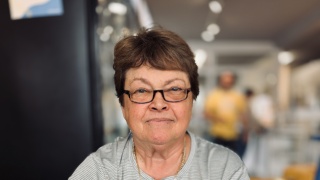
Kim Farnham’s breast cancer journey began with a routine check-in at her primary care office. A physician assistant noticed she hadn’t had a mammogram in two years and encouraged her to visit the radiology department at University of Vermont - Porter Medical Center. That simple nudge led to a scan, biopsy and eventually a lumpectomy, which wasn’t successful.
“At that point, my provider said, ‘You're going to the Breast Care Center. You’re just going to go right up there,’” Farnham recalls.
At UVM Medical Center’s Breast Care Center, Farnham was connected with a team of specialists and began planning her care.
Speaking Up for Better Care
Reconstruction options weren’t initially discussed, so Farnham spoke up.
That moment became a theme throughout her journey: Patients and families are partners in their care, she says, and asking questions is essential.
Now, more than nine years later, Farnham refers to herself and others treated for breast cancer as “Princess Warriors,” proud members of “the sorority.” Over the years, she has also become an active patient and family advisor — and the chair of the board of Porter Medical Center.
Recovery, Resilience and Reaching Others
Back in December 2016, shortly after her diagnosis, Farnham underwent a 20-hour breast cancer surgery, followed by several uncomfortable days lying still in the ICU, plus a follow-up surgery to remove staples. Her recovery was complex: phantom pain, six surgical drains to monitor and a series of secondary surgeries — eight in total.
Still, she considers herself fortunate. She didn’t need chemo or radiation and had a positive experience with her breast reconstruction team. But she also learned that life after cancer brings its own questions and challenges, and those aren’t always addressed in routine follow-up care. That gap inspired her to push for better post-cancer support; after seeing a local news story calling for advisors, she joined University of Vermont Health - UVM Medical Center’s patient and family advisory group.
Turning Experience Into Action
Soon after, while attending a health care conference, Farnham sat next to the head of the intensive care unit. She asked him a simple question: “Do you do rounding?” — the practice of care teams visiting patients regularly to check on their progress. When he said yes, she offered an idea: Include environmental services staff in those rounds.
“The person I saw most during my 10 days in the hospital [after my breast cancer surgery] was an environmental services worker,” she said. “She is from Peru. Her family is still there. You should include her and her peers in your rounds.”
Environmental services employees often spend more time in patient rooms than clinical staff, ensuring safety and cleanliness. For many patients, they are the most consistent presence — listening to fears, offering comfort in quiet, unnoticed ways. Farnham argued that recognizing their role could strengthen engagement and morale and make care feel more human.
Fast forward to summer 2025, Farnham, now serving as a patient advisor and board member at Porter, was invited by Patient Experience and Quality Improvement Coordinator Stacey Dwire to speak at a barbecue for the environmental services team. Morale had been low, and Farnham shared her perspective on the impact those in their role had during her hospitalization.
“Kim feels really passionate about the value of the whole care team,” says Dwire. “I was off to the side while Kim was sharing her stories of her interactions with environmental services while she was receiving care and what a difference they made during her time there. I could just see their faces light up. I mean, these are front-line workers, and to hear directly from a patient — who is also the board chair? Their faces really lit up."
A Local System That Learns and Leads
It wasn’t only at UVM Medical Center that Farnham advanced change. She also helped launch the patient and family advisory committee at Porter Medical Center.
Early on, she boldly proposed giving patient advisors a formal role in hospital strategy and decision-making.
Farnham recalls that when the president of Porter asked, "Where do you see your group going?” she replied, "I see them eventually having a place on the board."
That vision became reality. Farnham joined the board and eventually became chair, signaling Porter’s deep commitment to elevating patient and family voices.
Farnham’s advocacy didn’t end with her own treatment, nor has it been contained to her formal roles of patient advisor and board chair. She mentors other women, offering warmth, strength and encouragement to ask for the care they need.
Recently, she recalled the painful days after her own breast cancer surgery. “Nips, tucks, injections — that was painful and pretty invasive,” Farnham says.
Support at home made a difference. Visiting nurses helped her manage recovery, so Farnham now encourages others to ask for that help.
“You are entitled to them,” she says. “It’s also the role of care teams to make sure patients know what is available to them.
More Than Survival — A Legacy of Change
Farnham’s journey is about more than survival — it's about how patient voices can shape care beyond the bedside. From advocating for her own care to shaping policies that include patients and families, she has helped create a culture of collaboration and respect. Her experience shows that care improves when patients are heard and included.