Breast Reconstruction
Breast Reconstruction at UVM Health
Breast reconstruction surgery creates a natural shape and balance to one or both breasts following breast cancer surgery or for congenital deformities. At University of Vermont Health, we offer breast reconstruction using implants or your own tissue (autologous reconstruction).
Your decision to have breast reconstruction surgery is personal. Our breast reconstruction surgeons listen to your needs and expectations and help you decide what’s right for you. They then use their expert reconstructive and cosmetic surgical skills to give you the best possible results.
Why Choose UVM Health?
As a leading plastic surgery program in the region, we offer:
- Expertise: You receive care from surgeons with extensive training and experience in breast reconstruction. As academic leaders, we are among the first to adopt the latest advances in care.
- Support: Our team strives to create a warm, supportive environment — one where you feel comfortable asking questions and sharing your challenges. We are here for you at every step of the process.
- Education: We schedule a full hour for each new consultation to thoroughly discuss your options. If you need extra time, we schedule another appointment. We’re not satisfied until you feel comfortable with your decision.
- Convenience: We offer services at locations in Vermont and northern New York. We also offer digital health options for some types of visits.
Types of Breast Reconstruction
Our surgeons offer a range of breast reconstruction procedures. In some cases, they may combine procedures to achieve the desired outcome.
In this type of reconstruction, we recreate the breast using a saline or silicone implant.
To make room for the implant, your surgeon inserts a tissue expander during mastectomy surgery or after you have healed. Over multiple office visits, we slowly insert fluid into the expander. When the skin and muscle have fully expanded, your surgeon removes the expander and inserts the implant.
This approach involves using a flap of skin and fat tissue from another area of the body to rebuild the breast shape. The most common tissue flap procedure uses a deep inferior epigastric perforator (DIEP) flap from the abdomen.
In DEIP flap reconstruction, the surgeon removes the flap and transfers it to the breast area. They reattach blood vessels using microsurgery to maintain blood flow to the tissue.
One benefit of DIEP flap reconstruction is that it does not involve the removal of muscle tissue, like some other flap procedures. As a result, there is no risk of muscle damage or weakness.
Oncoplastic breast reconstruction may be an option for some patients with larger breasts. This procedure combines a breast reduction or a breast lift with a partial mastectomy. The oncologic surgeon removes the breast tumor while the plastic surgeon performs the reconstruction. Radiation therapy usually follows surgery as part of cancer treatment.
If you have breast cancer surgery on one breast, your care may also include surgery on the other breast to give a symmetrical appearance. The Women’s Health and Cancer Rights Act (WHCRA) requires health insurers to cover reconstruction of the other breast.
What to Expect
For most people, the process of breast reconstruction occurs in stages and takes about a year. During that time, we get to know you and share your breast reconstruction journey. If you have any challenges along the way, our compassionate team is available to help.
The typical path for breast reconstruction includes:
The first step in breast reconstruction is a consultation with one of our plastic surgeons. If you’ve received a breast cancer diagnosis, that consultation usually happens after you meet with the breast cancer surgeon.
Some people wait until after cancer treatment to think about reconstruction — even years after. We encourage you to take your time and see us when the time is right.
A consultation typically involves a physical exam to evaluate your breasts. We talk to you to understand your goals and explain your options, including not having any reconstruction (going flat).
In addition to your personal preferences, the type of breast reconstruction surgery that’s best for you depends on many factors, including:
- Breast cancer type
- Extent of breast cancer surgery and ability to spare the breast skin and nipple
- Damage to chest tissue due to radiation therapy or aging
- Previous reconstruction surgery
- Your overall health
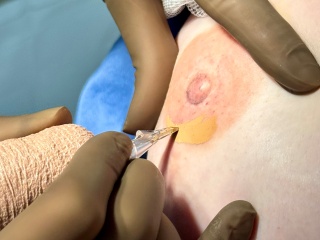
Once you choose the type of reconstruction, we develop a treatment plan, working with your oncology team as needed. Your plan may also include post-reconstruction nipple tattooing and nipple reconstruction.
The preoperative appointment provides everything you need to know about surgery, including the risks and what to expect. Our goal is to answer all your questions so you can make an informed decision and feel confident about having surgery.
We perform breast reconstruction surgery in an operating room using general anesthesia, so you are asleep. After surgery, you may have tubes under your skin to drain fluid. Your doctor will determine when it’s safe to remove these tubes.
The length of hospital stay depends on the type of reconstruction procedure. Before you go home, we provide:
- Instructions on how to care for the surgical incision(s)
- Medication prescriptions to help manage pain
- Supplies, such as dressings and support garments
After surgery, we see you in our office for follow-up appointments at one, two and six weeks. After the second visit, most people can resume their usual activities.
Longer term, we continue to track your recovery with regular visits. It may take several months or longer for the swelling to subside, the tissues to heal and the scars to fade. It’s also common to have lasting numbness in the breast, although some feeling may eventually return.
Our team understands the need for personalized care during recovery. We work with you to ensure you have the support you need to heal physically and emotionally.
Patient Resources
Locations near you
Share your location to see nearby providers and availability
214 Cornelia Street
Suite 103
Plattsburgh, NY 12901-2332
354 Mountain View Drive
Suite 103
Colchester, VT 05446-5923