Maternal Fetal Screening & Diagnostics
Fetal Diagnostic Center at UVM Health
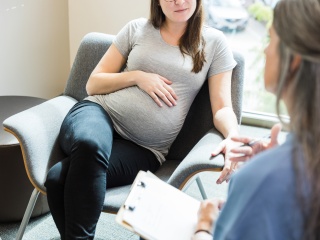
The Fetal Diagnostic Center at University of Vermont Health provides advanced fetal testing, delivered with compassion and care. We are here to support you and help ensure that your pregnancy is as worry-free as possible.
Testing may give you reassurance that your pregnancy is on track. If we find an abnormality or increased risk of an abnormality, our specialists can help you understand those findings. We’ll provide support and guidance as you make decisions about your pregnancy.
As part of Vermont’s only maternal-fetal medicine program, we accept referrals from across the region.

Why Choose UVM Health?
Whether you have a low-risk or high-risk pregnancy, you can turn to us for the latest fetal monitoring tests and a gentle, patient-focused approach to care. We offer:
- Expertise: Board-certified maternal-fetal medicine specialists lead our Fetal Diagnostics Center. These highly trained physicians have extensive training and experience in performing fetal tests, interpreting results and helping families make informed decisions.
- Multidisciplinary team: Our physicians partner with specialists in different fields, including fetal cardiologists and genetic counselors, to ensure you and your baby receive expert care. This includes optional access to national and regional clinical trials for types of fetal heart conditions.
- National accreditation: Our Fetal Diagnostic Center is the only center in Vermont with American Institute of Ultrasound Medicine accreditation for obstetrical ultrasound scans and fetal echocardiography. We meet national standards for performing and interpreting these ultrasound imaging tests. We include board-certified pediatric cardiologists on our accreditation team.
- Inclusive care: Our team recognizes the importance of individual choices during pregnancy. We have a strong commitment to diversity and welcome patients of all races, ethnicities, abilities, gender identities and sexual orientations.
Fetal Tests We Offer
We use a range of tests during pregnancy to rule out or detect fetal conditions. Tests may indicate an increased risk for, or confirmation of, a certain condition. Tests we offer include:
NIPT is a screening blood test given between 10 and 12 weeks of pregnancy to measure your baby’s risk for chromosomal disorders. This test looks for extra or missing chromosomes in the small pieces of fetal DNA circulating in your blood. NIPT is over 99% effective at detecting the most common chromosomal disorders — Down syndrome, trisomy 18 and trisomy 13.
Ultrasound uses sound waves to create detailed images of your baby. Our physicians use state-of-the-art ultrasound machines and have extensive experience interpreting these images. Depending on your risk of complications, we may perform different types of ultrasound scans, such as:
- Obstetric ultrasound: These routine ultrasounds can detect problems during pregnancy, including fetal abnormalities.
- Detailed obstetric ultrasound: This test is a thorough scan of your baby’s body during the second trimester of pregnancy. It helps us identify abnormalities of the fetus and placenta. You may have this test if your baby is at high risk of a congenital condition or if a blood test or routine ultrasound indicates an increased risk.
- Fetal echocardiography: This test involves a complete assessment of your baby’s heart. We work with pediatric cardiologists to perform and interpret fetal heart scans.
- Fetal Doppler ultrasound: A Doppler ultrasound measures how blood flows through blood vessels. In fetal medicine, we use this specialized test to check for fetal anemia, heart problems and development of the placenta.
- Biophysical profile (BPP): This test provides an overall picture of your baby’s well-being. A BPP involves several ultrasound measurements along with a nonstress test to check your baby’s heartbeat and movement. We typically perform a BPP later in pregnancy if there is a concern for your baby’s health. The results of a BPP can help us decide the right time for delivery.
Diagnostic tests involve collecting a small sample of fluid, tissue or blood for genetic and other lab tests. Because these tests are invasive and carry a small risk to the fetus, they are not a standard part of fetal care. We typically use them in high-risk pregnancies or if a problem is suspected.
Types of diagnostic tests we use include:
- Chorionic villus sampling (CVS): This test involves collecting cells from your placenta and analyzing them for chromosomal and genetic disorders. We offer this test between 10 and 13 weeks of pregnancy.
- Amniocentesis: In this test, we remove a small sample of the fluid in your uterus that contains fetal cells (amniotic fluid). Laboratory testing of the fluid helps us diagnose chromosomal and genetic disorders and other fetal conditions. We perform this test in the second trimester of pregnancy.
- Percutaneous umbilical blood sampling (PUBS): In this test, we collect blood from your baby’s umbilical cord to check for fetal anemia or other conditions. We use PUBS after 17 weeks of pregnancy and only when we cannot obtain the information we need from other tests.
Our maternal-fetal specialists can perform fetal interventions before your baby is born, using the same techniques we use for diagnostic tests. These procedures include:
- Blood transfusion: We use a procedure similar to PUBS to give your baby a blood transfusion through the umbilical cord.
- Amniotic fluid removal: We use amniocentesis as an interventional procedure to remove excess amniotic fluid (polyhydramnios).
- Fetal shunt: A shunt is a tube placed inside your baby to drain excess fluid from their bladder, abdomen or chest.
Carrier screening identifies genetic conditions for which your fetus may be at risk. We have genetics counselors and physicians available if discussion is needed.
What to Expect
People come to us for fetal testing for many reasons, including for reassurance or to rule out concerns. Your general obstetric provider may refer you to us for fetal testing if you:
- Want to make sure your unborn baby is healthy
- Have a high-risk pregnancy
- Have had an ultrasound or blood test that indicated a possible issue
A typical sequence in fetal testing by general obstetric providers is NIPT at 10 weeks and an anatomic obstetrical scan at 20 weeks. If the NIPT suggests your baby is at high risk for a chromosomal disorder, the Fetal Diagnostic Center can provide chorionic villus sampling after 10 weeks or amniocentesis after 15 weeks. We also offer detailed obstetrical scans that have a high level of precision.
If we identify a health issue, our maternal-fetal medicine team is by your side with expert care, support and education about your options. We treat you like we would our own families and do our best to help you through an uncertain and often challenging time.
Some fetal conditions are treatable with medication, minimally invasive procedures, or surgery. If you or your baby require more advanced care, our team will coordinate referrals to:
- Other hospitals for in utero surgery or higher-level care your baby may need after delivery
- Pediatric specialists, including fetal cardiologists, within UVM Health to give you information about your baby's condition including the short- and long-term management during your pregnancy and after delivery
- Support groups for parents of children with your baby’s condition
Awards & Certifications
March of Dimes
The March of Dimes awarded Golisano Children's Hospital at UVM Health an ‘A’ grade for perinatal services in their 2024 Report Card – making Vermont the only state to achieve an ‘A’ ranking in 2024 and setting a new benchmark for maternal and infant health across the United States.
American Institute of Ultrasound Medicine (AIUM) Accreditation
Our Fetal Diagnostic Center has received accreditation from the AIUM for routine obstetrical ultrasound evaluations and two specialized fetal tests, including detailed obstetrical ultrasound scans and fetal echocardiography. The AIUM only accredits centers that demonstrate a high level of ability and reliability in performing these tests.
Newsweek: America's Best Maternity Hospitals
Newsweek has included UVM Health's anchor academic medical center and Level 1 Trauma Center that serves the region on its ranking of America’s Best Maternity Hospitals after assessing the quality of perinatal care, operative obstetrics, patient education and counseling, accommodation and service, and nurse and midwife staffing.
Locations near you
Share your location to see nearby providers and availability
353 Blair Park Road
Williston, VT 05495-7530
111 Colchester Avenue
Main Campus, East Pavilion, Level 4
Burlington, VT 05401-1473
111 Colchester Avenue
Main Campus, East Pavilion, Level 4
Burlington, VT 05401