High-Tech Care Comes Home
Nursing program helps patients, brings relief for family caregivers.
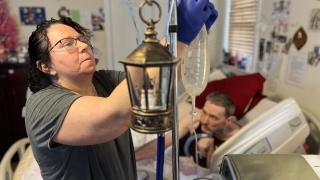
In his South Burlington home, Shaun McGuire is surrounded by mementos: a New York Yankees pennant, holiday decorations, family photos bearing handwritten messages and a wall-sized picture of his prize-winning demolition derby car.
He’s also enveloped in medical equipment that keeps him alive, including a ventilator providing 24-hour oxygen.
Despite severe, chronic physical conditions, McGuire can live at home thanks in part to high-tech nursing, a small but critical home health service that keeps patients out of the hospital while providing invaluable support for families throughout Vermont.
“Caregivers who provide care around the clock don’t necessarily have the opportunity to be a family,” says Jennifer Pennington, RN, specialty care team clinical manager at University of Vermont Health - Home Health & Hospice. “We go in and provide help with nurses who make sure their loved one is well cared-for.”
Meeting a Need
High-tech nursing is funded through Vermont’s Medicaid program and provided by home health agencies statewide. The McGuires are one of 11 families currently served by UVM Health — Home Health & Hospice through the program.
The program is meant for patients with long-term, 24-hour needs that can’t be met by periodic visits. They require technologically dependent care supported by equipment like ventilators, central lines and bilevel positive airway pressure (BiPAP) machines, Pennington says.
These patients typically would require care in a skilled nursing center or hospital — beds that are expensive and often scarce.
With high-tech nursing, “patients have the ability to stay home where they want to be, and we work hard to keep them from needing to go to those facilities,” Pennington says.
An assessment determines the number of nursing hours available to each patient. Families still provide much of the care, but high-tech nursing is there to provide coverage and support.
Healthier communities. Healthiest lives. Together.
Join us in making a difference!

‘Really Wonderful'
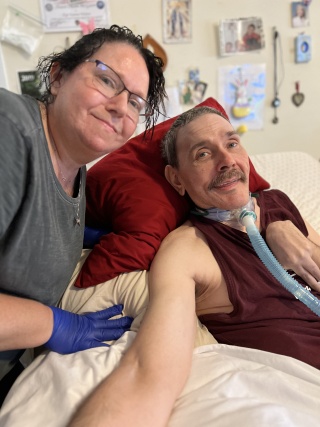
Shaun’s care is a family affair: His sisters, Kelly and Karen, live with him and take turns on day and night shifts.
Shaun suffered a traumatic brain injury almost two decades ago and developed other chronic conditions. He cannot walk or stand and relies on a ventilator, a tracheostomy tube and an ostomy bag.

On a typical day, Kelly — who also is employed by Home Health & Hospice as a caregiver through the Choices for Care program — and her sister handle a wide variety of care including suction; ventilator and ostomy maintenance; medication; dressing changes; washing; and meals.
The high-tech program provides nursing for the McGuires on Tuesdays, Thursdays, Saturdays and Sundays — about 40 hours a week. That respite matters.
“It’s really wonderful. We really appreciate the extra help,” Kelly says. “It gives us time to catch up on things.”
It also helps Shaun stay home.
“He’s more comfortable — he’s around family, people he knows,” Kelly says. “He plays his games; he has handheld games that he likes. And we can celebrate holidays with him.”
Strong Bonds
High-tech nursing looks different for every patient, said Julie Pecor, RN, who has been part of the program for two and a half years.
In addition to daily medical needs, nurses intervene in health issues to prevent hospitalization. They also help with household tasks and spend time with clients reading, talking and playing games. Pecor even accompanies patients to school.
“We’re able to really build strong relationships with the clients. We get to know the patient and the family, what they like and their preferences. We can design individualized care plans for them,” Pecor says.
“It’s very rewarding to have these bonds with them and be part of their health and well-being.”
It’s very rewarding to have these bonds with them and be part of their health and well-being.
Help Wanted
While there’s room to expand high-tech nursing, staffing remains a major obstacle.
Pennington says Home Health & Hospice currently has staff coverage for 60% to 70% of the high-tech nursing hours for which state funding is available. She would like to reach 100%.
“We want to keep this program going, so this can be an option for people,” Pennington says. “Finding the nurses to provide this type of skilled care isn’t always the easiest.”
For the McGuires, the need — and the benefits — are clear.
“We do it for this guy,” Kelly says, smiling at her brother. “We do it all for him.”