From Saranac Lake to Survival
After 47 days in the hospital, Marc Bombard thanks care givers across three hospitals in two states.
“Scraping paint off the side of my shed – that’s all I was doing,” recalls Marc Bombard from his home in Saranac Lake, New York. “And just like that, I felt a pain in my chest. At first, it was just discomfort. But it didn’t go away.”
Concerned, Bombard went to his local emergency department at Adirondack Medical Center – Saranac Lake (AMC). There, clinicians quickly found a ST-elevation myocardial infarction, or STEMI - a heart attack caused by a completely blocked artery. Without blood flow, part of the heart muscle begins to die, making time the most critical factor.
“Surviving a massive heart attack often depends on intense and timely collaboration between several different hospitals – from hospitals like AMC Saranac Lake to secondary and tertiary care centers like our hospitals in Plattsburgh and Burlington,” says Cameron Upchurch, MD, an intensive care and emergency medicine physician who later cared for Bombard at University of Vermont Health – UVM Medical Center. “In Marc’s case, the chain of care worked just as its designed to, beginning with our colleagues at AMC quickly identifying the problem and escalating his care.”
While AMC clinicians administered a clot-busting medication to restore his blood flow, they also arranged an immediate transfer to Champlain Valley Physicians Hospital in Plattsburgh – home to the closest cardiac catheterization lab.
A Descent into Cardiogenic Shock
Arriving in Plattsburgh, Bombard was rushed to the cath lab by Roger Ishac, MD, an interventional cardiologist who treats heart attacks using thin tubes known as catheters. After locating the blockage, Dr. Ishac placed two stents to re-open Bombard’s artery, restoring blood flow. For a time, Bombard stabilized.
But about 10 hours later, his condition began to deteriorate, alarming his nurses. They activated the hospital’s rapid response team – a specialized group of critical care nurses, respiratory therapists and physicians trained to intervene when patients show early signs of sudden deterioration.
“Their instincts were spot on. Marc quickly went into cardiac arrest. By the time I arrived, his nurses had already begun resuscitation – they did everything right.”
Working together, the team defibrillated his heart, placed a breathing tube and started medications to stabilize his blood pressure. They restored a pulse, but his condition worsened. Despite the re-opened artery, his heart could no longer deliver enough blood to his organs – a life-threatening condition known as cardiogenic shock. His kidneys began to fail. His liver function declined.
In the ICU, the team escalated care – returning Bombard to the cath lab to install a temporary pacemaker and balloon pump to support his heart. Even with those interventions, he did not improve.
Giving the Body a Chance to Recover with ECMO
“When someone is in cardiogenic shock, their heart isn’t strong enough to deliver blood and oxygen to the rest of the body – and recovery can be difficult,” says Dr. Upchurch, who also co-directs UVM Medical Center’s ECMO program. ECMO, or extracorporeal membrane oxygenation, is a form of life support that oxygenates and circulates blood outside the body, allowing the heart to rest while maintaining blood flow to vital organs.
“It’s what we turn to when other treatments aren’t enough – when we need to temporarily take over the body’s cardiovascular work to give the body a chance to recover,” he says.
Bombard was transferred to UVM Medical Center, where he was placed on ECMO by Lou Kirk, MD, and Constantino Lovoulos, MD. He would remain on ECMO for five days. Although the support improved his blood flow, the damage from prolonged shock had already taken a toll. His kidneys continued to struggle, even after ECMO was discontinued.
“It became increasingly clear that his recovery would be measured in weeks, not days,” Dr. Upchurch says.
Bowling a 222 Once Again
Nearly seven weeks later, Bombard returned home after 47 days in the hospital, including a lengthy stay in inpatient rehab at UVM Medical Center’s Fanny Allen campus. There, his focus shifted from survival to rebuilding strength, endurance and independence.
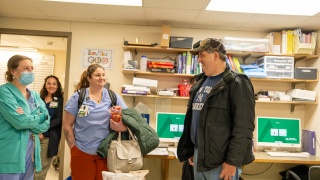
“It was slow going, but everyone in rehab was incredible – not to mention the many people who took care of me when I was unconscious, in the ICU or on ECMO,” Bombard says during a recent visit to Burlington to reunite with members of his care team. “They gave me my life back. From Saranac Lake hospital to the cath lab at CVPH to UVMMC to rehab – I’m alive because of them.”
Today, Bombard is back to his daily routine. He has returned to work part-time as department supervisor of the refrigeration department at Lake Placid’s former Olympic bobsled track. He walks two miles every day and is back in his weekly bowling league, closing in on his personal best – an average of 222.
For the clinicians who cared for him, Bombard’s case reflects both the complexity of cardiac emergencies and the coordination needed to treat them.
“It wasn’t one moment or one intervention that saved his life,” Dr. Upchurch says. “It was recognizing what was happening, getting the right care in place and knowing when to move Marc to the next level. That’s what made the difference.”