Cancer is Stressful, but There’s Help
The Mindfulness-Based Stress Reduction program helps patients manage stress, anxiety and uncertainty.
Melissa Hughes spent much of her life aware that cancer might be in her future.
A family history of cancer put her at greater risk, and that possibility was never far from her mind.
Then, during a routine medical visit, bloodwork revealed abnormal protein levels. A bone marrow biopsy at University of Vermont Cancer Center - FitzPatrick Cancer Treatment Center at Champlain Valley Physicians Hospital confirmed her diagnosis. “To actually sit across from the table and have a doctor say, ‘You have cancer,’ my whole world imploded,” Hughes says.
Hughes underwent treatment and participated in two clinical trials at Dana-Farber Cancer Institute in Boston. The first trial went well, and Hughes was cancer free for two years. But then it returned. A second trial rid her of cancer for a year. Hughes continues treatment and tries to stay as positive as she can, but the stress she experienced is sometimes overwhelming.
Every checkup brought worries. Already living with depression and anxiety, Hughes found herself living in a near-constant state of stress, her mind raging.
“You're always waiting for the other shoe to drop,” she says.
Everything changed when a friend suggested a yoga group at Champlain Valley Physicians Hospital. Hughes initially joined to stay active. Instead, she discovered something she hadn’t realized she needed: connection with others navigating life during and after cancer. When she found people just like her — struggling with the extreme stress surrounding cancer treatment — she quickly realized what she was missing.
Finding support
Hughes learned about the Mindfulness-Based Stress Reduction program for cancer survivors, which was developed three years ago by Charlotte Gosrich, a registered dietitian at FitzPatrick Cancer Treatment Center.
Gosrich saw firsthand how stress affected her patients and wanted to offer them practical tools to help cope. The free, eight-week course, offered each September, teaches evidence-based mindfulness practices designed to reduce stress and build resilience. Participants learn meditation, breathing exercises and body-awareness techniques they can continue using long after treatment ends. Some roll their eyes, she says, but the tools work. First started in the 1970s at the University of Massachusetts Medical Center, more than 700 similar programs are now offered around the world.
Finding her crew
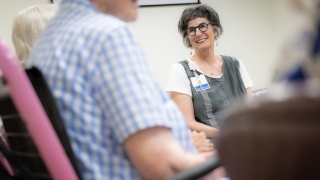
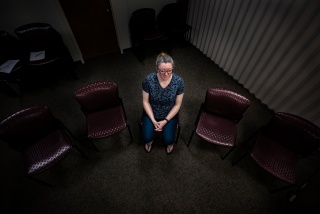
On the second Monday of each month, Gosrich arranges a dozen chairs in a circle in a conference room at Champlain Valley Physicians Hospital. Women trickle in, their faces lighting up as they enter. Charlotte hugs each one.
These women share a common experience: Navigating life during and after cancer. Most of them were part of the first Mindfulness-Based Stress Reduction program. When the eight weeks were up, they asked Gosrich if they could continue to meet. She agreed, and the second Monday meetups have been going ever since.
“We didn’t know each other, but we are all close friends now,” says one woman who wishes to remain anonymous.
Others share that having cancer makes them feel alone. The group helps them not feel that way. They also don’t sit around talking about cancer, they say. It’s not about that.
“We are a support group for whatever comes up,” shares another.
Nine years after her diagnosis, Hughes remains grateful for the support she found through the program. “Cancer is not an easy thing, but this program made it a little easier.”
To learn more about the Mindfulness-Based Stress Reduction Program for cancer survivors, contact Alex Fleming at 518-562-7534 or email afleming2@cvph.org.
To learn more about the women’s mindfulness support group for cancer survivors, contact Charlotte Gosrich at cgosrich@cvph.org.