The Road to Earlier Detection
Mobile outreach expands access to cancer screening, education and expertise into rural communities.
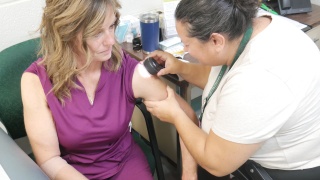
When the UVM Cancer Center's mobile outreach van rolls into a community, it brings something many rural residents struggle to access: direct connection to cancer prevention and screening. Increasingly, it also brings expert, hands-on care.
That's thanks in part to Rochelle “Shelly” Paquette, nurse practitioner, who joined the UVM Cancer Center in August as a community outreach and research advanced practice professional (APP). Her role focuses on bringing cancer prevention and screening services directly to communities across northern New York and Vermont, helping people take preventive action closer to home
It’s work that sits at the intersection of public health and patient care, a perfect fit for Paquette. With a background in community health nursing, she has spent much of her career focused on prevention and early detection. She sees the mobile outreach program as an opportunity to reach people who might otherwise delay care because of distance, scheduling challenges or limited access to specialists.
"People shouldn't have to choose between taking time off work, traveling long distances, or getting preventive care," Paquette says. "Our goal is to bring cancer prevention services to people where they are."
Bringing Cancer Screening Closer to Home
That approach reflects a broader understanding of how cancer outcomes can be improved. While advances in treatment continue to save lives, early detection remains one of the most effective tools for identifying cancer when it is most treatable.
With Paquette on board, the mobile van is expanding beyond education and awareness efforts. At community events, Paquette can answer medical questions, provide individualized guidance and perform community-based skin cancer screenings, offering people an opportunity to discuss concerns in a familiar setting.
If we can help someone understand their risk, complete a screening or catch something earlier than we otherwise would have, that can be lifesaving.
Addressing Skin Cancer Risk in Rural Communities
The service addresses a growing need. Access to dermatology care can be limited in many rural areas, and wait times can be long. At the same time, Vermont ranks third in the nation for the highest rates of melanoma.
"As a primary care provider, I've always looked at people's skin," Paquette says. "Now I'm receiving additional training so we can provide more focused skin cancer screening in the community and help connect people to care when needed."
During a screening, Paquette evaluates suspicious spots, discusses personal and family history, recommends next steps and connects individuals with care when further evaluation is needed.
For some people, those conversations provide reassurance. For others, they may be the first step toward identifying a problem earlier than they otherwise would have.
"Sometimes people come to us worried about a spot they've noticed or something they've been meaning to get checked," Paquette says. "If we can have that conversation, provide guidance and help them take the next step, that's incredibly valuable."
Expanding Cancer Prevention and Early Detection Services
Community-based skin checks are only one part of the broader vision. Paquette is helping develop additional community-based prevention initiatives, including colorectal cancer screening outreach, smoking cessation resources, lung cancer screening education and information about HPV vaccination.
But at its heart, the work is about removing barriers.
"Meeting people where they are is about creating opportunities for conversations that might not otherwise happen. When we're in their community, people are often more comfortable asking questions and talking about their concerns."
Paquette sees the mobile van as a way to build relationships and help people act before cancer becomes a crisis.
"The real opportunity is education and prevention working together," she says. "If we can help someone understand their risk, complete a screening, or catch something earlier than we otherwise would have, that can be lifesaving."
Building the Future of Community Cancer Care
As the program grows, Paquette hopes to continue expanding the services available through the mobile van.
"This is just the beginning," she says. "We're building something that brings cancer prevention and screening closer to the people who need it. That's where we can have the biggest impact."