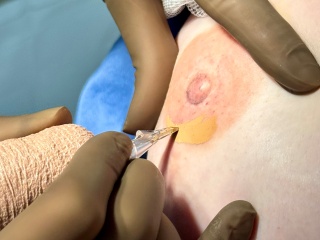
Breast Care
Advanced Screening and Treatment for All Breast Conditions
Breast conditions can be cancerous (malignant) or noncancerous (benign). Effective screening, diagnosis and treatment for breast conditions requires expertise, precision and advanced technology — all of which you’ll find at University of Vermont Health.
We offer a full range of treatment options customized to your needs. Throughout your care, we are by your side with compassion, guidance and encouragement.


Why Choose UVM Health?
We offer:
- Experienced teams: Highly trained physicians, including obstetrician-gynecologists (OB-GYNs), cancer specialists, radiologists and surgeons work together on your behalf. Your care team may also include skilled midwives, advanced practice providers, imaging technologists and nurses.
- Subspecialty care: Our network of providers gives you access to first-class breast care across Vermont and northern New York. If you need more specialized care, we coordinate UVM Health referrals for leading-edge treatments and clinical trials.
- Advanced technology: We offer 3D mammograms for breast cancer screening, which allow for more detailed imaging than 2D mammography. Our dedicated breast MRI scanner offers added precision for people who need additional testing or have an increased risk of breast cancer.
- Personalized approach: We help you understand your condition and treatment options and develop a personalized treatment plan. Out of respect for your time, we schedule multiple appointments on the same day whenever possible.
Diagnosing Breast Conditions
Early detection and diagnosis of cancerous and non-cancerous breast conditions are essential in breast care. We use the latest technology and protocols to improve disease detection.
- Mammogram screening: A mammogram is a special type of X-ray. It is the standard screening tool used to detect breast cancer. At UVM Health, we offer 3D mammography, which produces a more detailed image of your breast than traditional 2D imaging.
- Breast ultrasound: Your provider may recommend a breast ultrasound if you have an abnormal mammogram. It can also be used as an additional screening tool for those with dense breasts. Ultrasound uses sound wave technology to produce detailed images of your breast tissue. Breast ultrasound alone is not considered an effective screening test for breast cancer.
- Breast MRI: A breast MRI is an advanced imaging test designed specifically for the breast. If you are at high risk for breast cancer, your provider may recommend a breast MRI in addition to your annual mammogram. MRIs are also performed if your provider suspects cancer, or to determine the extent of breast cancer after a diagnosis. We are one of a few programs in the region with a dedicated breast MRI scanner.
The current screening guidelines from the U.S. Preventive Services Task Force (USPSTF) recommend mammograms every other year for women between the ages of 40 and 74. If you are at high risk for cancer, your provider may recommend earlier or more frequent breast cancer screening.
Diagnostic imaging tests may rule out cancer. But the only way to know for sure if a suspicious area (such as a lump) is breast cancer is a biopsy. In a breast biopsy, your provider uses a fine or hollow core needle to collect a sample of tissue for laboratory analysis. In some cases, we may implant a small clip at the site of your biopsy to make cancerous or precancerous cells easier to identify during surgery.
Our physicians usually perform biopsies with the help of imaging to guide the needle into the right location. We use two main types of imaging systems for breast biopsies including ultrasound-guided biopsy and mammogram-guided stereotactic biopsy.
Non-Cancerous Breast Conditions
Breast conditions may cause symptoms such as lumps, nipple discharge, pain, redness and swelling. These symptoms can be signs of breast cancer, but more often they are due to a noncancerous breast condition.
Noncancerous breast conditions are common. They may or may not require treatment, depending on your symptoms and whether they increase your risk of developing breast cancer.
Some noncancerous breast conditions include:
Fat necrosis occurs when an injury, surgery or radiation damages breast tissue. As the tissue breaks down, it forms an oil-filled cyst that you can feel as a lump. The skin around the lump may be red or bruised. Oil cysts are not linked to an increased risk of breast cancer.
These hard, round lumps are usually painless. There is a small chance that complex fibroadenomas might increase your risk of breast cancer.
Fibrocystic changes are fibrous tissue or cysts that feel rubbery or lumpy. You may also notice symptoms, such as swelling or tenderness, that change during your menstrual cycle. In general, fibrocystic changes do not affect your chance of breast cancer, but complex cysts may put you at a slightly higher risk.
Hyperplasia is an excess growth of cells in the milk-producing glands or ducts in your breast. You may not feel a lump, but the cells are usually visible on a mammogram. In some cases, there is a small risk the cells could become cancerous.
These benign tumors grow in the milk ducts in your breast and may cause nipple discharge. Having multiple papillomas can slightly increase your breast cancer risk.
In LCIS, the cells that line the milk-producing glands in your breast look like cancer cells, but do not spread to other areas. LCIS does not usually cause symptoms and is not visible on a mammogram. LCIS is usually found during a biopsy for another breast condition. Although LCIS is not cancer, people with LCIS have a higher risk of developing breast cancer.
Mastitis is an infection in your breast that usually occurs when you are breastfeeding. Your breast may be swollen, red and painful and you may develop a fever or headache. There is no association between mastitis and breast cancer risk.
Cancerous Breast Conditions
There are many types of breast cancer, including:
This is type of breast cancer forms in the milk ducts and has not spread to surrounding breast tissue. It may be an early-stage or noninvasive type of breast cancer.
Also called infiltrating breast cancer, this type spreads from its original location to other areas of the breast. Invasive ductal carcinoma and invasive lobular carcinoma are the two most common types of invasive breast cancer.
This is a rare but aggressive type of invasive breast cancer. The cancer cells block the normal drainage of lymph from the breast which causes red, swollen breasts.
This type of breast cancer begins in the milk-producing glands of the breast (lobules) and typically spreads to surrounding tissue. It is also known as invasive lobular carcinoma.
These cancer cells do not have receptors that are typically found in breast cancer, including estrogen receptors, progesterone receptors and HER2 proteins. Some treatments use receptors to destroy cancer cells, so triple-negative breast cancer has fewer treatment options.
Treating Breast Conditions
At UVM Health, we offer a full range of treatments for breast cancer and other breast conditions. Our breast specialists work together to provide the best treatment for your condition and needs:
Our breast surgeons have expertise in removing cancerous and noncancerous breast tissue while preserving as much healthy tissue as possible.
Reconstructive surgery maintains the appearance of your breast after surgery for breast cancer or a noncancerous breast condition. A plastic surgeon may perform reconstructive surgery at the same time as breast surgery.
We offer many types of medications to treat breast cancer. Your care may include chemotherapy or innovative treatments such as targeted therapy. Targeted therapy drugs bind to certain molecules on the surface of cancer cells and attack them.
Our radiation oncologists deliver radiation therapy using precise technologies to destroy cancer cells while avoiding damage to healthy tissue.
Our cancer care team includes social workers who provide emotional support and help you navigate common issues, like changes in insurance. Our other supportive care services include health coaching, support groups and rehabilitation therapy.