The Power of Everyday Movement
From helping patients leave the hospital stronger to reducing fall risk at home, movement can play a powerful role in independence.
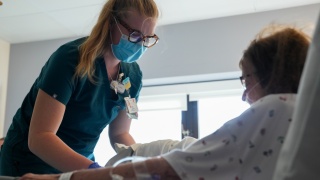
Izzy Paquette has a knack for getting people moving.
As a mobility aide on McClure 6 at University of Vermont Health – UVM Medical Center, she spends her days helping patients get out of bed, walk the hallways and regain the strength and confidence they need to return home.
Sometimes that means a walk. Other times, it’s helping someone into a chair for breakfast or practicing a daily activity they haven’t been able to do since becoming ill.
“Somebody that is really fearful about getting up, I’ll take my time to talk them through what their fears are,” Paquette says. “And when folks need a bit more encouragement, I just keep coming back.”
There’s nothing better than seeing someone realize they can do something they didn’t think was possible. Sometimes it’s just a few steps or getting up on their own, but those little victories add up.
The importance of that work is receiving growing attention in health care. Research has shown that helping hospitalized patients move earlier in their recovery can improve mobility and shorten hospital stays. For patients recovering from illness or injury, getting out of bed and taking a few steps can be an important part of getting back home and back to daily life.
Paquette was the first mobility aide hired at UVM Medical Center as part of a pilot program designed to help hospitalized patients stay active during recovery.
Extended inactivity in the hospital can contribute to muscle weakness, loss of independence and potential medical complications. Helping patients move safely supports recovery and eases the transition home.
“Independence looks different for every person,” she says.
For one patient, success might mean safely transferring from a bed to a wheelchair. For another, it’s walking to the bathroom without help. Paquette remembers patients who regained enough independence to go directly home rather than to additional rehabilitation.
“Anytime somebody says, ‘Oh, I’m so happy I can do this for myself,’ it’s really rewarding,” she says.
Staying Active, Staying Independent
That same focus on independence guides Paula Rupp’s work.
A physical therapist with UVM Health - Home Health & Hospice for 25 years, Rupp helps patients recover from injuries and manage conditions such as diabetes, heart disease and age-related mobility challenges.
“Movement is about much more than exercise. It’s about helping people maintain their independence and do the things that matter most to them,” Rupp says.
Her approach starts not with an exercise routine, but with a conversation. For one person, the goal might be walking safely to the bathroom at night. For another, it’s building stamina for a long-awaited vacation.
From there, Rupp evaluates what’s standing in the way. Muscle weakness? Joint pain? Poor balance? Shortness of breath? The answers shape a personalized plan that might combine strengthening, stretching, walking and balance training.
The work can play a key role in helping older adults remain independent. According to the Centers for Disease Control and Prevention, more than one in four adults age 65 and older falls each year. Improving strength, balance and mobility is one of the most effective ways to reduce fall risk and help people remain safely in their homes.
Seeing patients at home also reveals everyday obstacles, from stairs to getting in and out of bed.
“The important thing is to choose activities that work for you,” Rupp says. “See how your body responds and build up gradually rather than doing too much too soon.”
More than physical health
Movement can also benefit people living with neurological conditions such as Parkinson’s disease, which can affect balance, coordination and mobility.
Sara McMahon, founder of Movement for Parkinson’s, helps people living with the disease experience the physical, mental and social benefits of dance. A partnership between UVM Medical Center’s Frederick C. Binter Center for Parkinson’s Disease & Movement Disorders and the Flynn Theater, the program emphasizes creative movement and self-expression, helping participants discover what their bodies can do rather than what their disease makes difficult."
“You leave Parkinson’s disease behind when you walk in the dance studio. Here you’re just treated as a dancer,” McMahon says. “We focus on potential, not on limitations and the end result is people feeling joyful, connected and part of a community that sees them for who they are, not their diagnosis.”
Every movement matters
Back on McClure 6, Paquette sees that sense of empowerment every day.
Getting out of bed, sitting down for a meal or taking a few steps down the hallway may seem like small accomplishments. For someone recovering from illness, they can mean the difference between depending on others and doing something for themselves.
“There’s nothing better than seeing someone realize they can do something they didn’t think was possible,” Paquette says. “Sometimes it’s just a few steps or getting up on their own, but those little victories add up.”