Three Women, 135 Years of Hospice Care
Nation's longest-serving volunteers say hospice work brings joy.
When people learn about hospice volunteering, they often say something like: "Oh, that must be so sad."
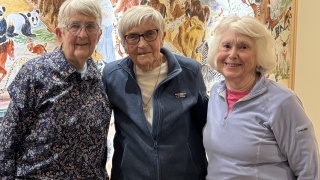
Charlotte Kenney, Jan Watt and Lil Venner have heard it countless times. Their answer surprises people: It's not sad at all.
"What I'm doing is enabling this person to live fully until the very last second," says Kenney. "So, to me, that is not sad."
These women have each provided more than 45 years of hospice volunteer service at University of Vermont Health – Home Health & Hospice, making them some of the country’s longest-serving hospice volunteers. But the story they tell isn’t about sacrifice or sorrow. It’s about presence, connection and the profound privilege of supporting patients and families during one of life’s most vulnerable times.
Before Hospice Was Hospice
In 1980, hospice care in Vermont was just beginning. The modern hospice movement, founded by Dame Cicely Saunders in 1960s London, had only recently reached the US. Medicare created the hospice benefit in 1983, giving people with a terminal illness access to care focused on comfort, dignity and quality of life.
Charlotte Kenney, then in her late 20s, attended one of the first local training sessions. "It was the most amazing educational experience of my life to this day," Kenney says.
Lil Venner was in that same training cohort, and Jan Watt attended the next a few months later. None of them realized they were at the forefront of a movement. They just knew they wanted to help.
Learning to Be Present
Venner's initial motivation was practical: preparing for the inevitable losses as her parents aged. After training, she tried volunteering. Her first patient died before they could meet, so she supported his grieving wife — making sandwiches, listening and learning that "people grieve differently." She's been volunteering ever since.
Jan Watt came to hospice from her work as a cytotechnologist at University of Vermont Health – UVM Medical Center, studying cells to determine if they were malignant. "I often was at the very beginning of when somebody finds out they have a progressive disease," she explains. She wanted to understand how families cope. She later trained as an interfaith chaplain and worked as a hospice chaplain for 10 years, while continuing to volunteer.
Charlotte Kenney realized she'd do "pretty much anything" to help — bedside presence, light housework, preparing meals. She still volunteers Wednesday mornings at McClure Miller Respite House.
What the Work Means for Patients
Over 135 collective years, these women have learned that meaningful moments arise from simply being there. There was the fastidious French woman who asked Venner to dust her chandelier — an activity that took most of a morning — "but it made her day better." There was the man who had grown apples and longed to see the trees bloom one last time. Venner got permission and drove him to the orchard.
You see the world differently when you’re looking at it through the eyes of somebody who may be seeing this particular thing for the last time.
Venner remembers sitting with a Greek woman, watching sunlight transform a pine tree, a cardinal landing on a branch. "These little things become a teaching lesson," she says. "To look for something like that every day to brighten your life."
Annie Meredith-Mitchell, hospice and palliative program director at Home Health & Hospice, sees what sustains volunteers across decades. "What really hits home for me is this concept of our volunteers being in the most present moment," she says. "Everything else falls away, and you're just completely committed to the human being you're with.”
Watt calls it "pure giving." When volunteers sit with a patient or support a family, she says, "they know they don't ever have to repay you. It’s a gift."
A Living Legacy
These three were part of the grassroots effort that helped shape modern hospice care and support the creation of the 1983 Medicare hospice benefit. Today, federal law still requires that volunteers provide at least 5% of hospice care hours — a reminder that community involvement is central to hospice’s mission. Home Health & Hospice's 200 volunteers provide more than 20%.
Kenney is now in her late 70s, Venner and Watt in their late 80s. All three continue to serve as their health allows. Asked what sustains them, they struggle for words.
"I know it’s in my heart, but it’s difficult to put into words," Watt says. "It’s a connection you can't really explain."
An Invitation
For anyone considering hospice volunteering, these three women have a message: Don't let fear hold you back.
"It's not sad," Kenney emphasizes. "It brings joy."
The cardinal, the apple blossoms, the clean chandelier — these aren't sad moments. They're reminders to see the world as a gift.
Home Health & Hospice welcomes volunteers of all ages, from their 20s to past 100. Interested in learning more about hospice volunteer opportunities? Email our volunteer office at voloff@uvmhomehealth.org.