'This is What We’ve Got, Baby'
When an emergency physician became the patient, a skilled team — and a little rock and roll — helped save his life.
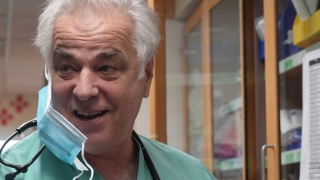
Mike Kiernan was four steps into the emergency department at University of Vermont Health – Porter Medical Center when a distinctly unsettling sensation stopped him in his tracks.
“For some reason, I imagined a young kid digging his fingers into the sand, trying to find a shell, but instead it was the miniscule layers of my aorta that those tiny fingers were dissecting,” recalls Kiernan, an emergency medicine physician of nearly 35 years.
Within minutes, Dr. Kiernan went from physician to patient. Tests at Porter Medical Center quickly revealed an aortic dissection – a tear in his ascending aorta, the main artery carrying oxygen-rich blood from the heart to the rest of the body. Left untreated, it could rupture and prove fatal.
“I've always felt a degree of anger about death, that life is kind of a rip off because you have to die,” recalls Kiernan from his home in Weybridge, Vermont. “But after what I experienced, I’m left feeling nothing but love and gratitude for everyone around me.”
Time Is of the Essence
For aortic dissections, every hour untreated increases the chance of death by 1%.
“If I’d been at home and thought I could manage this with an antacid, this could have ended differently,” says Dr. Kiernan. “I was in a dire situation and needed a cardiothoracic surgeon quickly.”
Across town at Rainbow Pediatrics, Tawnya Kiernan, MD, saw she’d missed a nondescript text and a few calls from her husband. A long-time pediatrician in Middlebury, she reached the hospital just as Mike was being prepped for an emergency transfer to University of Vermont Health – UVM Medical Center — the nearest hospital equipped for complex cardiovascular surgery. As he was whisked north, Tawnya began calling family, including their two adult daughters, Leila and Emily.
In Burlington, Elizabeth Pocock, MD, was mobilizing her team to receive Mike in the ED. A cardiothoracic surgeon who studied at Baylor College of Medicine — one of the nation’s top training centers — Dr. Pocock had already performed more than six aortic dissection surgeries in the previous two months, an unusually high number for rural Vermont and northern New York.
“When Mike arrived, I told him we were exactly the team he needed,” she says. “We were a well-oiled machine and had the operating room ready.”
Their conversation lasted only minutes — Mike’s last memory before cardiac arrest.
Healthier communities. Healthiest lives. Together.
Join us in making a difference!
A Magic Carpet Ride
Resuscitation during an aortic dissection is especially risky — chest compressions can worsen the tear. A cardiac anesthesiologist performed just enough compressions to keep blood flowing to Mike’s brain and other vital organs while Dr. Pocock’s team opened his chest and accessed his heart.
“Our goal was to bring him back and get him on a heart-lung machine to ensure his body received the blood and oxygen it needed,” says Dr. Pocock. “We were fortunate — not many people in that condition come back.”
Mike remembers only one thing: Steppenwolf.
“All I could hear was ‘Magic Carpet Ride’ on repeat,” he says. “Trippy song, great beat — I think it was my brain telling me to hold on tight.”
'We had been through something extraordinary together'
Over the next eight hours, Dr. Pocock’s team restored Mike’s heart function and replaced the damaged section of his aorta with a specially coated fabric sleeve. His prognosis improved.
“It was an extremely tense and emotional time,” says Tawnya. “I’m so grateful to the staff who made us feel welcome and cared for.”
Mike was finally off the ventilator and awake as northern New York and Vermont prepared for the upcoming solar eclipse. Though he wasn’t particularly enthusiastic about it, Emily and Leila insisted he see it. He rolled outside with a group of patients to watch the moon slip across the sun.
“As we sat there in our wheelchairs glinting in the fading light, we all looked at each other,” Mike says. “It was something unspoken: a kind of brotherhood and sisterhood. Like, this is what we’ve got, baby. This is the wonderful world we live in. And we’re still here.”
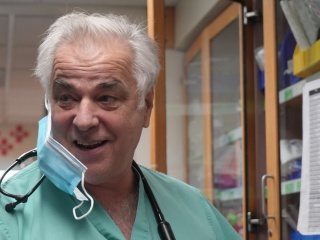
Mike Kiernan, MD, was working his shift in the emergency department of UVM Health – Porter Medical Center when an unsettling sensation stopped him in his tracks. Within minutes, Mike went from physician to patient, the beginning of a medical emergency that would nearly take his life.
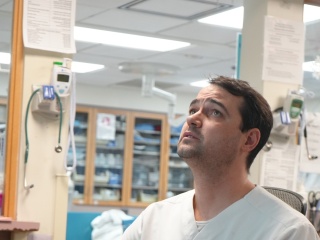
Finn Yarbrough, RN, was by Mike’s side when he received his diagnosis. It was an aortic dissection – a tear in his ascending aorta, the main artery supplying oxygen-rich blood to the body. “With emergencies like aortic dissections, the name of the game is speed. The margins between life and death can be incredibly slim.”
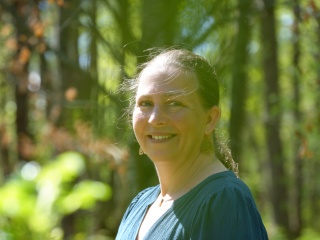
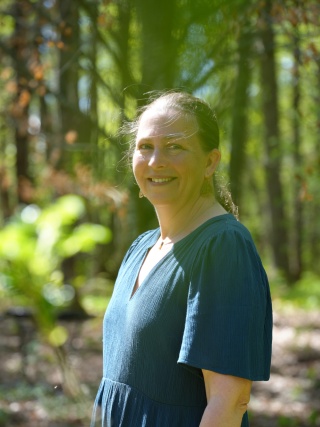
While at work across town at Rainbow Pediatrics, Tawnya Kiernan, MD, saw she’d missed a few calls from her physician husband. She reached the hospital as he was prepped for an emergency transfer to UVM Medical Center.
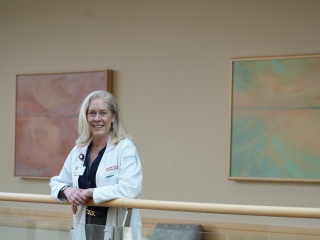
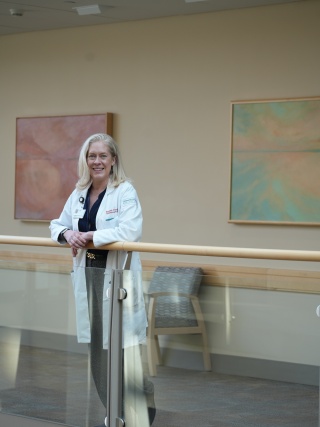
In Burlington, Elizabeth Pocock, MD, readied her team at UVM Medical Center to receive Mike. A new cardiothoracic surgeon, she’d already handled an unusual number of aortic dissections. “We were exactly the team he needed,” she told him.
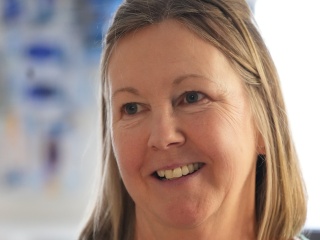
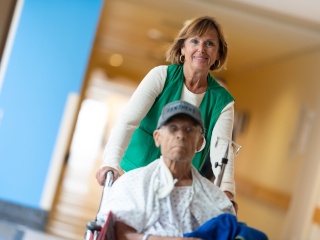
After more than 8 hours of surgery, Mike began his recovery while on a ventilator in the intensive care unit. “Seeing a loved one in intensive care is incredibly hard, so I try to treat each patient like I would my own mother or father,” says Darlene Hester, a long-time nurse in the ICU who cared for Kiernan and his family.
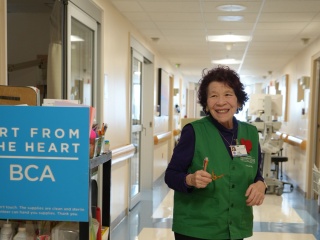
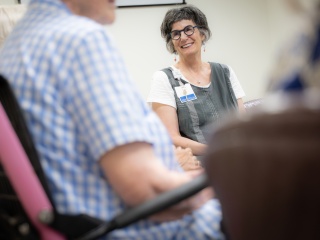
Emily, a long-time artist, found solace and emotional release thanks to volunteers like Lori (above) from Art from the Heart, a volunteer group from Burlington City Arts that visits patients and families with a cart full of art supplies.
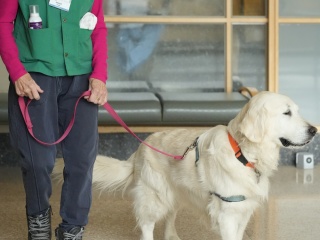
As Mike continued his recovery, Tawnya and her daughters found warmth in the community of caregivers around them, including therapy dog Rocko, an 8-year-old English Cream Golden Retriever, and his owner, Debbie.

“We found love and support from nearly everyone we encountered, even people who had zero idea what was going on with us – it was incredible,” says Mike’s daughter, Emily. “Sometimes you think that the world has become so divided, but in those moments, we found the best of community.”
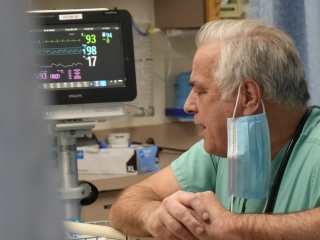
About six months later, Mike returned to work. “I’m so grateful for this place and everyone who supported us,” he says from the Porter Medical Center ED. After about six months, Mike returned to work. “I’m so grateful for this place and everyone who supported us,” he says from the Porter Medical Center ED. “I’m lucky to be part of a system that was ready – and to be back with my team, giving back.”