When Vision Comes Back
Patients often see dramatic improvements after cataract surgery.
“I can’t believe how bright things are; it’s like someone has turned on the lights, and even the colors are brighter.”
Jeffery D. Young, MD, an ophthalmologist with University of Vermont Health, hears reactions like this every day from patients after cataract surgery. "Patients tell me before surgery, ‘I'm kind of bothered by driving. I don't see the signs as well,’” Dr. Young says. “Then, after surgery, they say, ‘I can't believe I was driving with my vision the way it was. I don’t feel like I was safe to drive before surgery.’ That's not uncommon.”
Signs of cataracts vs. normal aging
One reason people delay care is that early cataract symptoms can feel like normal age-related changes. Both present early on with difficulty in low light settings, especially while driving at night. But cataracts often cause additional symptoms, including:
- Glare or halos with oncoming headlights at night
- Headlights that seem unusually bright or evenblinding
- Difficulty reading white text against a black background, such as TV subtitles
- Trouble reading menus in a dimly lit restaurant
Cataracts also do not always progress at a steady pace.
“The change can be slow for many years, and then it can accelerate,” Dr. Young says. People can suddenly feel very uncomfortable driving after dark.”
Common cataract surgery myths
Another reason people wait to seek treatment being seen is concern about the surgery itself. Dr. Young says many fears stem from common misconceptions, including the following:
Myth: Cataract surgery involves scraping something off the eye
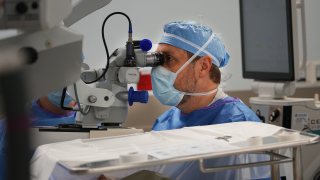
Fact: Cataracts form in the eye’s natural lens. “It's actually a lens inside the eye that needs to be removed and replaced,” Dr. Young says. "We're not scraping anything. We make a small incision to remove the cloudy lens and replace it with a clear artificial lens.”
Myth: Cataract surgery is performed with a laser
Fact: The most common and widely used technique does not require a laser. “As far as I know, there are no places in Vermont using laser-assisted cataract surgery, says Dr. Young. “That was kind of popular probably 10 years ago. The standard way to remove a cataract is to use a tiny ultrasound device that breaks up and removes the clouded lens through the small incision.
Myth: I’ll be fully awake during the surgery
Fact: Some people may request to have no anesthesia at all during their surgery, but most receive medication to help them relax, along with numbing eye drops. “We use anesthesia that keeps you comfortable and relaxed but does not put you to sleep,” Dr. Young says. "Most people don’t really realize what’s going on until we’re done.”
Myth: Cataract surgery means I won’t need glasses anymore
Fact: Cataract surgery can dramatically improve vision, but most people will still need glasses afterward. “Many people will say after their surgery that they’ve never seen this well in their entire life,” Dr. Young says. Our goal is to minimize the amount of prescription that you have afterward, but we often can't eliminate glasses completely.”
Many people will say after their surgery that they’ve never seen this well in their entire life.

Cataract surgery is a common, accessible treatment
Dr. Young says another benefit of cataract surgery is its relatively simple recovery process.
“The follow-up doesn't involve any sort of physical therapy,” Dr. Young says. “It really just involves eyedrops and a few follow-up visits to make sure everything is healing well.”
For patients whose vision is affecting daily activities, cataract surgery can offer a significant improvement in both independence and quality of life.
"If someone’s struggling with vision, especially with things like driving at night, it’s worth getting evaluated,” Young says. “Many people don’t realize how cataracts are affecting them until after they’re treated.”