Baby on Board
As rural hospitals struggle to provide obstetric care, hospitals in our region are teaming up to ensure emergency departments are ready for unexpected births.
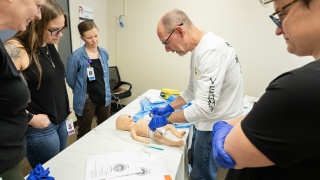
“It’s slippery, right?”
A nurse quickly nods, trying to keep a firm grip on the fast-emerging baby being born in a small conference room, it’s skin slick against their medical-gloved hands making for a surprisingly precarious hold for the uninitiated.
“In real life, the baby would keep coming,” advises Julie Vieth, MD, head of University of Vermont Medical Center’s Emergency Department. She urges the nurse to take care not to drop the baby. “It’s a lot easier than you think,” she jokes to the engaged looks from about a dozen emergency staff in the room. Luckily for everyone, there is no actual birth going on at Grace Cottage today, the only health care resource for miles in the rural town of Townshend in southern Vermont. As Dr. Vieth manipulates the mock baby model, straining to push it through a simulation model of a pelvis and birth canal, the skills being practiced could — maybe one day soon — help the emergency department better deliver a real baby.
That’s because Grace Cottage — a critical care access hospital — is in the middle of a ‘maternity desert’ where access to obstetrics care is declining. After one area hospital to the northeast closed their OB unit, Brattleboro Memorial Hospital is the only nearby option left, about 30 minutes away from Grace Cottage. But depending on where you are coming from, the trip could take closer to an hour or more. Other options are even further away. That leaves a mother in labor with few choices, the best of which is having their baby at Grace Cottage’s Emergency Department.
It’s a choice that more and more pregnant women face both in Vermont, northern New York, and across the country as hospitals — faced with increasing financial and staffing challenges — can no longer offer obstetrics care.
That’s where Dr. Vieth, Laura Mulvey, MD, and a team of emergency experts come in. Thanks to a grant from UVM Larner College of Medicine Simulation Lab, the team from UVM Medical Center is going to places like Grace Cottage and other hospital emergency departments in our region that lack obstetrics resources to train and help better prepare them for the increasing chance of a laboring mother coming to their facility to give birth.
That training, supported by the UVM Health Sciences Simulation Lab, is hands on, covering everything from delivering a baby, how to navigate a breech delivery or other complications, respiratory skills, to even inserting an intraosseous (IO) line to gain emergency access to the baby’s circulatory system, training that can be invaluable during an emergency delivery.
Healthier communities. Healthiest lives. Together.
Join us in making a difference!

Dylan Margolis, AEMT, Emergency Department Tech at UVM Medical Center and a Charlotte Rescue volunteer, knows firsthand just how valuable the training can be.
During a snowstorm in 2024, Margolis and his partner responded to a home and a mother in labor. As they rushed her to nearby UVM Medical Center, time ran out. Margolis was forced to deliver the baby in the back of the ambulance.
“Proper sequencing of care was delivered to both mother and baby, and everything went smoothly,” Margolis recalls. “And that’s thanks to the training I received from Julie and her colleagues.”
At Grace Cottage, after successfully delivering a mock baby and even practicing how to navigate a dangerous complication — the umbilical cord wrapped around the baby’s neck — Jennifer Zwieg, MD, Chief Medical Officer, says she feels more confident that her team is better prepared for just such an emergency.
Practicing so that we get the muscle memory of it is really important.
Dr. Zwieg and her colleagues also practiced installing an intraosseous line or IO into a newborn’s leg, using chicken legs as a practice model. The emergency procedure can be critical in establishing a temporary, direct route into the bone marrow of an infant to rapidly deliver fluids, medications or blood when a conventional intravenous or IV access is not practical or even impossible depending on the circumstances. For infants in cardiac arrest, severe shock or other serious conditions, the procedure is lifesaving.
For Dr. Mulvey, who instructs the procedure, it’s all about better preparing clinicians for what is becoming more and more likely.
“Smaller hospitals are going to be tasked in the Emergency Department with taking care of obstetric and neonate patients,” Dr. Mulvey says. “It’s our goal and our mission to improve the morbidity and mortality for everyone, regardless of where their closest health care institution happens to be.”