Targeting Tumors, Sparing the Patient
The innovative treatment that could make cancer care easier to tolerate.
For decades, chemotherapy has been one of the most effective tools for treating cancer because it poisons cancerous cells and causes them to die. But most chemotherapy drugs travel throughout the whole body, which means they can also affect healthy cells and cause side effects such as fatigue, hair loss, nausea and nerve damage.
Researchers at University of Vermont Cancer Center are exploring a different approach: If we only want to kill the cancerous cells, what happens if chemotherapy were to be injected directly into a tumor?
Through a clinical trial at UVM Cancer Center, this technique is showing promise in lung cancer, where a drug called cisplatin is commonly used. Rather than delivering the medication through an IV and exposing the entire body to the drug, physicians are considering the benefits of injecting cisplatin directly into the tumor itself.
The goal is simple, but powerful: deliver a high dose of cancer-fighting medicine exactly where it's needed while minimizing exposure to the rest of the body.
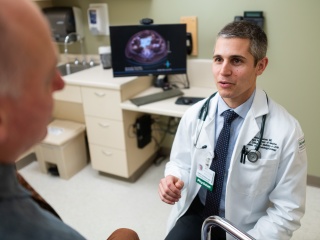
"We're trying to maximize the effect on the tumor and minimize side effects for patients," said Matthew Kinsey, MD, MPH, an interventional pulmonologist and the leader of the research study at UVM Cancer Center.
Why is this approach exciting?
Early results of the UVM Cancer Center clinical trial indicate that directly injecting cisplatin into lung tumors can:
- Cause significant tumor cell death
- Produce very few side effects
- Potentially enhance the body's immune response against cancer
- Improve patients' quality of life during treatment
While Kinsey and his team are continuing to study the approach, the findings point to a future where some cancer treatments could be both more targeted and less burdensome for patients.
We're trying to maximize the effect on the tumor and minimize side effects for patients.
Making treatment more precise and convenient
Having demonstrated efficacy, the next step is making these chemo injections even more accurate.
The same UVM Cancer Center research team recently earned National Cancer Institute funding to develop a clinical trial that uses CT imaging and computational modeling to guide drug delivery within tumors. By mapping each tumor individually, researchers hope to make these treatments more precise, while increasing tumor destruction and further reducing unwanted side effects.
As part of the trial, patients will be diagnosed and treated during the same visit, shortening the time between diagnosis and care. The streamlined approach could be especially valuable for rural patients, who often travel long distances to UVM Cancer Center and would otherwise need multiple appointments for diagnosis and treatment.
Looking ahead
This treatment method is still being studied and is only available to patients with stage IV Non-Small Cell Lung Cancer. However, the research reflects a growing movement in cancer care toward more precise, personalized treatments that target cancer while preserving quality of life.
For patients, that could mean a future where cancer treatment is not only more effective, but also easier to tolerate.
A clinical trial evaluating this approach in patients with Stage IV non-small cell lung cancer is expected to begin enrolling in 2026. Talk to your clinician if you are interested in learning more about this trial.