Dialysis Services at UVM Health
End-stage renal disease (kidney failure) happens when the kidneys no longer filter waste products from blood. Kidney dialysis is a treatment that takes over the work your kidneys used to do.
Dialysis cannot cure kidney disease, but it may improve your quality of life and help you live longer. Kidney experts at University of Vermont Health can help you understand your options so you can decide whether dialysis is right for you.
We offer outpatient dialysis at clinics throughout Vermont and northern New York. You may also be eligible for home dialysis.
Why Choose UVM Health?
As one of the leading kidney care programs in the region, we offer:
- Dedicated kidney experts: Our board-certified nephrologists, together with our nurses, dietitians, pharmacists and kidney care experts, provide advanced care for all kidney disease types. With medications and lifestyle interventions, we help you stay as healthy as possible while on dialysis.
- Compassionate care: Choosing to start dialysis can be difficult for you and your loved ones. We make sure you have the information and resources you need to make this decision and manage this care transition.
- Leading-edge research: As part of a health system anchored by an academic center, our physician-leaders participate in research and innovation to improve patient care. Your provider may talk with you about participating in a clinical trial or research study.
Conditions We Treat
Dialysis is a process that replaces some of your kidney function. It helps keep your body healthy by removing extra fluid and waste products from your blood when your kidneys fail. You may need dialysis if you have:
- Acute kidney injury (acute renal failure): Your kidneys stop functioning suddenly (over days or weeks) due to an injury or condition that damages them
- End-stage renal disease (kidney failure): You have limited or no kidney function, so your kidneys can’t filter waste from your blood
A Kidney Journey Fueled by Hope
A new program for patients with chronic kidney disease helps them understand diet, exercise, medications and dialysis options to stay healthier and avoid crisis. A recent analysis comparing patients in the program with those who were not showed striking results.
Types of Dialysis Services We Offer
Some people with kidney failure choose dialysis while they wait for a donated kidney to become available for transplant. Others choose dialysis instead of a kidney transplant.
UVM Health offers several dialysis types to suit different needs and preferences. Your clinician will help you determine which type of dialysis is right for you.
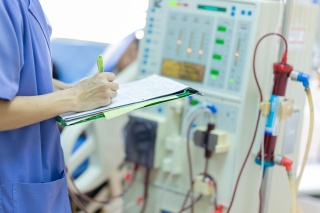
Hemodialysis uses a machine to filter your blood. Most people have hemodialysis treatment in an outpatient dialysis center near home. When you travel, we can help you arrange treatment at a dialysis center near your destination.
In hemodialysis, clinicians need a way to carry blood from your body to the machine and back. Before dialysis starts, we will create a hemodialysis access, usually in your arm, known as an AV (arteriovenous) fistula or AV graft. If an emergency hemodialysis access is needed, your doctor may insert a hemodialysis catheter.
- AV fistula: A surgeon creates this by connecting an artery directly to a vein to allow for adequate blood flow for dialysis treatments
- AV graft: A surgeon creates this by joining an artery and a vein using a short, soft tube. This also allows for adequate blood flow for dialysis treatment.
- Catheter: A flexible tube is inserted into a large vein, usually a vein in the neck. The catheter has two lumens.
- Ellipsys Vascular Access System: Replaces the need for a surgical incision with a single, needle puncture in the arm.
During hemodialysis treatment:
- We insert two needles into the hemodialysis access. Each needle is connected to a soft, flexible tube that goes to the dialysis machine.
- If your hemodialysis access is a catheter, the flexible tubes are connected to the lumens
- Blood leaves your body through one of the flexible tubes
- Blood goes through a filter (dialyzer) in the dialysis machine to remove waste products and excess fluids
- Filtered blood returns to your body through the other flexible tube
At-Home Hemodialysis
We also offer at-home hemodialysis services for eligible patients. To participate in home dialysis, you will need to have a safe place with access to electricity where you can complete your dialysis treatment and a caregiver to support you.
We supply the necessary equipment and train you and your caregiver to manage your treatment. Our team provides 24-hour support if you have questions or concerns about hemodialysis.
Peritoneal dialysis is an at-home treatment that uses your abdominal lining (peritoneum) as a natural filter to remove waste products and extra fluid from your body. You use a special fluid (dialysis solution) to flush your abdomen in a process called an exchange.
Our dialysis experts are available by phone 24 hours a day if you have questions or concerns. We supply all the equipment you need and teach you and your caregiver how to manage your treatment.
There are two types of peritoneal dialysis:
Continuous Ambulatory Peritoneal Dialysis
You complete three to four exchanges each day. Each exchange takes about 30 minutes to complete. The number of exchanges you need depends on whether your kidneys still have some function or don’t function at all.
During continuous ambulatory peritoneal dialysis, you:
- Empty a bag of dialysis solution into your abdomen through a catheter placed in the muscle of the abdominal wall
- Wait a few hours for your peritoneum to filter the solution
- Use the catheter to drain the used solution from your abdomen
- Discard the used solution
Continuous Cycling Peritoneal Dialysis
We provide you with a machine called a cycler. You connect the catheter to the cycler and exchanges happen automatically (typically at night while you are resting or asleep). Typically, you will also have fluid exchanges once or twice during the day, depending on your remaining kidney function.
Our nephrologists offer continuous renal replacement therapy for critically ill people who require intensive care. CRRT uses a machine to continuously remove waste products from blood. Our nephrology team manages the CRRT process to stabilize blood pressure and protect your heart from the stress of dialysis.
What to Expect
Our Chronic Kidney Disease Navigator Program provides care for people living with declining kidney function. We take the time to build a relationship with you as we support you in deciding whether dialysis is right for you.
When you choose dialysis, you work with a team of specialists to manage your health, including:
- Dialysis nurses: Educate you about what dialysis is and how it works. If you’ll be doing dialysis at home, we provide training and support to you and a caregiver. We make sure you have everything you need to feel comfortable with the process.
- Dietitians: Help you understand how what you eat and drink (including salt and water) affects your kidneys and the dialysis process. They may also recommend dietary changes to support successful dialysis treatments and can provide guidance from nutrition services.
- Nephrologists: Monitor your kidney function and any health conditions you have that may affect your kidneys. They make sure you understand your test results and will review your lifestyle and medications to recommend a dialysis type for you.
- Social workers: Dialysis can be challenging, with many details to manage. Social workers provide emotional support and can connect you with resources to make your dialysis treatments as easy as possible.
When you’ve made the decision to begin dialysis, your care team will help you prepare for treatment. They will teach you about the dialysis process and create an access point for the dialysis procedure. The access point — typically in your arm — is where needles will be placed during dialysis.
Dialysis takes time, and you’ll need to plan your activities around your dialysis treatments. Our team will work with you to find a dialysis schedule that accommodates your work and daily activities as much as possible.
Most people don’t feel any discomfort during dialysis. Follow your care team’s instructions about what you should eat and drink. Lifestyle and dietary changes can help make dialysis treatments easier and more effective. Dialysis at home also allows you and your caregivers to be in control of your dialysis treatment schedule.
Locations near you
Share your location to see nearby providers and availability
7 Crest Road
Saint Albans City, VT 05478
189 Prouty Drive
North Country Hospital
Newport, VT 05855
91 Plaza Boulevard
Plattsburgh, NY 12901
20 Fourth Street
Malone, NY 12901
130 Fisher Road
Berlin, VT 05602-8132
111 Colchester Avenue
Main Campus, Shepardson South, Level 4
Burlington, VT 05401
160 Allen Street
Third Floor Dialysis
Rutland, VT 05701
35 Joy Drive
South Burlington, VT 05403
1 South Prospect Street
Rehab, Level 2
Burlington, VT 05401-5505
111 Colchester Avenue
Burlington, VT 05401-1473