
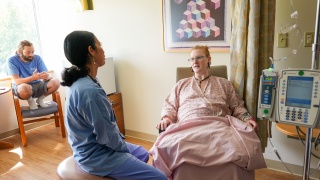
What to expect before, during and after your delivery at Porter Birthing Center.
We are honored that you have entrusted us with your care during this important moment in your life. We look forward to working with you to create a positive experience for you, your family and your new baby.
Our team is here to help you through every step of your birthing journey. With that in mind, we created this guide to inform you about what to expect before, during and after your delivery.
This guide will help you:
- Get ready for your labor and delivery
- Understand what to expect while in the birthing center
- Give you the support you need to have the best possible experience
- Make a plan to go home
- Understand what to expect after you go home
- Answer your questions
How to Prepare for Labor & Delivery
Porter Medical Center offers three different types of expectant parent classes:
- Understanding Birth (this includes a unit tour)
- Understanding Breastfeeding
- Comfort Measures
These classes are offered once per month to prepare you for what to expect towards the end of your pregnancy and beyond. Ask your provider for enrollment information.
Preparing For Your Visit
Our Birthing Center provides essential hygiene items for you and your baby during your stay at the hospital, but there are additional items you may consider bringing.
How to Tell If You're in Labor
If you are feeling contractions, it is important to pay attention to:
- Timing: How frequently do they occur and how long do they last?
- Strength: Are they getting stronger or weaker?
- Location of the pain: Is pain in the front of the belly or starting from the back and moving to the front
- Changes: Do the contractions change with movement or rest?
You likely will not need to go to the hospital until your contractions are 5 minutes apart, last 1 minute each and continue in this pattern for 1 hour.
- 0-6 cm dilated: Known as early labor and can last anywhere from 6-12+ hours. You may feel more comfortable at home during early labor.
- 6-8 cm dilated: Considered active labor and can last anywhere from 3-5+ hours.
- 8-10 cm dilated: Considered transition and can last anywhere from 30 minutes to 2 hours.
- If you think your water has broken (pay attention to the color of the fluid, if the fluid has an odor, how much fluid came out, and what time you noticed the fluid)
- Vomiting with contractions
- Feeling rectal pressure
- Are unable to walk or talk through contractions
- Tested positive for group B strep and need more time at the hospital to receive antibiotics
- Live far away from the hospital
- Changes in your baby’s movement
- Progress quickly (Call 9-1-1 and get into a side-lying position if you are having an extremely fast labor)
During Labor
Once you arrive at the Birthing Center, you will be directed to your room. In most cases this will remain your room throughout your entire stay.
One of the Birthing Center nurses will greet you and begin admission process. This includes review of your current health and medications as well as placing your baby on our monitoring system.
- We can monitor the health and wellbeing of you and your baby by monitoring heart rates and contraction patterns. Two circular monitors will be placed on your belly which allows the information to flow wirelessly to our computer system.
- These monitors may need to be adjusted throughout your labor to provide continuous data.
Partners and support persons can provide essential support throughout labor. The presence of a support person can help to increase emotional support by providing encouraging words, help with position changes, provide a focal point, massage and give reminders for conscious breathing.
You may be induced into labor for a number of reasons. Those may include conditions such as gestational diabetes mellitus, pre-eclampsia, gestational hypertension, chronic hypertension, twin gestation, advanced maternal age, postdates and IVF pregnancies.
- Labor pain is a natural and expected part of the process in order to guide your baby into birthing position.
- Labor pain comes and goes, and there is time to rest between contractions.
- Labor pain stops with the birth of your baby.
- Hydrotherapy: The use of warm water during labor helps to reduce tension in your muscles and body. Tubs or pools deep enough to submerge your belly can help to take weight off and ease contraction and back pain. We have a special tub we can use if you are interested in water birth.
- Medication: You may choose to have an epidural, intrathecal or IV pain medication.
- Epidural anesthesia: A procedure which numbs pain sensations in the lower abdomen, back and perineum.
- You may still feel contraction pressure as well as pressure on the pelvic floor.
- You will not be able to feel sensations in your feet and legs — this means you will be bed bound until feeling returns.
- A urinary catheter will be placed to assist with voiding urine.
- Massage: This is a helpful tool to keep muscles loose and provide distraction for the birthing parent.
- Conscious breathing: Cleansing breaths at the start and end of each contraction can help to ready you for the contraction or the rest period. Be careful not to breathe too rapidly as it can cause lightheadedness and tingling around the mouth.
- Aromatherapy: Diffusing essential oils can help promote a calm and relaxing environment especially when lights are dimmed in the room.
There are different positions which can help ease the pain of the contractions and to promote the baby to descend further into the pelvis:
- Walking or standing
- Sitting or sitting upright
- Hands-and-knees position
- Side-lying position
- Squatting
- Knealing or leaning forward
- Semi-reclining position
- Fetal Scalp Electrode (FSE): Internal monitoring which allows the provider to be able to accurately and continuously monitor the fetal heart rate.
- Intrauterine Pressure Catheter (IUPC): Internal monitoring which helps the provider to accurately measure the intensity and frequency of contractions.
Delivery
When you get close to the delivery of your baby, your care team will perform a huddle at the bedside. This is a safety initiative to make sure everyone involved in your care and your baby’s care is aware of all important information.
The nurse who will be taking care of your baby will come in to introduce themselves and check the equipment needed for your baby. You will hear some beeps and noises coming from the newborn warmer. This is normal and nothing to be concerned about.
Take this time to inform the team of any special requests for the delivery of your baby (e.g. if your partner would like to cut the umbilical cord).
C-section is an operation which is performed to surgically remove your baby from the uterus. This may be clinically necessary due to medical history or changes in condition throughout the labor.
Most of the time anesthesia can be achieved with a spinal or an epidural. Occasionally general anesthesia is required.
A small flexible cup attaches to the top of the baby’s head and suction is applied to allow the provider to gently guide the baby to delivery as you push.
A surgical cut that extends into the perineum to widen the vaginal opening and allow the baby’s head to pass through.
One your baby is delivered they will be placed on your abdomen for skin-to-skin contact. The nurse caring for your baby will come to the bedside to dry your baby and help position them until the umbilical cord is ready to be clamped and cut. The nurse will take this time to assess your baby by listening to their heart and lungs.
If there is no need for closer inspection, your baby will remain skin-to-skin with you for at least two hours. This is a good time to begin breastfeeding if that is how you plan to feed your baby. Skin-to-skin provides the following benefits:
- Increases breastfeeding success
- Promotes parent and baby bonding
- Lowers pain and stress for mom and baby
- Helps keep baby’s blood sugar normal
- Helps baby feel secure and content
- Helps keep mom and baby’s temperature, heart rate and breathing normal
Sometimes babies might need extra help to breathe and transition after delivery. They may need to be carried to the newborn warmer within the room to be examined. Your partner or support person is welcome to follow the baby to the warmer. Your care team will keep you informed of your baby’s condition.
Maternal Care After Delivery
It is common for an injection of Pitocin to be ordered by the provider to be injected into your thigh to help your uterus contract down and help with bleeding.
The placenta is the last thing to be delivered. The provider may require you to push in order to help deliver the placenta.
After the delivery of the placenta, the provider will check your perineum for any tears. These sometimes need to be repaired with stitches. If you require a repair, a numbing medication will be administered prior to the start of the repair.
After delivery, your care team will assess your uterus by doing a fundal massage by pressing firmly in your abdomen to locate the top of the uterus (known as the fundus).
Baby Care After Delivery
- Your baby will be cared for in the same room you are recovering in. The goal of our care team is to keep mom and baby together as much as possible.
- Once baby has spent some quality skin-to-skin time with you, the birthing center nurses will need to examine your baby and gather weight, height and head circumference. This helps your care team to track your baby’s growth pattern over the next several years.
- An ID band will be placed on your baby’s ankle as well as a security device. The security tag will alarm hospital-wide if tampered with or if it becomes too close to any of the exits. This is a safety initiative to prevent your baby from leaving the unit without you.
- Footprints will be collected as a keepsake for you to take home.
- Medications will be administered if you elect that option for your baby.
- Vitamin K is administered to help your baby’s blood to clot and prevent dangerous bleeding. This is given by injection into your baby’s thigh.
- The first of three vaccinations against hepatitis B will be given at this time by injection into your baby’s thigh.
- Erythromycin is an antibiotic ointment that is placed in the baby’s eyes to prevent infections which can sometimes affect vision.
Feeding Your Baby
We are here to support you in the way you choose to nourish your baby. We encourage infant feeding within 1-2 hours after delivery.
Breastfeeding: The Birthing Center nurses are trained to teach breastfeeding and to troubleshoot common problems in breastfeeding. Many nurses are Certified Lactation Counselors.
- Formula feeding: Bottles and formula are available and provided for parents who choose to nourish their baby with formula.
Going Home
- You will receive a booklet and mobile app Understanding Postpartum Health and Baby Care. This has information on how to take care of yourself after surgery. This also has information about how to care for your baby.
- Your provider will make a plan for follow-up appointments at the office.
- Please reach out to your provider if you have any questions before your follow-up appointment.
- Your nurse will schedule you and your baby to return to the Birthing Center 24-48 hours after you are discharged for a Porter Care Connection Visit.
- You will schedule an appointment with your chosen pediatrician for your baby to be seen around 7 days of age.
You are ready to leave the hospital when:
- You are able to eat and drink normally
- Your pain is manageable even with activity
- Your activity level is similar to what you anticipate doing at home
- You are comfortable taking care of yourself and your baby
- Your baby is able to eat effectively
- You have made a plan for birth control with your OB provider