
How One Family Came Together to Respond a Stroke
"Every minute is vital to a person’s chance of recovery."
As Derek “Big D” Sprague sat down in his recliner to watch the Super Bowl half time show, fresh brownie in hand, everything froze. He couldn’t hear. He couldn’t speak. He couldn’t move.
“I remember seeing my family members appear in front of me, looking concerned,” says Sprague, from his home in Moriah, New York. “First my son, Jason, then my wife Lani and granddaughters Mackie and Taylor. But I couldn’t do anything but stare straight forward.”
As Sprague’s world came to a halt, his family was coming to terms with a frightening situation. His granddaughter, Mackie Sprague, was home visiting for the weekend from SUNY Polytechnic Institute, where she’s finishing her education to become a nurse practitioner. As she listened to her grandfather try to talk, she noticed the telltale slurred speech of someone experiencing a stroke. She knew right then and there that the clock was ticking.
“The first thing we learn about strokes is that every minute is vital to a person’s chance of recovery,” says Mackie, who also works as a per diem emergency department nurse at University of Vermont Health – Elizabethtown Community Hospital in Ticonderoga. “Every minute that passes means millions of brain cells damaged by the stroke, so we knew we needed to get him to the hospital right away.”
With Stroke, Time Is of the Essence
Thirty minutes after initially freezing in his recliner, Sprague was in the emergency department of Elizabethtown Community Hospital, laying on a bed with his family and a portable computer monitor at his side. Aware of where he was, he remained unable to speak.
The hospital had been prepared for his arrival thanks to earlier phone calls from the family. Sami Kalman, RN, a nurse in the emergency department, was there to help Sprague inside when he arrived and cared for him throughout the night.
"When someone who is experiencing a stroke arrives at our door, it becomes everyone’s top priority. We know that their recovery depends on how quickly and effectively we work as a team to evaluate, assess and treat people like Derek in the early stages of their stroke," says Kalman.
One of the early priorities was performing a CT scan of Sprague's brain to assess the extent of the damage and better understand his treatment options.
While Sprague’s scan was being performed, Kalman also activated the telestroke alert, a UVM Health capability connecting stroke care across hospitals using televideo technology.
Kicked off across the health system in 2020, telestroke is built on the idea that technology can give people experiencing a stroke a better chance of making a full recovery by quickly connecting them with appropriate specialty care, even if it is based at another location. Telestroke uses mobile telemedicine carts to help neurology specialists get involved early in a stroke patient’s evaluation and work remotely with their emergency department colleagues at other locations to develop a treatment plan.
The program has grown rapidly since its inception. When first launched in 2020-2021, only three hospitals had access to the telestroke capability, but it has since been used more than 500 times by providers from all six of the health system’s hospitals.
“This is a huge asset for our patients, particularly in rural areas,” says Kalman. “It truly elevates the level of care we can offer to our community members.”
Stroke Expertise at the Click of a Button
Seventy miles away, Fatemeh Sobhani, MD, a stroke neurologist based at University of Vermont Medical Center in Burlington, Vermont, received an incoming telestroke alert. Within minutes, she was reviewing Sprague's CT scan and case notes using UVM Health's common electronic health record system. Not long after, she too was observing Sprague using the mobile telemedicine cart and discussing treatment options with his family and medical team in Elizabethtown.
“Derek had a significant blockage in one his brain’s main arteries and was at high risk of lasting damage if he didn’t receive treatment soon,” say Dr. Sobhani. “Thankfully, his family acted quickly – their early recognition of his stroke and fast action meant that we had more treatment options on the table. It’s not an exaggeration to say that every minute counts.”
One of the best options was administering thrombolytics, a medication designed to break up the blood clot restricting the flow of blood and oxygen to the brain. Usable up to four and a half hours after the onset of a stroke, the medication can be highly effective at preventing long-term damage. With Sprague still unable to communicate or move as he was accustomed to, the decision was made to move ahead with the thrombolytic treatment.
“It was an incredible experience to give Derek that medication and have him almost immediately start speaking again,” says Kalman. “It was so beautiful to finally hear his voice and to hear that after everything he’d just been through, he remembered my name.”
"In that moment, it was so good to have my family by my side and supported by a really professional group of doctors and nurses. I’m not sure I’d be here today if it weren’t for the quick thinking of my family and the wonderful care I received from everyone involved," says Sprague.
Know the Signs of Stroke
Several months on from his stroke, Sprague says he’s back to himself again, growing garlic – one of his favorite past times – with his granddaughter Taylor. Celebrating her grandfather’s good fortune, Taylor has been raising money for Stroke Awareness Month from her farm, Hunter Way Farm, where she has raised more than $500 for Elizabethtown Community Hospital in honor of Big D.
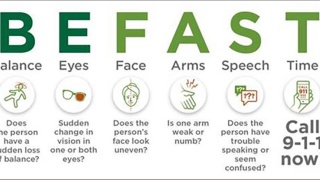
You can learn to recognize the signs and symptoms of stroke: B.E.F.A.S.T (B – balance, E – eyes, F – face drooping, A – arm weakness, S – speech difficulties, T – time to call 9-1-1).