A Second Chance at the Big Life
After a rare brain infection nearly took his life, a Vermont photographer reflects on survival, gratitude and the people who carried him through.
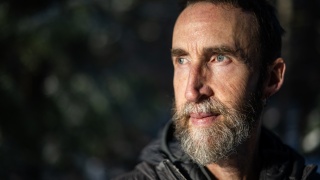
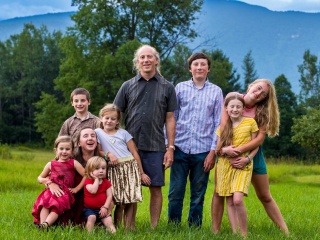
In March 2023, central Vermont landscape photographer and educator Kurt Budliger was living what he calls The Big Life — teaching photo workshops across the globe, skiing deep spring snow at Mad River Glen, and planning the next adventure with his wife, Katy, and their two daughters.
But without warning, things changed. Over the course of just four days, Kurt developed nausea, a fever and a headache he couldn’t shake. When he started making comments that didn’t make sense, Katy called their primary care physician, Jeremiah Eckhaus, MD, at Integrative Family Medicine in Montpelier. He urged them to go to the emergency department for a meningitis screening.
Kurt was reluctant to go to the ED, but at Katy’s insistence, he agreed. From that point on, Kurt remembers nothing. Not his treatment in the ED at University of Vermont Health–Central Vermont Medical Center nor the helicopter transport to University of Vermont Health–UVM Medical Center.
What he does remember begins a week later, waking up in the ICU at UVM Medical Center, surrounded by clinicians and staff who had spent days working to stabilize him. All told, he spent two weeks in the hospital — and survived an illness that is often fatal.
What Kurt had was HSV encephalitis, a rare and dangerous brain infection caused by the common herpes simplex virus. While extremely common, individuals very rarely experience complications from the virus beyond an occasional cold sore. For Kurt, the virus had crossed into his brain.
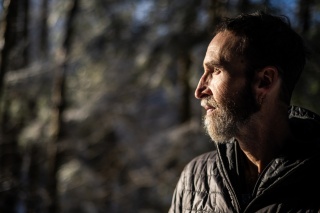
Today, he is back behind the camera, back enjoying the outdoors and, as he puts it, “so lucky to even be sitting here right now.”
Q: What do you remember about getting sick?
A: I remember having conversations with Katy about not feeling great and her being more concerned than I was. And me being sort of a typical guy, kind of like, ‘I'll be fine, just give me a day or two.’ She was concerned enough to reach out to my primary care doc who got the ball rolling with her, encouraging her to take me to the emergency department. During the drive to CVMC, which I don't remember at all, I was apparently not making a lot of sense and slurring my words a little bit. When we got to the hospital, as Katy tells me, I was still in a stubborn mindset and told her to drop me at the door. I made it as far as the check-in and had a seizure right there. When she came in after parking, it was already an all-hands-on-deck situation. I don’t remember any of it.
Q: What do you remember about waking up?
A: Being terrified. I didn’t know where I was. I was on a ventilator and restrained as a precaution, so I wouldn’t pull it out. Doctors and nurses explained where I was, what was going on, that I was okay, and that they’d be taking me off the ventilator after more scans. They told me I had HSV encephalitis. That hit me hard — I knew someone who died from it when I was in high school.
Katy and everyone else pieced the story together for me. I got to see a little video of getting loaded onto the helicopter. I’d never gotten a ride in a helicopter before. And, well…I don't recommend this being the way to do it.
Q: How serious was it?
A: I’ve been told there were days when I had a 50/50 chance of surviving. That was quite something to hear. It took me about a year to feel close to normal. I’m so lucky to even be sitting here right now.
Q: Did the illness leave any lasting effects?
A: The infection was in my right temporal lobe. I’ve been told that about 30% is now scar tissue. If it had been on the left side — the communication epicenter — I might be completely incommunicative. The right side is an emotional epicenter. I’ve always been a deeply feeling person; now it’s like that dial is turned to 11. Joy and awe at 11 are amazing. Stress, anxiety or panic at 11 — not so fun. Being outdoors and physically active helps counteract some of that.
Q: Who and what do you credit for getting through this?
A: The people who were in charge of my care were incredible — the professionalism, kindness and empathy — from the time I was in the ICU to the rest of my hospital stay and the folks who took care of me in the middle of the night.
I credit three things for my survival and recovery. Without science, love and friendship, I wouldn’t be alive today. Being able to spend time in wild places, like we have right here in Vermont, has been the key to my ongoing recovery. I literally feel the therapeutic impact of being outside, especially when exercising.
Q: How did this experience change you?
A: It’s made me much more appreciative of what I have and where I live and who I spend my time with. I think I've always been appreciative and grateful for that. But this has definitely made it a lot more acute.
It also made me double down on what my friend calls “the Big Life.” It’s like carpe diem. For me, that means seizing the day, filling it with the experiences that matter, and not getting distracted by the stuff that isn’t important. The fact that I get a second shot at continuing to live that Big Life and my family doesn’t have to deal with the consequences of me not being here — I’m just eternally grateful for that.
Q: Wow. I keep thinking of how things had to go just right for you.
A: Yeah. There's no question about it. Everything kind of went my way. The first responders and the doctors and nurses kicking into gear and doing what they're trained to do, and my body cooperating to the extent that it could. Being a relatively healthy and fit person going into that event — had that not been the case, the outcome might not have been the same. The luck factor is amazing. No doubt about it. If there's karma out there, I must've done something right.