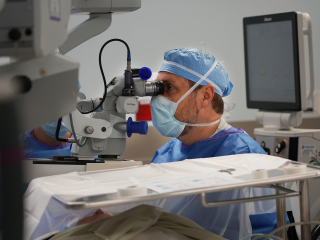
Glaucoma Care at UVM Health
Glaucoma occurs when there’s an injury to the optic nerve, typically from high eye pressure. The optic nerve connects your eye and brain. Damage to this nerve can happen slowly and painlessly over years, eventually causing vision loss.
Glaucoma is usually an age-related eye disease and is the second leading cause of blindness worldwide. Eye exams can detect glaucoma early, allowing you to quickly start vision-saving treatments, such as eyedrops. With treatment, most people with glaucoma maintain excellent vision.

Why Choose UVM Health?
At the University of Vermont Health ophthalmology program, you benefit from advanced glaucoma tests and treatments, delivered with compassion. As one of the only comprehensive ophthalmology programs in the region, we offer:
- Skilled glaucoma specialists: You receive care from board-certified, fellowship-trained eye doctors (ophthalmologists) with deep expertise treating glaucoma. We treat all types of glaucoma, from common to rare.
- Minimally invasive glaucoma surgeries: We offer minimally invasive glaucoma surgeries (MIGS) that use the latest techniques and devices. We’re also able to treat both glaucoma and cataracts in one procedure.
- Care founded in research: As part of an academic medical center, our providers are always current on the latest research to improve the early detection and treatment of glaucoma.
Causes of Glaucoma
Your eyes naturally make a fluid called aqueous humor, which inflates the eyeball to maintain proper shape and size. This fluid drains through channels between your iris (the colored part of your eye) and cornea (the clear tissue that covers your iris and pupil). When something affects this drainage, fluid builds up and eye pressure increases.
Your risk for glaucoma increases as you get older. Other risk factors include:
Types of Glaucoma
Glaucoma typically occurs in both eyes but can also only affect one. There are several types of glaucoma:
- Open-angle glaucoma: A problem with the eye’s drainage channels causes fluid buildup and pressure. This is the most common type of glaucoma.
- Closed-angle glaucoma: Also called narrow-angle or angle-closure glaucoma, this type results from a narrow or closed drainage channel. The blockage can cause a sudden, rapid pressure buildup in the eye. Closed-angle glaucoma is a medical emergency.
- Normal-tension glaucoma: Optic nerve damage occurs with normal eye pressure. Also called low-tension glaucoma, the cause of this type of glaucoma is poorly understood.
- Congenital (pediatric) glaucoma: This condition is present at birth, although symptoms like eye clouding may not be noticeable for a few months. Congenital glaucoma is usually a result of drainage channels not forming as they should during fetal development.
- Neovascular glaucoma: Uncontrolled diabetes can cause abnormal blood vessels to grow inside the eye.
Symptoms of Glaucoma
Many people with glaucoma don’t have pain or other symptoms. Vision changes often aren’t noticeable until the problem becomes severe. Glaucoma tends to affect peripheral vision first (your ability to see things off to the side without turning your head).
Closed-angle glaucoma sometimes occurs suddenly, causing symptoms such as:
- Blurred vision or blind spots
- Eye pain or pressure
- Headaches
- Colored halos around lights
- Nausea and vomiting
- Red eyes
Diagnosing Glaucoma
Your eye doctor will review your medical history and symptoms. You’ll also get several diagnostic tests:
- Perimetry test (visual field testing): Checks your peripheral vision
- Vision tests: Check how clearly you see far and near
- Dilated eye exam: Enables your provider to look inside your eyes and view the optic nerve
- Gonioscopy: Measures the drainage angle
- Pachymetry: Measures corneal thickness
- Retinal imaging tests, such as optical coherence tomography (OCT): View and measure the retina and optic nerve
- Slit lamp examination: Views the optic nerve and drainage channel
- Tonometry: Measures eye pressure
Attentive, educated, professional, caring team approach from start to finish. I so appreciate the care I receive. I was part of the team and decisions about my care.
Glaucoma Treatment
Optic nerve damage from glaucoma is permanent. However, treatments can slow or stop the disease from getting worse. Our ophthalmology program offers a full range of glaucoma treatments.
Prescription eye medications effectively lower eye pressure in most people with glaucoma. They work by reducing the production of fluid inside the eye or by increasing drainage from the eye.
Your provider may use laser eye therapies alone or in combination with eyedrops. We offer:
- Laser trabeculoplasty for open-angle and normal-pressure glaucoma: Your provider uses a laser to improve the flow of fluid out of the eye.
- Laser iridotomy for closed-angle glaucoma: Your provider uses a laser to make a tiny hole in your iris that allows fluid to flow into a drainage channel.
Our team offers several minimally invasive glaucoma surgeries (MIGS). We use tiny surgical instruments and incisions to create new ways for fluid to leave the eye. For people with cataracts, MIGS may take place as part of a combination glaucoma and cataract surgery.
Some people require traditional glaucoma surgeries. We offer:
- Filtration surgery (trabeculectomy): Your provider makes a small drainage channel in the wall of the eye to drain fluid.
- Tube-shunt surgery: Your provider places a tiny tube (shunt) into your eye to drain fluid into a surgically made reservoir. Surrounding blood vessels absorb this fluid.
Locations Near You
Share your location to see nearby providers and availability
462 Shelburne Road
Suite 201
Burlington, VT 05401-6947
58 East View Lane
Berlin, VT 05641-5324
350 Tilley Drive
Suite 101
South Burlington, VT 05403-4539