Cataracts
Cataract Care at UVM Health
Cataracts occur when proteins in the eye’s lens (a clear structure that helps focus light) break down. These proteins create a cloudy film within the lens that impacts vision.
More than half the people over 80 have, or have had, cataracts. Although cataracts are common with age, it’s still distressing when they affect your vision. At University of Vermont Health's ophthalmology program, we specialize in advanced cataract surgeries to improve your vision and your quality of life.

Why Choose UVM Health?
As one of the only comprehensive ophthalmology programs in the region, we offer:
- Experienced cataract specialists: Our board-certified eye surgeons (ophthalmologists) have decades of experience performing cataract surgery. We’re experts at common and complex cataract procedures.
- Advanced lens technology: We use the latest corrective lens technology to ensure your replacement lens helps you see clearly. For complex eye conditions, we use advanced technology to ensure correct lens placement during surgery.
- Complex cataract-glaucoma surgery: Our team works together to perform a combination procedure that treats cataracts and glaucoma at the same time. You benefit from improved vision and fewer surgeries.
Who Is Most Likely to Develop Cataracts?
Anyone can develop cataracts, although they are most common in older adults.
Some infants are born with cataracts (a congenital condition). Children and adults who have diabetes, metabolic disorders or eye injuries are also at risk for cataracts.
Causes of Cataracts
Proteins in your eye lens naturally break down as you get older, causing the lens to cloud. In addition to age, other causes of cataracts include:
- Diabetes
- Excessive alcohol use
- Eye injury or eye surgery
- Family history of cataracts
- Long-term use of corticosteroids
- Radiation therapy to the upper body
- Smoking
- Ultraviolet (UV) light exposure
The team was very thorough and respectful. I really felt I was getting all the background review that was needed to make my time with the provider efficient and effective.
Symptoms of Cataracts
Vision changes from cataracts can occur slowly and may not be noticeable at first. When symptoms occur, you may experience:
- Blurry or cloudy vision
- Changes in how you see colors
- Difficulty seeing at night
- Double vision
- Frequent prescription changes to your eyeglasses or contact lenses
- Halos or glare around light
- Light sensitivity
Diagnosing Cataracts
Your provider will review your medical history and symptoms. You may also get these tests:
- Vision tests: Determine how clearly you can see at varying distances
- Slit lamp examination: Helps your provider detect changes to the eye lens
- Dilated eye exam: Helps your provider look inside your eyes to evaluate the retina and optic nerve
Cataract Treatment
Surgery to remove the clouded lens is the only way to treat cataracts. However, some people don’t need surgery right away — or ever. They may be able to see better with an updated eyeglass or contact lens prescription.
You may need cataract surgery if vision problems are keeping you from doing the things you love. Cataract surgery is very safe, with nine out of 10 people experiencing better vision afterward.
Before surgery, your provider will take complex measurements of your eye in order to choose the proper artificial lens, also called an intraocular lens (IOL) implant. Your provider then orders an implant that fits your eye shape and size.
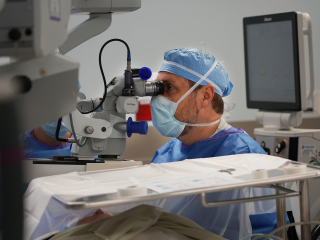
Cataract surgery is an outpatient procedure. You will receive numbing eye drops and a sedative to help you relax. During the procedure, your provider will remove the clouded lens and replace it with the lens implant.
We can use advanced technology during surgery to ensure proper lens placement in patients with unique eye changes from a previous eye procedure, astigmatism or another eye condition. This step may increase the chance of seeing better without corrective lenses (like glasses) after surgery.
Our team also has the expertise to treat glaucoma during cataract surgery. Minimally invasive glaucoma surgery (MIGS) takes place through the same incision made for cataract surgery. A glaucoma specialist treats a blockage or places a shunt (small tube) to drain eye fluid to control the pressure in the eye.
If you choose an implant with vision correction, you may need to wear eyeglasses or contact lenses less often (or not at all) after cataract surgery.
In some instances, months or years after your cataract surgery, your eye’s natural lens capsule, which holds the replacement lens in place, becomes cloudy. This isn’t another cataract. Your provider can perform a capsulotomy laser procedure to make a tiny opening in the capsule to allow light to pass through again. Cataract surgery can also very rarely cause retinal detachment.
Locations Near You
Share your location to see nearby providers and availability
462 Shelburne Road
Suite 201
Burlington, VT 05401-6947
58 East View Lane
Berlin, VT 05641-5324
350 Tilley Drive
Suite 101
South Burlington, VT 05403-4539