Nurse-Led Pilot Program Rethinks Pre-Procedure Fasting
A collaborative effort that brought together frontline nursing staff, interventional cardiologists, anesthesia leaders, quality specialists and operational teams.

For decades, patients awaiting cardiac catheterization followed a familiar routine on the day of their procedure: no food, no drink. An important part of reducing the rare but serious risk of aspiration during sedation, the practice was nevertheless a recipe for patient and family frustration.
“And if delays pushed the procedure into the following day, that cycle of fasting and frustration often repeated itself,” Elissa Johnsen, RN, says. “Over time, a small group of us began to wonder whether there was a better way — to help our patients be more comfortable without compromising the safety of their procedure.”
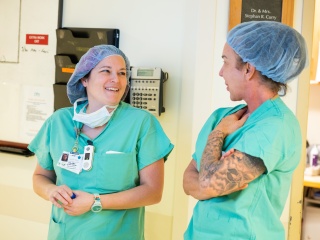
A nurse with University of Vermont Medical Center’s medical ICU (MICU), Johnsen says the answer emerged not from a single department, but through a collaborative effort that brought together frontline nursing staff, interventional cardiologists, anesthesia leaders, quality specialists and operational teams.
Reexamining long-standing fasting practices
Traditionally, patients awaiting cardiac catheterization are placed under strict “NPO” guidelines — nothing by mouth after midnight. But growing evidence from other health systems suggested that carefully selected patients could safely eat and drink much closer to procedure time. The team reviewed that evidence together, balancing emerging research with the realities of patient care.
“We recognized that we were already safely caring for emergency patients who have eaten before arriving in the cath lab,” Johnsen says. “So the conversation became: how do we thoughtfully apply that evidence to our other patients?”
The project was intentionally launched through a quality and patient experience lens, allowing the team to focus first on safety outcomes and operational feasibility. Before the pilot began, the pilot team reviewed roughly 8,500 historical cardiac catheterization cases and found no documented aspiration events — a trend which continues under the pilot program today.
A small group of us began to wonder whether there was a better way — to help our patients be more comfortable without compromising the safety of their procedure.
Room for growth
The pilot ultimately allowed eligible patients on Miller 4, the MICU and surgical ICU to eat a light breakfast until about 8:30 am and continue drinking clear liquids until they were called for their procedure. Patients with higher-risk conditions — including prior aspiration history, delayed gastric emptying or elevated surgical risk — continued following traditional fasting protocols.
In a busy cardiac service, inpatient procedures are often scheduled around urgent cases and outpatient appointments. Delays can leave patients fasting for much of the day, sometimes across multiple days. Clinicians involved in the pilot saw firsthand how hunger, dehydration and frustration affected patients already coping with anxiety and uncertainty surrounding heart procedures.
As the pilot unfolded, nurses reported fewer distressed patients and fewer difficult conversations with families frustrated by delays.
“We will investigate the ability to safely expand this approach to additional patient populations and procedural areas where similar levels of sedation are used,” Johnsen says.