Rebuilding Connection: The MICU Mentorship Program
Mentorship program positively impacts new staff, retention and our overall workplace culture.

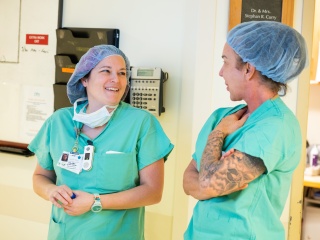
Throughout 2025, University of Vermont Medical Center’s medical ICU (MICU) was hard at work rebuilding their mentor-mentee program. Set aside during the pandemic, the program was reestablished after bedside staff recognized a need to more formally support and guide nurses who are new to the unit. It promotes both one-on-one relationships between seasoned and new staff as well as group activities.
“The program is made up of dedicated nurses that focus on post-orientation support for new graduate nurses or new critical care nurses,” says Nikki Sturges, RN, a member of the MICU’s mentorship committee. “By fostering connection and supporting our new nurses, we aim to strengthen morale and retention and ease the transition from orientation — where new nurses are supervised and given feedback regularly — to being more independent.”
As part of the program, MICU nurses held multiple events throughout the year, including an apple picking outing, ice skating and a holiday party for all MICU staff, their family and friends. They also created a “MICU in the Wild!” display in the break room comprised of photos of staff enjoying life outside of work. These activities allow staff to get to know one another outside of the context of the hospital and the stressors of work, in a safe and neutral space.
By fostering connection and supporting our new nurses, we aim to strengthen morale and retention and ease the transition from orientation — where new nurses are supervised and given feedback regularly — to being more independent.
“There is a shared mutual respect and growing process that goes way beyond what we do at the bedside,” says Teresa Daigle, RN, a member of the MICU’s mentorship committee. “We get to know our new staff as people. We explore their past experiences and build on those experiences to enhance their connection — not only with their peers, but with their patients and the overall hospital community as well.”
Encouraging colleagues to better understand and trust one another is particularly important in an environment like the MICU, where high-stress clinical emergencies are a regular part of the job. The unique challenges that bedside nurses face can create a deep sense of shared understanding and camaraderie.
“The intensive care unit is a stressful place to work at times — it’s a fast-paced, ever-changing environment — and it’s not for everyone,” Daigle says. “However, if a new colleague feels comfortable and supported, it can help them to fully open up to the learning process and really grow as a nurse.”
“As a leader, I see firsthand how our unit’s mentorship program positively impacts new staff, retention and our overall workplace culture,” says Cindy Gebo, MICU nurse manager. “I’m incredibly proud of our team for leading these efforts, and I can’t wait to see how the program grows in the years to come.”