Mitigating Workplace Violence: Building Resilience and Community Connection
"At the end of the day, this work is about helping people feel safer — our staff, our patients and the broader community."
Reducing workplace violence against health care workers rarely comes down to a single program, policy or training session. At University of Vermont Medical Center, nurses and frontline staff are approaching the challenge from multiple directions — preparing staff to safely navigate volatile situations at the bedside, building stronger partnerships with community partners and creating systems that better support both staff and patients before situations escalate.
For Paulina, the hospital’s central programs trainer for workplace violence prevention, the work is deeply personal. Seven years ago, she joined the hospital as a patient safety attendant before later becoming a mental health technician in the emergency department. Both roles periodically exposed her to violence and aggressive behavior from patients and visitors. Rather than pushing her away from the work, the experience strengthened her commitment to it.
“When I first came to the hospital, I felt like a fish out of water,” Paulina says. “But I was drawn to the possibility of helping my colleagues feel empowered in difficult situations — to help them feel more confident and capable of keeping themselves safe.”
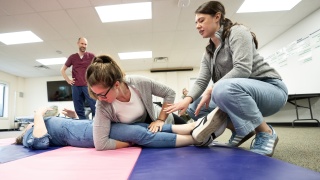
That perspective now shapes the education she helps deliver to staff throughout the organization. Alongsidenursingcolleagues Amanda Young and Heather Tetrault, Paulina facilitates trainings in de-escalation, trauma-informed care, MOAB, Pro-ACT and Code ASSIST — programs designed to improve safety and help staff feel more supported when caring for patients and families in distress.
When I first came to the hospital, I felt like a fish out of water. But I was drawn to the possibility of helping my colleagues feel empowered in difficult situations — to help them feel more confident and capable of keeping themselves safe.
The work extends far beyond the classroom. The team also consults on difficult patient situations across the hospital, responds to behavioral emergencies and supports units navigating high-stress encounters. Those efforts are beginning to show measurable results. According to data recently reviewed by the team, workplace violence incidents at the hospital have declined by 50% in recent years.
“Moving forward, we’re trying to get this education and training to all staff who want it,” Paulina says.
Strengthening community partnerships
Reducing violence against healthcare staff also requires work beyond the walls of the hospital– building relationships with law enforcement, the Department of Mental Health, restorative justice partners, victim advocates and the state’s attorney’s office.
“We can’t operate in silos — we all intersect with the same people, the same crises and the same systems,” says Sam Demers, a nurse with UVM Medical Center’s emergency department. “Maintaining those relationships and keeping communication open is critical to keeping both staff and our patients safe.”
Demers is now the hospital’s point person at a quarterly meeting that brings together stakeholders from the hospital and the community to address many of the overlapping issues connected to violence in healthcare settings. Participants discuss violence trends, clarify policies, recognize successful collaborations and coordinate responses to high-risk situations.
The meetings grew out of concerns following a rise in workplace violence during the pandemic.
“What started as difficult conversations became real partnership-building — all of us sitting at the table working to solve shared problems together,” Demers says. “Even if we’re not launching some major initiative, just having trusted lines of communication changes how we respond when difficult situations arise.”
Taken together, the work reflects a broader shift in how the organization approaches workplace violence prevention — not as a single department’s responsibility, but as an ongoing, collaborative effort rooted in education, communication, compassion and community partnership.
“At the end of the day, this work is about helping people feel safer — our staff, our patients and the broader community,” Demers adds. “That only happens when people trust each other enough to work together.”