The New Face of Emergency Support
Security teams are building a safer environment for patients and caregivers.
Just months after University of Vermont Health-Elizabethtown Community Hospital and its Ticonderoga campus introduced new security measures, staff say they feel more supported — and patients have noticed the difference.
The updates include dedicated overnight security staff, expanded camera coverage and secure badge-only access. Each change was made in close partnership with caregivers who asked for added reassurance during high-stress moments in the emergency department.
“My team was small: two RNs, a provider and a tech on night shift,” says Jamie Rathbun, RN, nurse manager of Elizabethtown Community Hospital’s emergency department. “These changes reassure us that we’re supported. It helps to know there’s someone else to turn to — not just me reacting alone in the moment.”
Building a Culture of Safety
Starting last year, Elizabethtown Community Hospital deployed overnight security (from 6 pm–6 am) at both emergency departments, added secure badge-only access, increased camera coverage and restricted badge access at the back entrance at Elizabethtown — all based on staff input
“Having security on site has been a real relief for our team,” says Rathbun. “On nights when staffing is lean, it makes a difference to know there’s someone available to support us so we can stay focused on our patients.”
“Knowing that trained security professionals are right there with us provides reassurance and consistency we didn’t have before,” adds Tracy Sprague, RN, nurse manager for the emergency department at the Ticonderoga hospital.
In just a few months, the security team has responded to dozens of workplace events. These include:
- A barricaded person
- Assisting law enforcement in apprehending a wanted individual
- Multiple psychiatric emergencies requiring hours of bedside monitoring
- A lockdown after a stabbing victim arrived at Ticonderoga
- Several successful de-escalations of distressed patients and families
- Support for state and local law enforcement investigations
“These are situations that, in the past, clinical staff often managed on their own,” says Brian Stoddard, Security & Emergency Preparedness Manager. “Now, we have trained professionals stepping in and staff are reporting concerns instead of just absorbing them as part of the job. That’s a big cultural shift.”
Compassion and Training in Action
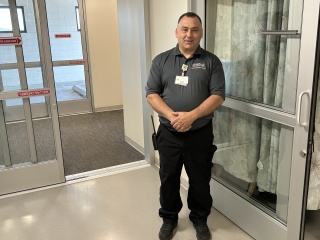
The impact of security often shows in small, human moments. One evening, Carl O’Kusky, a security guard at Elizabethtown Community Hospital, sat with an agitated patient who had grown intimidating. Instead of escalating, he struck up a conversation. Within minutes the patient asked for help. Another officer spent hours with a confused individual, offering reassurance. During a psychiatric emergency, staff and security worked together to keep a woman safe until she could be transferred.
“These moments matter,” says Stoddard. “Security isn’t only about preventing violence. It’s about helping staff and patients feel safe.”
To reinforce that culture, Stoddard introduced MOAB (Management of Aggressive Behavior) training, a trauma-informed program that teaches staff to recognize and defuse high-stress situations. Nearly 50 staff members have completed training, with more sessions planned this fall. For many, the training underscored that aggression is not “part of the job.”
“Whether you’re a nurse, a tech, or security, these tools give confidence in difficult interactions,” Stoddard says. “Staff know they don’t have to handle it alone.”
Trust and Support
More incidents are being reported — not because conditions have worsened, but because staff and security now work together to track and respond to situations that once might have gone unreported. It’s a sign of stronger teamwork and clearer expectations.
“We’re teaching staff it’s okay to say, ‘This isn’t acceptable,’ and then following up,” Stoddard says. “That validation is as important as the security presence itself.”
“If someone makes the workplace feel unsafe, we’ll act,” Rathbun says. “We back our staff every time. That allows them to focus on care.”
Aligning Systemwide Efforts
Elizabethtown Community Hospital’s measures reflect broader UVM Health initiatives. UVM Health-Central Vermont Medical Center installed a metal detector last year that identified thousands of weapons and contraband. UVM Health-UVM Medical Center in Burlington has implemented a clear bag policy and other safeguards.
“We’ve added practical tools, trained our teams, and reinforced compassion,” Stoddard says. “At Elizabethtown Community Hospital, the approach has been simple but effective, and it connects directly to the work happening across UVM Health to make every site a safer place for staff, patients and visitors.”