
UVM Medical Center Helps Pioneer New Heart Valve Replacement Procedure
Patients with previously undertreated heart valve disease now have new, minimally-invasive options for care, close to home.
Burlington, Vt. – Charlene Burroughs can’t remember the last time she didn’t feel short of breath — that is, until recently. Several days after leaving University of Vermont Medical Center — where she became one of the first people in the region to undergo a new heart valve replacement procedure — Burroughs was back home in Crown Point, New York.
“I feel so much better than I did just a week ago,” said the 82-year-old, who has a form of heart valve disease known as tricuspid valve regurgitation. “I used to be tired all the time, but I’m finally starting to have some energy again.”
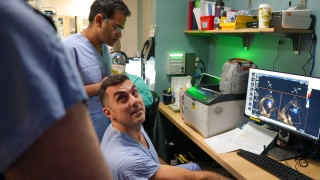
Burroughs’ change of health is due to her recent transcatheter tricuspid valve replacement (TTVR) procedure, performed by interventional cardiologists Tanush Gupta, MD, and Rony Lahoud, MD, and advanced imaging cardiologists Kramer Wahlberg, MD, and Trace Barrett, MD, at UVM Medical Center. The team used thin, flexible tubes known as catheters to steer an artificial tricuspid valve into position in Burroughs’ heart, replacing the faulty original.
“TTVR is opening up an entirely new path to better health for people with tricuspid valve regurgitation” says Dr. Gupta. “For people like Charlene, who has severe tricuspid regurgitation, this procedure can lead to dramatic improvements in their quality of life.”
‘Forgotten Valve’ No More
Last year, for the first time, Drs. Gupta and Lahoud, along with Dr. Barrett and Peter VanBuren, MD, began performing tricuspid valve procedures to repair a patient’s tricuspid valve. This summer, the structural heart team at UVM Medical Center launched the TTVR program — further solidifying the hospital as a leading center of expertise in heart valve treatment and innovation.
“Pushing the boundaries of advanced cardiac care requires true collaboration between different specialties, including interventional cardiology, advanced cardiac imaging, cardiac anesthesia and cardiothoracic surgery, among others,” says Dr. Lahoud. “We are fortunate to have the prerequisite talent right here in Vermont to continue to grow a high-quality structural cardiology program.”
About 1.6 million Americans have tricuspid valve regurgitation, a condition where a faulty tricuspid valve allows blood to leak backward into the heart, putting it under intense strain. The condition can cause fatigue, swelling in the legs, shortness of breath, irregular heart rhythms and, in severe cases, heart failure.
Nicknamed the “forgotten valve”, the tricuspid valve has historically been under-treated because of its more complex anatomy and its location deep inside the heart’s right chamber, making it more difficult for surgeons to access. In the past, many with severe tricuspid valve regurgitation were faced with a choice between living with the debilitating effects of the condition and open-heart surgery.
Patients who undergo TTVR, are typically back home within a few days of their procedure, and most start seeing improvements in their condition right away.
“I definitely recommend this procedure to anyone who needs it,” says Burroughs. “I won’t lie, I was a little nervous about it all — but it’s been absolutely worth it — so much better than I thought.”
A National Leader in Heart Valve Treatment
Using a catheter to repair or replace a valve is a fairly recent breakthrough in the world of interventional cardiology. Early on, it was a procedure reserved largely for patients with a faulty aortic valve, the most commonly treated heart valve disease, who were also higher risk candidates for surgery.
Clinicians at UVM Medical Center completed just over 20 transcatheter aortic valve replacements (TAVR) in 2012, the first year the procedure was offered. Today, the team averages more than 350 each year, with growing volumes, as additional treatments — like TTVR — provide safer, less invasive options to treat other heart valves.
“Early on, we saw the potential for transcatheter valve replacements to be transformative for our most critically ill patients — and we’re thrilled to see a whole new collection of our community members benefit from this treatment,” says Harold Dauerman, MD, director of interventional cardiology and structural heart interventions for UVM Health. “The advancements we’re seeing now in our treatment of valvular disease is the product of 20 years of careful research, team development and investment in the advanced technologies needed to offer this high-quality care in a timely manner.”
University of Vermont Health – UVM Medical Center
111 Colchester Avenue
Burlington, VT 05401
###
About University of Vermont Medical Center
University of Vermont Health – UVM Medical Center is a 499-bed tertiary care regional referral center and Level I Trauma Center, providing advanced, specialized care to more than 1 million residents across Vermont and northern New York. Home to University of Vermont Cancer Center and University of Vermont Children’s Hospital, we serve as both a high-acuity referral hospital and a community hospital for approximately 150,000 residents in Chittenden and Grand Isle counties. As part of a rural academic health system, we are driving innovation in rural health care delivery, education and research in close partnership with The Robert Larner, M.D. College of Medicine and the College of Nursing and Health Sciences at the University of Vermont. Together, we are tackling health care’s toughest challenges while strengthening our communities — addressing critical needs that impact access, affordability and health outcomes.
About University of Vermont Health
University of Vermont Health is a rural academic health system with more than 100 years of service to small towns and cities across Vermont and northern New York. We are deeply committed to reimagining rural health in ways that will benefit our communities for generations to come and keep exceptional care close to home. Our system includes an academic medical center, two community hospitals, three critical access hospitals, a children’s hospital, a cancer center, a multispecialty medical group, 154 outpatient sites and care beyond the hospital through home health, hospice care, four skilled nursing facilities and other support services. Our care is informed by an essential partnership with University of Vermont’s The Robert Larner, M.D. College of Medicine and College of Nursing and Health Sciences. Together, as a health system serving a rural area, we are tackling health care’s biggest challenges — supporting the communities we serve and investing in our employees by addressing housing affordability, quality childcare and professional development needs. To learn more, visit us at www.uvmhealth.org