
About Our Program
Serving our community.
We are committed to training and growing the next generation of paramedics in northern New York and Vermont.
Mission
The Paramedic Education Program’s purpose is to prepare entry level paramedics in career and volunteer positions to be capable of providing comprehensive, compassionate and efficient emergency care, in northern New York and Vermont areas.
Vision
To be the premier provider of paramedic education in northern New York and Vermont, modeling the way for other rural education programs.
Values
Teamwork, Quality, Compassion, Respect, Communication, Accountability, Service and Trust.
These values are expected of all faculty and students representing the program.
Goal
To prepare competent entry level paramedics who are competent in the cognitive (knowledge), psychomotor (skills), and affective (behavior) learning domains to enter the profession.
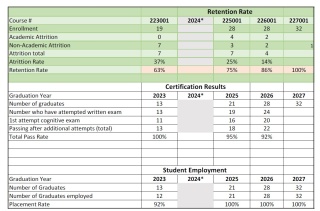
CAAHEP Accredited Paramedic Programs and CoAEMSP Letter of Review (LoR) Programs track and report outcome measures annually to the Committee on Accreditation for the Emergency Medical Services Professions (CoAEMSP).
The most current CoAEMSP Annual Report was for the calendar year 2024.
Statement on Diversity and Inclusion
Elizabethtown Community Hospital is committed to fostering an inclusive learning environment that facilitates and supports student success. We believe that our campus is enriched and strengthened by diversity along a range of different dimensions. The various perspectives that stem from the multifaceted identities and experiences of our campus community are invaluable assets in the classroom that bring complexity and nuance to the process of critical thinking as well as intellectual and personal growth. We are all vital in promoting and cultivating a culture of respect that honors and affirms the rights, safety, dignity, and worth of every individual.
Harassment and Hazing Policy
The Paramedic Education Program has a zero-tolerance policy against harassment. We take this very seriously. We are committed to providing an educational environment free from discrimination and harassment. Harassment of any individual based on sex, race, religion, national origin, handicap, age, or sexual orientation is forbidden. Anyone who believes they have been subjected to such harassment should immediately report it through the complaint procedure outlined in this manual.
Sexual Harassment Policy
The Paramedic Education Program has a zero-tolerance policy against sexual harassment. We take this very seriously. Anyone who believes they have been subjected to such harassment should immediately report it through the complaint procedure outlined in this manual. Sexual Harassment may include:
- Verbal harassment or abuse
- Subtle pressure for sexual activities
- Touching, patting or pinching
- Leering at a person’s body
- Requests for sexual favors accompanied by implied or overt threats concerning one’s job, performance evaluation, promotion, or course grades
Sexual harassment, or harassment of any kind, will not be tolerated. Individuals accused of harassing behavior will be subject to disciplinary action including employment termination or enrollment.
FERPA
The Family Educational Rights and Privacy Act (FERPA) is a federal law that protects the privacy of student education records. The law applies to all schools that receive funds under an applicable program of the U.S. Department of Education. FERPA gives parents certain rights with respect to their children's education records. These rights transfer to the student when he or she reaches the age of 18 or attends a school beyond the high school level. Students to whom the rights have transferred are "eligible students."
HIPAA
HIPAA stands for the Health Insurance Portability and Accountability Act of 1996 (Public Law 104-191). HIPAA calls for changes in healthcare transactions and administrative information systems. All healthcare organizations and healthcare personnel are required to follow the HIPAA laws. All students must always comply with HIPAA regulations and follow these regulations during all Clinical or Field internship rotations.
ADA
It is the policy of the Paramedic Education Program and the EMS Programs to provide equal opportunities, free of discrimination, for its students and employees. Accordingly, the Paramedic Education Program applies the Americans with Disabilities Act of 1990 (ADA) and section 504 of the Rehabilitation Act of 1973 to all its policies, procedures, or practices.
Attendance Policy
Experience demonstrates that regular attendance enhances academic success. Students are expected to attend each meeting of their registered courses, whether taught online or in the traditional classroom setting. Participation in classroom activities such as lectures, films, guest speakers, class discussions, labs, group activities, and online work contributes to student success in college level coursework.
It is the student’s responsibility to inform the instructor of an anticipated absence ahead of time. The instructor may require students to document their absence. Students are responsible for making up any missed work, as allowed by the instructor’s syllabus and/or course outline.
Non-Discrimination Policy
The Paramedic Education Program in accordance with Title VII of the Civil Rights Act of 1964 as amended and all other New York State and Federal Laws, does not discriminate on the basis of race, color, creed, national origin, religion, sex, marital status, age, sexual orientation, or handicap in any of its policies, procedures, or practices.
Grading Policy
The Paramedic Education Program will publish a syllabus for each course in which the specifics for that class are detailed. In general, the program requires a minimum of C or 73% in all courses to complete the semesters work. Failure of any class, in any semester, will result in the student's failure of the paramedic program, and the student would be required to start the program over in its entirety.
Students will have regular and unrestricted access to grades via the Learning Management System (LMS). Students will be able to track clinical progress freely. Students are responsible for their academic progress. Staff will make efforts to keep grades updated and accurate. Any discrepancy should be directed to the lead instructor of the course.
Grading Scale
| A | 93 – 100 | C | 73 – 76.99 |
| A- | 90 - 92.99 | C- | 70 – 72.99 |
| B+ | 87 - 89.99 | D+ | 67 – 69.99 |
| B | 83 – 86.99 | D | 63 – 66.99 |
| B- | 80 – 82.99 | D- | 60 – 62.99 |
| C+ | 77 – 79.99 | F | Less than 59.99 |
Student advisement and counseling is a continual process of communication and information exchange between instructors, preceptors, and students. This relationship is based on a shared responsibility of the instructor/preceptor as the facilitator and student as the active participant and decision-maker.
Responsibilities for advisement and counseling:
- Help students define & develop realistic educational career plans.
- Monitor progress towards educational/career goals.
- Reinforce and discuss links between instructional program and occupation/career.
- Interpret and provide rationale for policies, procedures and requirements.
- Refer students when academic, attitudinal, attendance, or other personal problems require intervention by other professional.
- Maintain and advisement record on each student.
- Develop and foster a positive relationship with the student.
The National Academic Advising Association has developed a set of goals for academic advisors. They include:
- Assist students in self-understanding and self-acceptance (values, abilities, aptitudes, interests, and limitations).
- Assist students in considering their life goals by relating their interests, skills, abilities and values to careers.
- Assist students in developing an educational plan consistent with life goals and objectives.
- Assist students in developing decision making skills.
- Refer students to other institutional or community support services.
- Assist students in evaluating or reevaluating their progress towards established goals and educational plans.