Pediatric Ophthalmology
Pediatric Ophthalmology at Golisano Children's Hospital
Children develop vision in the first eight to ten years of life. Just like they need to learn how to walk and talk, they need to learn how to see. Misaligned eyes, drooping lids, cataracts or weak eye muscles can disrupt how a child’s sight develops. Treating vision problems during childhood can help people see better as adults.
The pediatric ophthalmology program at Golisano Children’s Hospital at University of Vermont Health offers leading-edge, compassionate care for children with common and complex eye disorders. We work to protect and improve your child’s vision so they can have the clearest, best possible vision in adulthood.
Why Choose Golisano Children's Hospital?
We offer:
- Skilled pediatric eye experts: Your child receives care from board-certified, fellowship-trained eye doctors (ophthalmologists), orthoptists and pediatric ophthalmic technicians with advanced training in pediatric eye disorders. When needed, our team partners with other specialists at Golisano Children’s Hospital to provide complete care.
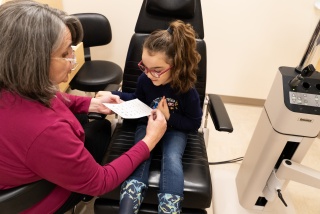
- Child-friendly care: We’re experts at working with active kids and kids who have developmental or physical challenges. We get accurate eye exam results quickly and know how to keep your child comfortable during treatments.
- Advanced pediatric eye treatments: We offer the latest nonsurgical and surgical treatments for common and complex pediatric eye disorders. We’re one of a few programs in the region with the expertise to perform strabismus surgery to correct eye misalignment in children.
Pediatric Ophthalmology Services
As part of UVM Health and Golisano Children’s Hospital, our pediatric ophthalmology program provides comprehensive services.
Your family benefits from:
- Pediatric social workers: We coordinate with social workers in our primary care locations to provide support and resources to children with complex vision needs, including vision loss
- A dedicated orthoptist: An advanced practice professional who works with pediatric ophthalmologists to manage problems with eye alignment and movement
Conditions We Treat
We offer treatments for all types of childhood vision problems, including:
- Accommodative esotropia: One or both eyes cross inward while trying to focus causing farsightedness and requiring glasses to keep eyes straight and see clearly
- Amblyopia: One eye is stronger and works better than the other
- Congenital glaucoma: High eye (intraocular) pressure that’s present at birth
- Eye injuries: Punctures, scratches and blows to the eye from accidents, foreign objects and other injuries
- Inherited (genetic) eye disorders: Conditions that affect members of the same family, such as nystagmus (rapid, involuntary eye movements) and albinism (lack of pigment color in the iris)
- Nasolacrimal duct obstruction: A blocked tear duct
- Ptosis (drooping eyelid): One or both upper eyelids droop or hang over the eyes
- Strabismus: Misaligned eyes point in different directions, either crossed or wandering out
- Pediatric cataracts: A cloudy film on the eye lens that may be present at birth or occur from inherited gene changes or infections
- Retinopathy of prematurity: Premature babies or those whose birth weight is less than three pounds are at increased risk for abnormal retina development, eye misalignment and needing strong eyeglasses
- Refractive errors: Nearsightedness (myopia), farsightedness (hyperopia) and astigmatism can occur when light rays are not focusing well on the back of the eye (retina)
Treatments and Diagnostics
Our pediatric ophthalmologists customize a treatment plan based on your child’s unique diagnosis and eye anatomy.
Your child may get these diagnostic tests:
- Vision tests: Determine how clearly your child sees at varying distances
- Dilated eye exam: Helps your child’s provider view internal eye structures
- Slit lamp examination: Helps your child’s provider identify changes to the lenses of your child’s eyes
- Cycloplegic refraction: Measures the eyeglasses prescription after dilation drops
Treatments vary depending on the eye condition and other factors. We offer a full range of nonsurgical treatments, including:
- Eye medications
- Eye patches
- Laser eye treatments
- Prescription eyeglasses, including corrective prism eyeglasses
When nonsurgical treatments don’t help or aren’t an option, we have the expertise to perform eye surgery to improve your child’s vision. Different types of eye surgery can treat:
- Nasolacrimal duct obstruction
- Ptosis
- Strabismus
Child Life Program
Medical care can be overwhelming for children. Our Child Life Specialists help your child cope with stress, prepare for procedures and understand their care. These highly trained specialists offer your family support as you navigate our health system.

Patient Resources
- American Association for Pediatric Ophthalmology and Strabismus: Helping resources and glossary of terms about eye disorders in children.
- The Vermont Association for the Blind and Visually Impaired: VABVI provides direct services, consultation services, assessments, and hands-on training for children (ages 0– 22), teaching them skills that are unique to children with visual impairments.
Locations near you
Share your location to see nearby providers and availability
462 Shelburne Road
Suite 201
Burlington, VT 05401-6947