Electrical Cardioversion for a Fast Heart Rate
Treatment Overview
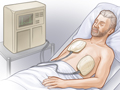
Electrical cardioversion is a procedure in which a brief electric shock is given to the heart to reset the heart rhythm back to its normal, regular pattern (normal sinus rhythm). The shock is given through patches applied to the outside of the chest wall. In some situations an external defibrillator, which has paddles, might be used.
Usually, the person is sedated. If the person is conscious, medicine is given to control pain and to cause the person to relax to the point of being nearly unconscious during the procedure.
What To Expect
After cardioversion, you will be monitored to make sure that you have a stable heart rhythm.
You might take a medicine (called a blood thinner) that prevents blood clots before and after the procedure. This medicine lowers your risk of a stroke.
Other medicines to help prevent the return of heart rhythm problems (antiarrhythmics) also may be given before and after the procedure.
Why It Is Done
Cardioversion is used:
- As a non-emergency procedure to stop a heart rhythm problem that has not stopped on its own. These heart problems include atrial fibrillation, atrial flutter, and supraventricular tachycardia.
- As an emergency procedure to stop a fast heart rate that is causing low blood pressure or severe symptoms. These heart rate problems include atrial fibrillation, atrial flutter, supraventricular tachycardia, and ventricular tachycardia.
How Well It Works
Most people who receive cardioversion return to normal sinus rhythm immediately after the procedure. But how long a person's heart stays in this normal rhythm can depend on the type of heart rhythm problem, how long it has lasted, and if you have other health problems.footnote 1, footnote 2
Risks
Risks of the procedure include the following:
- A blood clot may become dislodged from the heart and cause a stroke. Your doctor will try to decrease this risk by using anticoagulants or other measures.
- The procedure may not work. You may need another cardioversion or other treatment.
- Antiarrhythmic medicines used before and after the procedure or even the procedure itself may cause a life-threatening irregular heartbeat.
- You could have a reaction to the medicine given to you before the procedure. But harmful reactions are rare.
- You can get a small area of burn on your skin where the patches are placed.
References
Citations
- Page RL, et al. (2015). 2015 ACC/AHA/HRS guideline for the management of adult patients with supraventricular tachycardia: A report of the American College of Cardiology/American Heart Association Task Force on Clinical Practice Guidelines and the Heart Rhythm Society. Circulation. DOI: 10.1161/CIR.0000000000000311. Accessed September 23, 2015.
- Al-Khatib SM, et al. (2017). 2017 AHA/ACC/HRS guideline for management of patients with ventricular arrhythmias and the prevention of sudden cardiac death. Circulation, published online October 30, 2017. DOI: 10.1161/CIR.0000000000000549. Accessed November 6, 2017.
Credits
Current as of: October 2, 2025
Author: Ignite Healthwise, LLC Staff
Clinical Review Board
All Ignite Healthwise, LLC education is reviewed by a team that includes physicians, nurses, advanced practitioners, registered dieticians, and other healthcare professionals.
Current as of: October 2, 2025
Author: Ignite Healthwise, LLC Staff
Clinical Review Board
All Ignite Healthwise, LLC education is reviewed by a team that includes physicians, nurses, advanced practitioners, registered dieticians, and other healthcare professionals.