Shock Wave Lithotripsy
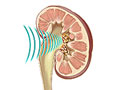
Shock wave lithotripsy is a way to treat kidney stones without surgery. It is also called extracorporeal shock wave lithotripsy, or ESWL. This treatment uses sound waves to break kidney stones into tiny pieces. These pieces can then pass out of the body in the urine.
You may get medicine to make you relaxed and help with pain or discomfort.
You will lie on a table. The lithotripsy machine directs sound waves at your stone through a cushion.
The doctor may use a small, flexible tube called a stent. The stent will let the stone pass more easily.
Most people are at the doctor's office or clinic for about 2 hours. You can go back to your normal routine right away.
Most stones pass within 24 hours after the procedure. But it can take as long as several weeks. If you have a large stone, you may need to come back for several treatments. In some cases lithotripsy does not break up the stones. Surgery may be needed to remove them.
What To Expect
Shock wave lithotripsy is usually an outpatient procedure. You go home after the treatment and don't have to spend a night in the hospital.
After the procedure, stone fragments usually pass in the urine for a few days and cause mild pain. If you have a larger stone, you may need more shock wave therapy or other treatments.
Why It Is Done
Shock wave lithotripsy may be used on a person who has a kidney stone that is causing pain or blocking the urine flow. Stones that are between 4 mm (0.16 in.) and 2 cm (0.8 in.) in diameter are most likely to be treated with shock wave lithotripsy.
The procedure may work best for kidney stones in the kidney or in the part of the ureter close to the kidney. Your surgeon may try to push the stone back into the kidney with a small tool (ureteroscope) and then use the procedure.
Shock wave lithotripsy is usually not used if you:
- Are pregnant. The sound waves and X-rays may be harmful to the fetus.
- Have a bleeding disorder.
- Have a kidney infection, urinary tract infection, or kidney cancer.
- Have kidneys with abnormal structure or function.
- Have obesity.
How Well It Works
Shock wave treatment works for most people who have small to medium kidney stones—either in the kidney or in the ureter. How well it works depends on a few things, such as the size and location of the stone.
Risks
Risks of shock wave treatment include:
- Pain caused by the passage of stone fragments.
- Blocked urine flow because of stone fragments getting stuck in the urinary tract. The fragments may then need to be removed with a ureteroscope.
- Urinary tract infection.
- Bleeding around the outside of the kidney.
Current as of: April 9, 2025
Author: Ignite Healthwise, LLC Staff
Clinical Review Board
All Ignite Healthwise, LLC education is reviewed by a team that includes physicians, nurses, advanced practitioners, registered dieticians, and other healthcare professionals.