
Recovering from Surgery, Every Move Matters
How home health physical therapists help clients regain strength and independence.
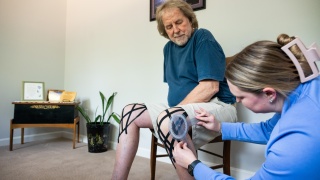
They say movement is medicine, but what does that really mean? For Jim Walbridge, it meant getting back on his feet as quickly as possible.
Walbridge recently underwent double knee replacement surgery. Before he could return home from the hospital, he had to be able to climb five stairs and come back down. There are 17 stairs leading to his apartment door.
“When I got home, I basically couldn’t walk around, couldn’t move,” says Walbridge.
That’s why his surgeon referred him to UVM Health - Home Health & Hospice for in-home physical therapy. Walbridge was familiar with the process after watching his wife recover from shoulder replacement surgery.
“After her procedure, the surgeon told me, ‘If she doesn’t do the physical therapy, she will lose the use of her right arm,’” says Walbridge.
Turning Goals into Progress
Every patient who receives in-home physical therapy has unique needs, but the most important piece of any recovery is movement.
“Some people just want to walk to the bathroom at night without falling,” explains Paula Rupp, PT. “Others might be looking to go on a cruise in a few months. Once we understand their goal, we develop a plan based on their current deficits and strengths.”
Walbridge’s surgeon, like many others, emphasized the importance of recovering a range of motion in his knees, looking for 90 degrees by four weeks. So, Walbridge and his therapist prioritized functional activities, such as getting up from a chair.
Keeping patients motivated is a big part of the treatment plan. Physical therapists are constantly working to understand what might get in the way of progress.
“I always try to figure out my patient’s limiting factor. Is it that you're breathing hard? Are your knees hurting? It could be a number of things,” says Rupp. “We focus on the biggest barriers first. Then we reassess and adjust. Little by little, the range of what they can accomplish begins to grow.”
Small Adjustments, Big Results
For Walbridge, it all came down to “squeezing the cheeks.”
“I was trying to put weight on my legs, struggling to go that next step and my therapist says, ‘squeeze those cheeks!’” says Walbridge. “What a difference! I would not have thought to engage my glutes to stand up.”
As for staying motivated, Walbridge keeps the focus on gratitude. “You have to remember that they are here to help you and what they’re doing for you will make a big difference,” he says.