Login to MyChart

Help us elevate and expand our care, make breakthroughs in biomedical science and improve community health and wellness.

Donate today

Search UVM Health

Healthwise

Breathing Problems: Helping a Child Use a Metered-Dose Inhaler and Mask Spacer

A metered-dose inhaler (MDI) with a regular spacer has a mouthpiece that some younger children find hard to use. But a mask spacer that fits snugly over the mouth and nose can make the inhaler easier to use.

Using an MDI with a mask spacer:

  • Helps get the right amount of medicine into your child's lungs.
  • Can help keep your child's asthma symptoms under control and allow your child to live an active life.
  • May prevent or reduce side effects of the medicine.
  • May let your child use less medicine than is found in a pill but get the same effect.
  • May result in the medicine working faster than a pill form.

How to help your child use the inhaler

Before using a metered-dose inhaler (MDI) with a mask spacer:

  • Talk with your doctor about how to use it. Be sure your child uses it just as the doctor instructed.
  • If your child is old enough, teach them how to check to make sure it's the right medicine. If your child uses several inhalers, label each one. Then make sure your child knows what medicine to use at what time. You might try using colored stickers to teach the difference between medicines.
  • Keep track of how many puffs of medicine are in the inhaler. This may help you keep from running out of medicine. Refill the prescription before the medicine runs out. Ask your doctor or pharmacist to show you how to keep track of how much medicine is left.
  • If your child is using corticosteroids, have your child rinse their mouth with water after use.

Using a metered-dose inhaler with a mask spacer

Follow these steps for using a metered-dose inhaler with a mask spacer.
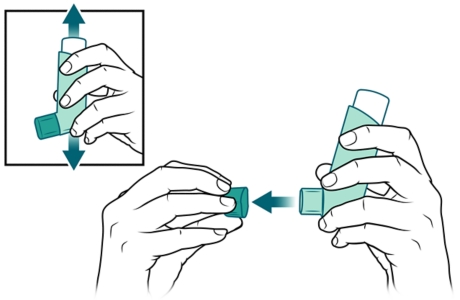
Person shaking inhaler and removing cap.

1. Shake the inhaler for 5 seconds. Remove the cap.
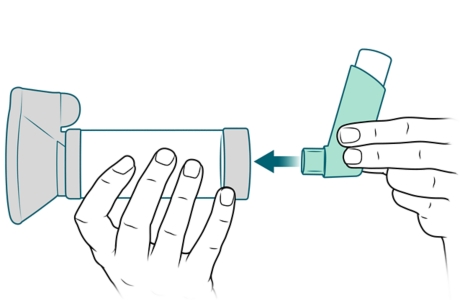
Mouthpiece of inhaler being placed into spacer.

2. Hold the inhaler upright with the mouthpiece at the bottom. Then place the mouthpiece of the inhaler into the spacer.
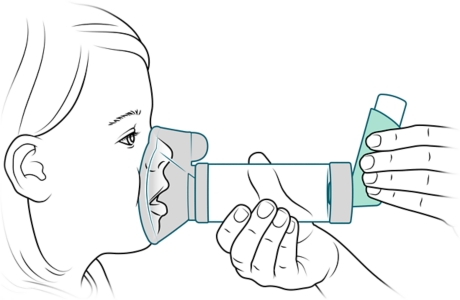
Mask spacer placed securely over child's mouth and nose.

3. Place the mask spacer securely over your child's mouth and nose. Be sure to get a good seal. The mask must fit snugly, with no gaps between the mask and the skin.
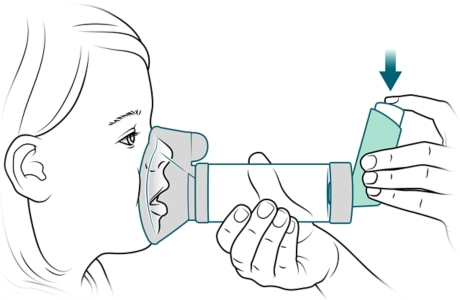
Person pressing down on inhaler to spray medicine into spacer.

4. With the mask spacer in place, press down on the inhaler to spray 1 puff of medicine into the spacer.
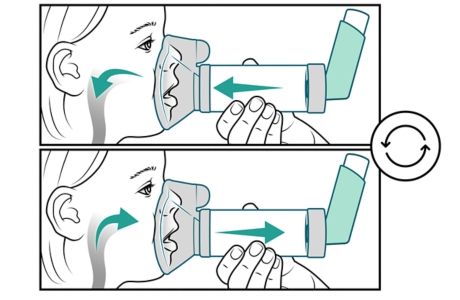
Child breathing in and breathing out through mask spacer.

5. Keep the mask spacer in place, and have your child breathe in and out normally for 5 or 6 breaths.
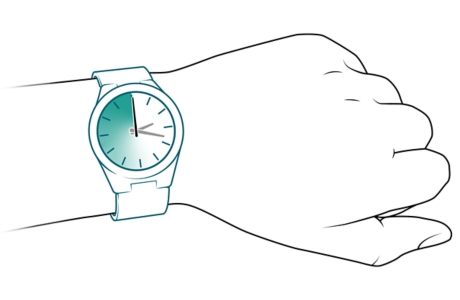
Wristwatch with shading to show elapsed time.

6. If your child needs another puff of medicine, wait 1 minute between puffs.
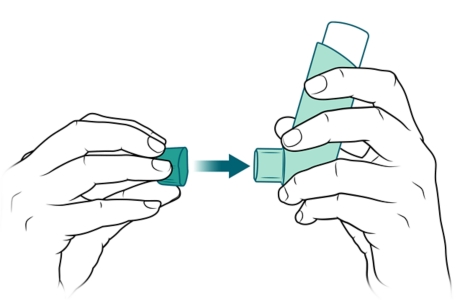
Person putting cap on inhaler.

7. Replace the cap on the inhaler.

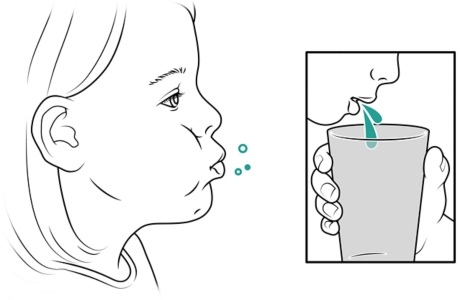
Child rinsing mouth and spitting into cup.

8. Have your child rinse their mouth with water if the inhaler has corticosteroids, such as fluticasone. (Controller inhalers usually have corticosteroids.) Do not let your child swallow the water.

Related Information

Credits

Current as of: September 29, 2025

Author: Ignite Healthwise, LLC Staff

Clinical Review Board
All Ignite Healthwise, LLC education is reviewed by a team that includes physicians, nurses, advanced practitioners, registered dieticians, and other healthcare professionals.


This information does not replace the advice of a doctor. Ignite Healthwise, LLC, disclaims any warranty or liability for your use of this information. Your use of this information means that you agree to the Terms of Use. Learn how we develop our content.

© 2024-2026 Ignite Healthwise, LLC.

This information does not replace the advice of a doctor. Ignite Healthwise, LLC, disclaims any warranty or liability for your use of this information. Your use of this information means that you agree to the Terms of Use. Learn how we develop our content.

844-UVM-HEALTH

Give to a Healthier Future

Help us elevate and expand our care, make breakthroughs in biomedical science and improve community health and wellness.

Healthier communities. Healthiest lives. Together.

University of Vermont Medical Center

111 Colchester Ave
Burlington, VT 05401

802-847-0000

Golisano Children's Hospital

111 Colchester Ave
Burlington, VT 05401

802-847-0000

Central Vermont Medical Center

130 Fisher Road
Berlin, VT 05602

802-371-4100

Champlain Valley Physicians Hospital

75 Beekman Street
Plattsburgh, NY 12901

518-561-2000

Elizabethtown Community Hospital

75 Park Street
Elizabethtown, NY 12932

518-873-6377

Alice Hyde Medical Center

133 Park Street
Malone, NY 12953

518-483-3000

Porter Medical Center

115 Porter Drive
Middlebury, VT 05753

802-388-4701

Home Health & Hospice

1110 Prim Road
Colchester, VT 05446

802-658-1900

© 2026 University of Vermont Health
Jump back to top