
Health Library
BRCA gene test
You must carefully read the "Consumer Information Use and Disclaimer" below in order to understand and correctly use this information
What is a BRCA gene test?
This is a test to check for "variants," or changes, in these 2 genes:
BRCA1
BRCA2
Certain variants in these genes increase a person's risk of breast and ovarian cancer. They also increase the risk of other hereditary cancers, like pancreatic and prostate cancer. "Hereditary" means related to genes that can be passed down from parent to child.
Often, BRCA1 and BRCA2 are checked as part of a group of tests called a "panel." This looks for variants in a group of genes that can affect a person's risk of cancer.
Why might I get a BRCA gene test?
You might choose to have this test if you:
Have 1 or more relatives with certain types of cancer – If a relative has cancer, you might want to know if you have a gene variant that increases your risk, too. Then, you can decide whether to take steps to lower your risk.
Already have cancer – Knowing about your genes might help you decide about treatment. You might also want this information to share with relatives, such as siblings and children.
If you are thinking about genetic testing, talk to your doctor or nurse. They might also suggest talking with a specialist, such as a genetic counselor.
How do I prepare for a BRCA gene test?
You need to give a sample of saliva, a swab from inside your cheek, or blood. The sample is then sent to a lab for testing.
Before giving the sample:
Do not eat or drink anything for at least 30 minutes.
Do not smoke for at least 30 minutes.
What happens during a BRCA gene test?
If your saliva is being tested:
You will spit into a small container. It will be marked so you know how much saliva is needed.
If a sample from inside your cheek is being tested:
The doctor or nurse will use a special swab to collect some cells. It will not hurt.
Your doctor or nurse might order a saliva or cheek swab test kit to be sent to your home. When you receive the kit, follow the instructions to collect a sample and mail it to a lab for testing.
If your blood is being tested:
You will get a "blood draw." Your doctor or nurse will tell you where to go for this. For the blood draw, a needle is used to take a small amount of blood from your arm (figure 1). Collecting the blood only takes a few minutes. The blood is then tested in a lab.
It might help to wear a short-sleeve shirt to your blood draw appointment. This makes it easier for the person drawing your blood to get to your arm.
Tell the person who takes your blood:
If you take "blood thinner" medicines or have a bleeding problem – They will make sure your bleeding is under control before you leave.
If you have a latex allergy – Some of the supplies used for blood draws might contain latex.
If you have a preferred arm to use
Most of the time, getting blood taken does not cause problems. You might have a little soreness or bruising where the needle went in.
What do my results mean?
Your doctor or nurse will tell you when to expect your results, and will contact you with the results. Or if you use an online "patient portal," you might get an alert there when your results are ready.
The results can be:
Positive – This means you do have a variant in the BRCA1 or BRCA2 gene.
Negative – This means you do not have a variant in the BRCA1 or BRCA2 gene.
Sometimes, a test comes back with the result "variant of uncertain significance." This means it's not known if the change is related to a disease or might increase your risk of disease.
If your results are positive, your doctor or a genetic counselor will talk to you about what this means. It can be scary to learn you have a variant that might increase your risk of cancer. But there are ways to lower the chances you will get cancer and ways to find it early.
It's also important to tell your relatives about your test results, if possible. If your results were positive, your close adult relatives might want to get tested, too.
Images
figure 1: Blood draw
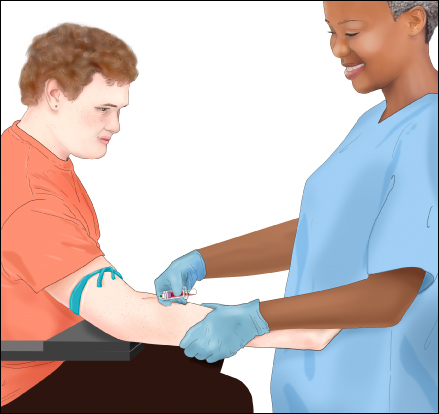
During a blood draw, a small sample of your blood is taken from a vein in your arm.
First, the person taking your blood cleans your skin. Then, they put a band called a "tourniquet" around your upper arm. This makes it easier to find your vein. Next, they insert a needle with a tube attached to it into your vein. Blood collects in the tube. They remove the tourniquet and needle, put pressure on the area with a piece of gauze, and bandage your arm.
Graphic 138490 Version 3.0
Give to a Healthier Future
Help us elevate and expand our care, make breakthroughs in biomedical science and improve community health and wellness.
Healthier communities. Healthiest lives. Together.