
Health Library
Diabetes and heart disease
You must carefully read the "Consumer Information Use and Disclaimer" below in order to understand and correctly use this information
Can diabetes cause heart disease?
Yes. If you have diabetes, you have an increased risk of getting "coronary artery disease." This is when the arteries that supply blood to the heart get clogged with fatty deposits (figure 1).
Coronary artery disease increases your risk for serious problems like heart attack and stroke. But there are things you can do to help lower this risk.
Is there a test for heart disease?
If you have diabetes, your doctor will do regular blood tests to check your:
Blood sugar
Blood pressure
Cholesterol levels
They might also do other tests to check your heart. These include:
Electrocardiogram, or "ECG" – This measures the electrical activity in your heart.
Stress test, also called an exercise test – You run or walk on a treadmill while you also have an ECG. Physical activity increases the heart's need for blood. This test helps doctors see if your heart is getting enough blood. If you cannot walk or run, your doctor might give you a medicine to make your heart pump faster instead.
Echocardiogram – This uses sound waves to create images of your heart as it beats.
What can I do on my own to protect my heart?
If you have diabetes, there are things you can do to lower your risk of heart disease. If you already have heart disease, these things can also help keep it from getting worse.
You should:
Manage your blood sugar – This includes taking your diabetes medicines as instructed.
Manage your blood pressure and cholesterol – High blood pressure or cholesterol increases your risk of heart attack or stroke. Improving your diet and exercise habits can help with this, too. Your doctor might also prescribe medicines.
Take aspirin, if your doctor recommends it – If you have coronary artery disease or had a heart attack or stroke, your doctor might prescribe daily low-dose aspirin. Some people also take another medicine to help prevent blood clots.
Make lifestyle changes, like:
Eating healthy food
Getting regular physical activity
Quitting smoking, if you smoke
Losing weight, if you have excess body weight
Limiting alcohol
Getting enough sleep
What other treatment might I have?
If medicines alone do not work, some people with heart disease also need a procedure. Examples include:
Stenting – The doctor puts a thin plastic tube into the blocked artery, and uses a tiny balloon to open the blockage. Then, they place a tiny mesh tube called a "stent" inside the artery to hold it open. The doctor prescribes medicines to prevent blood clots from forming in the stent.
Bypass surgery – This is also called "coronary artery bypass grafting," or "CABG." The doctor removes a piece of blood vessel from another part of the body. Then, they reattach the blood vessel above and below the clogged area. This re-routes blood around the clog and lets it get to the part of the heart that was not getting blood.
If you need treatment for heart disease, your doctor will talk to you about your options.
When should I call the doctor?
Call for emergency help right away (in the US and Canada, call 9-1-1) if you think you might be having a heart attack:
Symptoms of a heart attack usually include feeling pressure, discomfort, or pain in the chest, arms, back, or jaw.
Some people have trouble breathing, sweat, feel dizzy, or pass out.
Symptoms usually get worse with activity, like walking up stairs.
If you are used to having symptoms only with activity, call for help if you start having them when you are not active.
Images
figure 1: Coronary heart disease
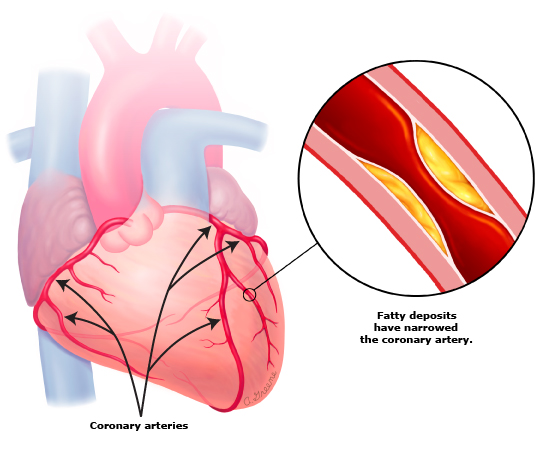
In people with coronary heart disease, the coronary arteries get clogged with fatty deposits called plaques.
Graphic 61785 Version 6.0
Give to a Healthier Future
Help us elevate and expand our care, make breakthroughs in biomedical science and improve community health and wellness.
Healthier communities. Healthiest lives. Together.