Login to MyChart

Help us elevate and expand our care, make breakthroughs in biomedical science and improve community health and wellness.

Donate today

Search UVM Health

Health Library

Asthma action plan for adults


You must carefully read the "Consumer Information Use and Disclaimer" below in order to understand and correctly use this information

What is an asthma action plan?

This is a list of instructions that tell you:

  • What medicines to take at home each day, if any

  • What symptoms to watch for

  • What other medicines to take if your symptoms get worse

  • When to call the doctor or get emergency help

Most action plans have 3 categories:

  • Green means you are breathing well and your asthma symptoms are under control.

  • Yellow means you are having some symptoms and need to use your asthma medicines to get asthma back under control.

  • Red means the symptoms are severe and you need medical help.

How do I create an asthma action plan?

You and your doctor will work together to make one. The figure is an example of an action plan (form 1).

Your doctor can help you fill in the information specific to you. For example, some people take daily "controller" medicines. Others do not take a daily medicine, and only need treatment if they have an asthma attack.

As part of the action plan, you might need to use a device called a "peak flow meter." You use this at home to see how well your lungs are working. The doctor will show you how to use it.

Your action plan might change over time.

How do I use an asthma action plan?

It's important to be familiar with your action plan. Review it before you need it, so you are prepared if you have an asthma attack. You might want to keep extra copies of the action plan so you can find it easily when you need it.

Ask your doctor or nurse if there is anything in the action plan you do not understand.

Images

form 1: Asthma action plan (adult)
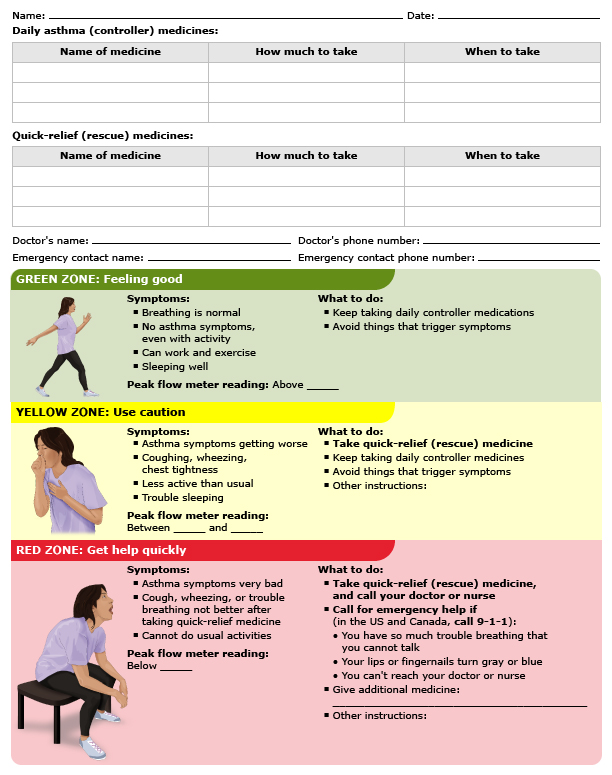
This is a form titled Asthma action plan (adult). Legend: An asthma action plan is a list of instructions that tell you:      What medicines to take at home each day, if any     What symptoms to watch for     What other medicines to take if your symptoms get worse     When to call the doctor or get emergency help

An asthma action plan is a list of instructions that tell you:

  • What medicines to take at home each day, if any

  • What symptoms to watch for

  • What other medicines to take if your symptoms get worse

  • When to call the doctor or get emergency help

Graphic 140838 Version 2.0


Consumer Information Use and Disclaimer: Disclaimer: This generalized information is a limited summary of diagnosis, treatment, and/or medication information. It is not meant to be comprehensive and should be used as a tool to help the user understand and/or assess potential diagnostic and treatment options. It does NOT include all information about conditions, treatments, medications, side effects, or risks that may apply to a specific patient. It is not intended to be medical advice or a substitute for the medical advice, diagnosis, or treatment of a health care provider based on the health care provider's examination and assessment of a patient's specific and unique circumstances. Patients must speak with a health care provider for complete information about their health, medical questions, and treatment options, including any risks or benefits regarding use of medications. This information does not endorse any treatments or medications as safe, effective, or approved for treating a specific patient. UpToDate, Inc. and its affiliates disclaim any warranty or liability relating to this information or the use thereof.The use of this information is governed by the Terms of Use, available at https://www.wolterskluwer.com/en/know/clinical-effectiveness-terms. 2026© UpToDate, Inc. and its affiliates and/or licensors. All rights reserved.
Retrieved from UpToDate® Digital Architect on: October 23, 2026
This topic retrieved from UpToDate on: Sep 25, 2026.
844-UVM-HEALTH

Give to a Healthier Future

Help us elevate and expand our care, make breakthroughs in biomedical science and improve community health and wellness.

Healthier communities. Healthiest lives. Together.

University of Vermont Medical Center

111 Colchester Ave
Burlington, VT 05401

802-847-0000

Golisano Children's Hospital

111 Colchester Ave
Burlington, VT 05401

802-847-0000

Central Vermont Medical Center

130 Fisher Road
Berlin, VT 05602

802-371-4100

Champlain Valley Physicians Hospital

75 Beekman Street
Plattsburgh, NY 12901

518-561-2000

Elizabethtown Community Hospital

75 Park Street
Elizabethtown, NY 12932

518-873-6377

Alice Hyde Medical Center

133 Park Street
Malone, NY 12953

518-483-3000

Porter Medical Center

115 Porter Drive
Middlebury, VT 05753

802-388-4701

Home Health & Hospice

1110 Prim Road
Colchester, VT 05446

802-658-1900

© 2026 University of Vermont Health
Jump back to top