
Health Library
Idiopathic intracranial hypertension (pseudotumor cerebri)
You must carefully read the "Consumer Information Use and Disclaimer" below in order to understand and correctly use this information
What is idiopathic intracranial hypertension?
This is a condition that causes pressure inside the skull. It is also called "pseudotumor cerebri."
High pressure around the brain causes headaches and vision loss.
What causes idiopathic intracranial hypertension?
Doctors do not know. "Idiopathic" means the cause is not known. But the condition is more common in females and people who have obesity.
Certain medicines seem to make some people more likely to get idiopathic intracranial hypertension. These include tetracycline, high doses of vitamin A, and growth hormone.
What are the symptoms of idiopathic intracranial hypertension?
Symptoms include:
Bad headaches – Some people say the worst pain is right behind their eyes.
Short periods of vision loss – This can happen in 1 or both eyes. It usually lasts a few seconds, and might happen once in a while or several times a day.
Dimming of vision
Trouble seeing things at the edge of your line of sight
Double vision
Seeing flashing lights
Noises inside your head, called "tinnitus" – The noise might sound like rushing water or wind. It often pulses in time with your heartbeat, and can come and go.
In rare cases, people with idiopathic intracranial hypertension lose their vision permanently.
Will I need tests?
Yes. Tests can include:
Eye exam – An eye doctor uses special tools to look for swelling at the back of your eye, near the optic nerve (figure 1). The optic nerve connects the eye to the brain. Most people with idiopathic intracranial hypertension have swelling of this nerve.
Visual field test – This checks how well you can see things at the edges of your line of sight. You will repeat the test occasionally to check your optic nerves.
MRI or CT scan – These are imaging tests that create pictures of the inside of your brain. They can show if a tumor or other problem is causing your symptoms.
Lumbar puncture, also called a "spinal tap" – The doctor puts a needle into your lower back to measure the fluid pressure inside your skull. They will also take a sample of spinal fluid (the fluid that surrounds the brain and spinal cord) and send it to the lab to check for problems.
How is idiopathic intracranial hypertension treated?
Treatments include:
Weight loss – If you have excess body weight, your doctor will recommend healthy ways to lose weight. If you have a lot of excess body weight and are having trouble losing weight by changing your diet and exercise habits, your doctor might recommend medicines or weight loss surgery.
Medicines – Your doctor might prescribe medicines to help lower how much spinal fluid your body makes. They might also recommend medicines used to prevent and treat headaches.
Surgery – Doctors only do surgery if losing weight and taking medicines don't help enough. The kinds of surgery include:
Shunting – The doctor puts a device called a "shunt" into a fluid-filled space inside your brain. The shunt is connected to a tube that is placed under your skin and empties into your belly. The shunt helps drain the extra spinal fluid from your brain and can relieve the pressure.
Optical nerve sheath fenestration – The doctor cuts a tiny, window-like hole in the tissue that covers your optic nerve. This helps lower pressure on the nerve to help save your vision.
Images
figure 1: Parts of the eye
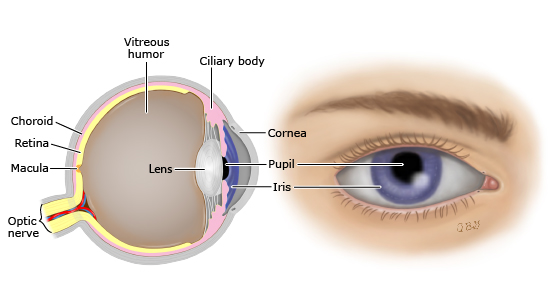
The parts of the eye include the:
Cornea – This is the clear tissue that covers the colored part of the eye. It focuses light (along with the lens).
Pupil – This is the dark area in the center of the eye that lets in light.
Iris – This is the colored part of the eye.
Lens – This is the part of the eye that focuses light (along with the cornea).
Ciliary body – This is a ring of tissue around the lens.
Vitreous humor – This is the jelly-like substance inside the eye.
Choroid and retina – These are layers in the back of the eye.
Macula – This is the part at the center of the retina. It lets you see detail.
Optic nerve – This connects the eye to the brain.
Together, the iris, ciliary body, and choroid are called the "uvea."
Graphic 70420 Version 4.0
Give to a Healthier Future
Help us elevate and expand our care, make breakthroughs in biomedical science and improve community health and wellness.
Healthier communities. Healthiest lives. Together.